Your blog posts are getting traffic. Your social media posts are getting likes. But your lead count? Still flat.
If that sounds familiar, you’re not alone. 61% of marketers say generating quality leads is their biggest challenge, and that number hasn’t budged in years. The problem isn’t that you’re not creating content — it’s that you’re creating the wrong kind of content.
Static blog posts, PDF downloads, and generic contact forms worked fine in 2020. But in 2026, your audience is drowning in passive content. There are over 7.5 million blog posts published every single day. To stand out — and to actually capture leads — you need to give visitors something to do, not just something to read.
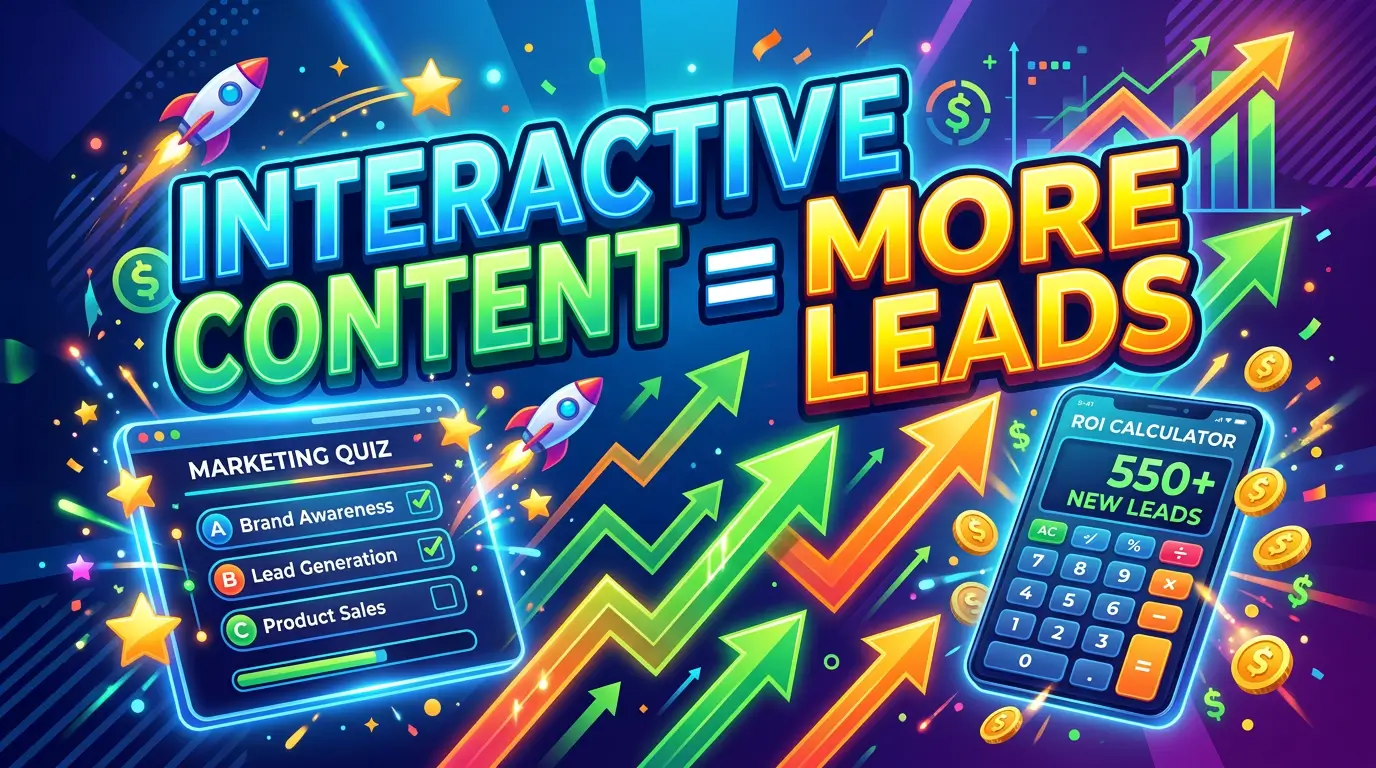
That’s where interactive content comes in. And the data backs it up in a big way.
Why Interactive Content Works (The Numbers Don’t Lie)
Interactive content isn’t a gimmick. It’s one of the most effective lead generation tactics available to small businesses right now, and the performance gap between interactive and static content is widening.
Here’s what the data shows:
- Interactive content generates 2x more conversions and 5x more pageviews than static content (Martal Group)
- 45% of marketers report that interactive content (quizzes, calculators, assessments) is effective for lead generation (Martal Group)
- 81% of marketers agree that interactive content grabs attention more effectively than passive pages (DemandGen, via WE Interactive)
- Leads acquired through high-engagement content have a 22% higher lifetime value than leads from static display ads (WE Interactive)
- Users spend 2-3x longer on pages with interactive content, directly improving dwell time and SEO signals (Hashmeta)
The reason is simple: interactive content creates a two-way exchange. Instead of passively reading and bouncing, visitors engage, answer questions, and invest time. That investment makes them far more likely to share their contact information because they’ve already started a relationship with your brand.
The 5 Best Types of Interactive Content for Small Businesses
You don’t need a massive budget or a development team to create interactive content. Here are the five formats that deliver the best results for small businesses, ranked by ease of implementation and lead generation potential.
1. Assessment Quizzes
Assessment quizzes are the Swiss Army knife of interactive content. They work for virtually every industry because they tap into a universal human desire: people want to know how they stack up.
How it works: You create a short quiz (5-10 questions) that evaluates the visitor’s current situation. At the end, they enter their email to receive their personalized results.
Examples for small businesses:
- HVAC company: “Is Your Home Ready for Summer? Take Our 2-Minute Energy Efficiency Quiz”
- Marketing agency: “Grade Your Website: How Does Your Online Presence Score?”
- Financial advisor: “What’s Your Retirement Readiness Score?”
- Fitness studio: “What’s Your Ideal Workout Style? Take the Quiz”
Why it works: One case study from EmailToolTester found that a single quiz generated a 78% email opt-in rate — compared to the typical 1-3% opt-in rate of a standard email signup form. Another company generated 2,500 leads from a single quiz, and a third improved their conversion rate by 55.8%.
Tools to build it: Interact, Outgrow, LeadQuizzes, or Involve.me. Most have free plans or trials and require zero coding.
2. ROI and Cost Calculators
If assessment quizzes appeal to curiosity, calculators appeal to something even more powerful: the wallet. A calculator that shows a prospect how much money they could save (or make) by working with you is one of the most persuasive lead generation tools that exists.
How it works: The visitor inputs their specific numbers (budget, current costs, team size, etc.) and the calculator instantly shows projected results, savings, or ROI. You gate the detailed report behind an email capture.
Examples for small businesses:
- Web design agency: “Website ROI Calculator — Find Out What Your Site Should Be Earning”
- Solar installer: “Solar Savings Calculator — See Your 10-Year Energy Savings”
- SaaS product: “Time Savings Calculator — How Many Hours Could You Save Per Week?”
- Accountant: “Tax Deduction Estimator for Small Business Owners”
Why it works: Calculators capture high-intent users who are already in the consideration phase. Someone plugging their numbers into your ROI calculator is much closer to buying than someone who downloaded a generic ebook. According to Outgrow, ROI calculators are among the top-performing B2B lead generation formats in 2026.
Tools to build it: Outgrow, Calconic, ConvertCalculator, or even a well-designed Google Sheet embedded on your page.
3. Interactive Assessments and Audits
This is the assessment quiz’s more sophisticated cousin. Instead of a fun personality-style quiz, an interactive audit provides genuine, actionable value — and positions you as the expert who can fix what’s broken.
How it works: The visitor answers detailed questions about their business, website, or marketing. Your tool generates a personalized report with specific recommendations. The full report requires an email address.
Examples for small businesses:
- SEO agency: “Free SEO Health Check — Get Your Personalized Report”
- Cybersecurity firm: “How Secure Is Your Business? Take Our Risk Assessment”
- HR consultant: “Employee Retention Audit — Identify Your Biggest Flight Risks”
- Business coach: “Is Your Business Ready to Scale? Take the Growth Readiness Assessment”
Why it works: These tools generate some of the highest-quality leads because the visitor has essentially told you exactly what their problems are. Your sales team receives a warm lead and a detailed understanding of their pain points. The conversion rates on interactive assessments in SaaS verticals can reach engagement-to-conversion ratios as high as 94% for top performers.
4. Product or Service Recommendation Tools
If you sell multiple products or services, a recommendation tool removes the friction of choosing. Instead of forcing visitors to browse through your offerings and figure it out themselves, you guide them to the right solution.
How it works: A short series of questions about the visitor’s needs, budget, and preferences. The tool recommends the best-fit product or service package. You capture their email to send a detailed comparison or proposal.
Examples for small businesses:
- Web design agency: “Which Website Package Is Right for Your Business?”
- Insurance broker: “Find Your Perfect Coverage in 60 Seconds”
- Skincare brand: “Build Your Custom Skincare Routine”
- IT services: “What Level of IT Support Does Your Business Need?”
Why it works: Recommendation tools reduce decision fatigue and guide prospects toward a purchase. They also pre-qualify leads — by the time someone completes the tool, you already know their budget range, needs, and timeline.
5. Interactive Infographics and Data Explorers
This format is more about SEO and brand awareness than direct lead capture, but it plays a critical supporting role. Interactive infographics naturally attract backlinks — which Hashmeta reports as one of the primary SEO benefits of interactive content, with publishers referencing valuable tools without outreach campaigns.
How it works: Take industry data relevant to your audience and present it as a clickable, filterable, or animated visual experience.
Examples for small businesses:
- Real estate agent: “Interactive Map: Median Home Prices in [Your City] by Neighborhood”
- Marketing agency: “Digital Marketing Benchmark Explorer: See How Your Industry Compares”
- Staffing firm: “Salary Explorer: What Are Companies Paying for [Role] in 2026?”
How to Build Your First Interactive Lead Magnet (Step by Step)
You don’t need a developer. Here’s a practical roadmap any small business can follow this week.
Step 1: Choose Your Format Based on Your Sales Funnel
Match the interactive content type to where your leads are in the buying process:
| Funnel Stage | Best Format | Goal |
|---|---|---|
| Awareness (top) | Quiz, Interactive Infographic | Attract traffic, build email list |
| Consideration (middle) | Calculator, Assessment | Qualify leads, demonstrate value |
| Decision (bottom) | Recommendation Tool, Audit | Convert leads, drive consultations |
If you’re just getting started, an assessment quiz is usually the best first choice. It’s the easiest to build, works for almost any industry, and has the highest viral potential.
Step 2: Define Your Questions (Keep It Short)
The sweet spot is 5-8 questions. Any fewer and you won’t collect enough information to personalize results. Any more and you’ll see drop-off rates spike.
Each question should:
- Be easy to understand (no jargon)
- Have 3-4 clear answer options
- Actually inform the results (don’t ask questions just to fill space)
Step 3: Create Meaningful Results
This is where most businesses drop the ball. Generic results like “You scored 7/10!” are worthless. Your results page should:
- Diagnose the problem — “Your website is losing an estimated $2,400/month in potential revenue based on your traffic and current conversion rate.”
- Provide actionable next steps — “Here are 3 things you can fix this week.”
- Include a clear call to action — “Want us to fix this for you? Book a free consultation.”
Step 4: Set Up the Email Gate Strategically
Don’t gate the quiz itself — that kills participation. Instead, gate the detailed results. Show a teaser of the results, then require an email for the full report. This approach respects the user’s time investment while still capturing the lead.
Step 5: Integrate with Your CRM and Email
Connect your interactive tool to your email marketing platform. Most tools like Outgrow and Interact integrate natively with Mailchimp, HubSpot, ActiveCampaign, and dozens of other platforms.
Set up an automated email sequence that:
- Delivers the detailed results immediately
- Follows up 2 days later with additional related content
- Makes a soft offer on day 4-5
The SEO Bonus: Why Interactive Content Helps You Rank
Interactive content doesn’t just generate leads — it sends powerful signals to Google that boost your rankings.
Longer dwell time: When users spend 2-3x longer on your page engaging with a calculator or quiz, Google interprets that as a sign of quality content. According to Hashmeta, this extended engagement is one of the primary ranking signals interactive content improves.
Lower bounce rates: A visitor who starts a quiz is far less likely to bounce. And with 60% of Google searches ending without a click in 2026 thanks to AI Overviews, keeping the visitors you do get is more important than ever.
Natural backlink generation: Useful tools get linked to. Period. A mortgage calculator, a salary comparison tool, or an industry benchmark quiz becomes a resource that bloggers and journalists reference naturally.
Long-tail keyword coverage: A single interactive tool can rank for hundreds of long-tail keyword variations you never explicitly targeted, expanding your organic reach far beyond what a static blog post could achieve.
Common Mistakes to Avoid
Making it too long. If your quiz takes more than 2-3 minutes, you’ll lose people. Keep it tight.
Generic results. “You’re a Type B personality!” isn’t useful. Give specific, actionable insights tied to your services.
No follow-up. Capturing the lead is only half the battle. If you don’t have an email nurture sequence ready to go, you’re leaving money on the table. Remember — 79% of leads never convert into sales due to poor nurturing.
Ignoring mobile. Over half your traffic is on mobile. Test your interactive content on phones before launching.
Forgetting analytics. Track completion rates, drop-off points, and conversion rates. Every tool mentioned above has built-in analytics. Use them to optimize.
Getting Started This Week
Here’s your action plan:
- Pick one format. If in doubt, start with an assessment quiz.
- Sign up for a tool. Interact and Involve.me both have free tiers.
- Draft 5-8 questions relevant to your ideal customer’s biggest pain point.
- Create 3-4 result categories with personalized recommendations.
- Connect to your email platform and set up a 3-email follow-up sequence.
- Embed it on a dedicated landing page and promote it in your existing content.
The entire process can take as little as an afternoon. And unlike a blog post that generates traffic and little else, an interactive lead magnet works around the clock — qualifying prospects, collecting contact information, and warming leads while you focus on running your business.
Ready to Turn Your Website Into a Lead Generation Machine?
Interactive content is just one piece of the puzzle. If your website isn’t converting visitors into leads, it doesn’t matter how much traffic you drive to it.
At Your Web Team, we build websites and marketing systems designed to do one thing: generate leads for your business. From interactive tools to conversion-optimized landing pages, we help small businesses turn their online presence into their most productive salesperson.

Richard Kastl
Founder & Lead EngineerRichard Kastl has spent 14 years engineering websites that generate revenue. He combines expertise in web development, SEO, digital marketing, and conversion optimization to build sites that make the phone ring. His work has helped generate over $30M in pipeline for clients ranging from industrial manufacturers to SaaS companies.