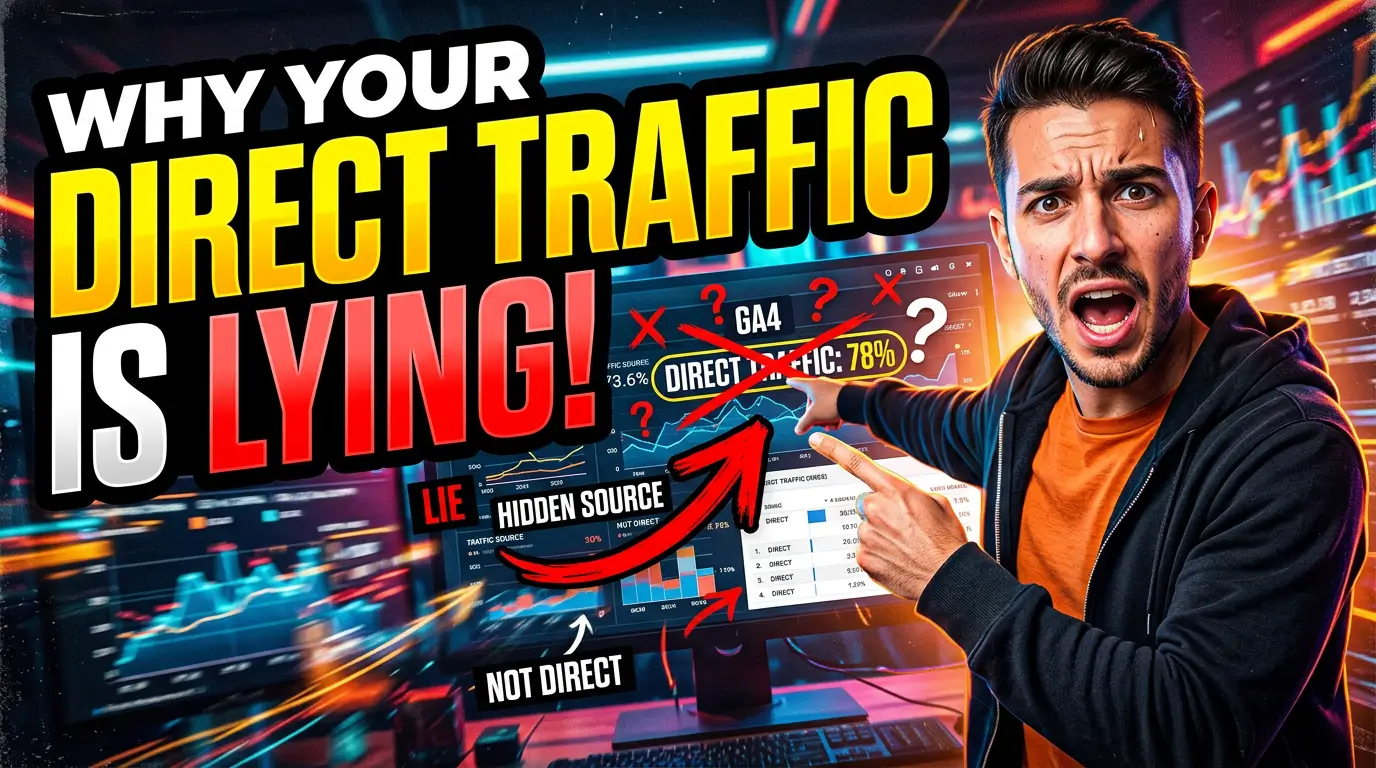
Your analytics report is probably giving “direct” traffic credit for work it did not do.
That does not mean GA4 is broken. It means buyers do not move through neat little reporting lanes anymore. They see a post on LinkedIn, send it to a partner in Slack, ask ChatGPT for a second opinion, search your name on Google, read your reviews, and finally fill out a form from a bookmarked link. By the time the lead shows up, the report may say “direct.” That label can hide the real source of demand.
This is the dark social problem. It is not new, but it matters more now because private sharing, AI search, messaging apps, and copy-pasted links are becoming normal parts of the buying process. If you run a small business and you only trust last-click reports, you can accidentally cut the content, referral, social, or community work that made the lead happen.
What dark social means in plain English
Dark social is traffic that came from a real recommendation or share, but the analytics tool cannot see where it came from.
Someone texts your service page to their spouse. A customer shares your blog post in a private Facebook group. A purchasing manager drops your pricing page into Teams. A prospect asks an AI assistant about local vendors, then clicks or searches later. In many of those cases, referral details are missing, stripped, or too muddy to classify cleanly.
Google’s own GA4 channel definitions say “Direct” is traffic from a saved link or someone entering your URL, while GA4 also now has a separate “AI Assistants” channel for sources like ChatGPT, Gemini, DeepSeek, Copilot, and Grok when the source is visible (Google Analytics Help). That detail matters. If the source is not visible, the visit may still get grouped somewhere less helpful, often direct.
That is why “direct” should not always be read as “people typed our URL because they already knew us.” Sometimes that is true. Often it is not.
Why this matters more in 2026
The web is becoming more private and more fragmented. People are not only searching on Google, clicking public social links, and converting in the same visit.
BrightLocal’s consumer search research found that 70% of general online searches are still effectively conducted through Google products, but 40% of consumers actively use generative AI when searching online, and one in five consumers conduct local searches directly within maps (BrightLocal Consumer Search Behavior). That means discovery is split across search engines, maps, AI tools, review platforms, and private conversations.
HubSpot’s 2026 State of Marketing data points in the same direction. HubSpot reports that updating SEO for search changes is a top trend, cited by 40.6% of marketers, and that marketers are recalibrating content because consumers are using AI-powered search and arriving later in the buying process (HubSpot 2026 State of Marketing).
Social use is still massive too. Pew Research Center found that 83% of U.S. adults report ever using YouTube, 68% use Facebook, and 47% use Instagram (Pew Research Center). A lot of small business discovery starts in those environments, then moves into DMs, texts, email forwards, group chats, screenshots, and branded searches.
For a local contractor, med spa, law firm, clinic, manufacturer, or consultant, this is not an abstract attribution debate. It changes where you put money next month.
The direct traffic warning signs
Direct traffic is not bad. A strong brand should have some direct traffic. The problem is assuming every direct visit is brand strength.
Here are the signs that your direct bucket is probably hiding dark social or broken tracking:
- Direct traffic lands on deep pages, not just your homepage. If people are landing directly on
/commercial-roof-repair-costs/,/case-study-food-plant-retrofit/, or/pricing/, many of them probably clicked a copied link somewhere. - Direct conversions spike after campaigns. If direct leads jump the same week you send an email, post a popular LinkedIn update, sponsor an event, or publish a useful guide, the campaign may have assisted the lead.
- Leads mention sources your analytics does not show. If form responses say “friend,” “podcast,” “Facebook group,” “ChatGPT,” “sales rep,” or “saw you at an event,” but GA4 says direct, believe the human clue.
- Branded search rises after non-search activity. A webinar, trade show, community post, YouTube video, or referral partner can create branded Google searches later.
- Your highest intent pages have weak source data. Pricing pages, quote pages, comparison pages, and case studies are often shared privately because buyers use them to make decisions.
None of these signs prove one specific source. They tell you not to make lazy budget cuts based only on the last click.
What small businesses should stop doing
The biggest mistake is treating direct traffic as one clean channel.
Direct is a bucket. Some of it is loyal customers. Some of it is bookmarked traffic. Some of it is untagged email. Some of it is QR code traffic. Some of it is private sharing. Some of it is a browser, app, privacy setting, or redirect that did not pass source data.
The second mistake is expecting attribution to be perfect. HubSpot’s 2026 marketing statistics page says lead-to-customer conversion is the second most important KPI for marketers across business sizes, and nearly 56% of marketers say improving conversion rates is easier now than ten years ago (HubSpot Marketing Statistics). Better tools help, but they do not remove human behavior from the process.
The third mistake is cutting top-of-funnel work because it does not close in GA4. If your guide, checklist, YouTube video, review page, or comparison article gets shared privately, last-click reporting may not reward it. That does not mean it failed.
A practical dark social measurement setup
You do not need enterprise software to get a clearer picture. You need a few disciplined habits.
1. Separate homepage direct from deep-page direct
Start with a simple GA4 exploration or report. Look at direct sessions by landing page.
Homepage direct is often a mix of brand awareness, repeat customers, typed URLs, bookmarks, and local reputation. Deep-page direct is different. If someone lands directly on a long blog URL, a case study, a pricing page, or a service-area page, there is a good chance the link was copied, shared, saved, or opened from a source without clean referral data.
For small businesses, this one view is usually more useful than staring at the total direct number.
2. Use UTMs everywhere you control the link
UTMs will not solve dark social, but they remove preventable mystery.
Tag links in email campaigns, SMS campaigns, QR codes, partner newsletters, sponsorship placements, non-Google ads, PDF downloads, social profile links, and sales follow-up templates. If your team sends a link outside your website, decide whether it needs a UTM.
Keep the naming simple. A roofing company does not need a 40-column tracking sheet. It needs consistent values like utm_source=mailchimp, utm_medium=email, and utm_campaign=spring_storm_damage.
This prevents one of the most common problems: traffic being labeled direct because nobody tagged the link in the first place.
3. Add a self-reported attribution field
Ask leads: “How did you first hear about us?”
Make it optional if you are worried about form friction. Use a short dropdown plus an “Other” field if you want cleaner data. Good options include Google, Google Maps, referral, social media, YouTube, email, AI assistant, event, review site, and not sure.
This will not be perfect either. People forget. They compress the story. They may write “Google” even though they first heard your name from a friend. Still, it gives you a human signal GA4 cannot always capture.
A useful lead report should compare both views: analytics source and self-reported source. If GA4 says direct but the lead says “Facebook group” or “customer referral,” you just learned something your dashboard missed.
4. Track assisted signals, not only final clicks
A small business owner does not need a PhD in attribution modeling. You need to watch the patterns that tend to precede leads.
Look at branded search volume. Watch direct traffic to deep pages. Track repeat visits to case studies and pricing pages. Review call tracking notes. Compare campaign dates against direct lead spikes. Ask sales what prospects mentioned on calls.
This is not as clean as a single number. It is better than pretending a single number tells the whole truth.
5. Build shareable pages on purpose
If private sharing is part of the buying journey, your website should make those shared pages useful.
Case studies should have a clear problem, scope, numbers, photos where appropriate, and the result. Service pages should answer the questions buyers actually ask before they call. Pricing pages should explain ranges, variables, and next steps. Comparison pages should be honest enough that someone would send them to a coworker.
BrightLocal found that 85% of consumers consider contact information and opening hours important when researching local businesses (BrightLocal Consumer Search Behavior). That is a reminder that shared pages still need the basics: phone number, location or service area, hours, proof, next step, and a clear way to contact you.
How to read reports without fooling yourself
When you review marketing performance, use three buckets instead of one winner.
First, look at source data. What did GA4, ad platforms, call tracking, and CRM data record?
Second, look at human data. What did people say in forms, calls, emails, chats, and sales conversations?
Third, look at timing. What campaigns, posts, events, emails, videos, or referrals happened before the lead spike?
If all three point in the same direction, you can act with confidence. If they disagree, do not panic. That usually means the buying journey crossed channels. The correct move is not to crown one winner. The correct move is to improve tracking, protect what creates demand, and shift budget slowly.
That is the level of truth most small businesses need. Not perfect. Useful.
What to do this week
Do not turn this into a six-month analytics project. Start with a cleanup sprint.
- Open GA4 and list your top direct landing pages from the last 90 days.
- Mark which ones are homepage, service pages, blog posts, pricing pages, case studies, and quote pages.
- Add UTMs to every email, SMS, QR code, partner, sponsorship, and sales-template link you control.
- Add “How did you first hear about us?” to your main form.
- Review direct lead spikes alongside campaign dates once per month.
That is enough to stop making the most expensive mistake: assuming the visible source is the whole story.
Dark social is not a reason to give up on measurement. It is a reason to measure like a grown-up. Your customers talk in private, compare options across tools, and come back when they are ready. Build reports that respect that reality.
If your website and analytics are making good leads look like mystery traffic, we can help you clean up the tracking and fix the pages that should be doing the selling. Start here.
FAQ
Is dark social the same as direct traffic?
No. Direct traffic is an analytics label. Dark social is one possible cause of traffic being mislabeled or under-attributed. Some direct traffic is legitimate typed, bookmarked, or saved traffic.
Can GA4 track AI assistant traffic?
Sometimes. Google’s GA4 channel documentation includes an “AI Assistants” channel for visible sources like ChatGPT, Gemini, DeepSeek, Copilot, and Grok, but not every AI-influenced visit will pass clean source data (Google Analytics Help).
Should small businesses still use UTMs?
Yes. UTMs do not capture every private share, but they prevent avoidable attribution problems on links you control, especially email, SMS, QR codes, partner links, and paid campaigns outside Google’s auto-tagging.
What is the best dark social metric?
There is no single perfect metric. Start with direct traffic by landing page, self-reported attribution, branded search trends, CRM notes, and campaign timing. Together, those signals tell a more useful story than last click alone.