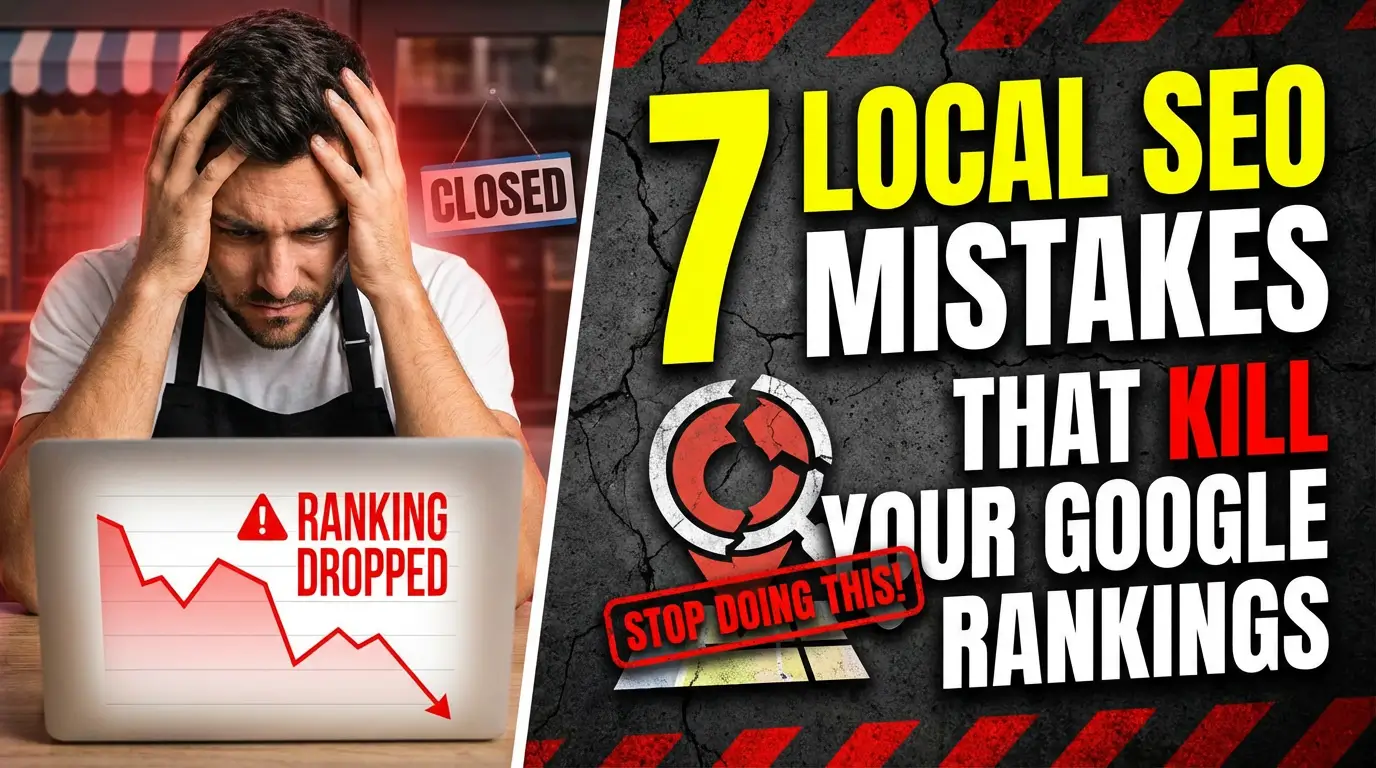
7 Local SEO Mistakes Small Businesses Make That Kill Their Google Rankings
Here’s a number that should keep you up at night: 76% of people who search for something “near me” on their phone visit a business within 24 hours. That’s not “might visit.” That’s foot traffic with money to spend.
If your business doesn’t show up in those searches, you’re not losing hypothetical future customers. You’re losing people who are ready to buy right now, today, within driving distance of your location.
Most small businesses make the same local SEO mistakes. They’re fixable, but only if you know what they are.
1. Your Google Business Profile Is Incomplete
Google Business Profile (GBP) is the single most important factor in local search rankings, and most businesses treat it like an afterthought. They claim their listing, add a phone number and address, and never touch it again.
That’s like opening a storefront and leaving the lights off.
A complete GBP profile includes your business hours (including holiday hours), a detailed business description using relevant keywords, your service areas, the specific services you offer, and at least 10 to 15 high-quality photos. BrightLocal’s 2025 local SEO survey found that businesses with complete profiles are significantly more likely to appear in Google’s local pack, the three listings that show up with the map at the top of search results.
Post weekly updates to your GBP. Share offers, events, new products, or simple business updates. Google rewards active profiles with better visibility.
2. Your NAP Information Is Inconsistent
NAP stands for Name, Address, Phone number. It sounds simple, but inconsistent NAP data across the internet is one of the fastest ways to tank your local rankings.
If your website says “123 Main Street” but Yelp says “123 Main St.” and your Facebook page says “123 Main Street, Suite 100,” Google doesn’t know which one is correct. When Google can’t verify your business information, it loses confidence in showing your listing to searchers.
Audit every place your business is listed online. Google, Yelp, Facebook, Apple Maps, Bing Places, Yellow Pages, industry-specific directories. Every single one needs to show the exact same name, address, and phone number. Not close. Exact.
3. You’re Ignoring Reviews (Or Worse, Faking Them)
Reviews are the second most important local ranking factor after GBP optimization. BrightLocal found that the quantity, velocity, and diversity of reviews all impact how Google ranks local businesses.
The mistakes businesses make with reviews fall into three categories. First, not asking for them at all. Happy customers rarely leave reviews unprompted. You need a systematic process for requesting reviews after every transaction or service. Second, not responding to reviews, especially negative ones. Google’s own documentation confirms that responding to reviews improves your local ranking. Third, buying fake reviews. Google’s algorithm is increasingly sophisticated at detecting fake reviews, and the penalty is devastating. You can lose your entire GBP listing.
Set up an automated email or text that goes to customers 24 to 48 hours after their purchase asking for a Google review. Include a direct link to your review page. Make it as easy as two taps on their phone.
4. Your Website Isn’t Optimized for Local Keywords
Having a page that says “We offer plumbing services” doesn’t help you rank for “plumber in Cleveland.” Local SEO requires local keyword optimization on your actual website, not just your GBP profile.
Every service page should include your city and state in the title tag, H1 heading, meta description, and naturally throughout the body content. If you serve multiple cities, you need individual landing pages for each location. A single “Areas We Serve” page with a list of city names is not enough.
Create dedicated pages for each service in each city you serve. “Emergency Plumbing in Cleveland, OH” is a different page from “Drain Cleaning in Cleveland, OH” and a different page from “Emergency Plumbing in Akron, OH.” Each page should have unique content, not just the city name swapped out.
5. You Have No Local Schema Markup
Schema markup is structured data that tells Google exactly what your business is, where it’s located, and what you do. Without it, you’re forcing Google to guess this information from your page content.
LocalBusiness schema should be on every page of your website. It includes your business name, address, phone number, hours of operation, geographic coordinates, and the type of business you are. This directly feeds into Google’s knowledge graph and can improve how your business appears in search results.
Most small business websites have zero schema markup. Adding it is one of the fastest, lowest-effort improvements you can make to your local SEO. If you’re using a basic WordPress template or website builder, schema markup probably isn’t included by default.
6. Your Site Isn’t Mobile-First
According to BrightLocal, the majority of local searches happen on mobile devices. If your website looks broken, loads slowly, or is hard to navigate on a phone, you’re losing the customers who find you through local search.
Mobile-first doesn’t just mean “responsive.” It means your phone number is tappable. Your address links to Google Maps. Your contact form works with a thumb. Your fonts are readable without zooming. Your images don’t take 8 seconds to load on a cellular connection.
Google uses mobile-first indexing, which means it ranks your site based on the mobile version, not the desktop version. A beautiful desktop site with a mediocre mobile experience will rank below a simpler site that works perfectly on phones.
7. You’re Not Building Local Backlinks
Backlinks from local organizations, news sites, chambers of commerce, and business directories signal to Google that your business is a legitimate, established part of the local community.
Most small businesses don’t actively pursue local link building because it feels overwhelming. But it doesn’t have to be complicated. Join your local chamber of commerce (instant backlink). Sponsor a local Little League team (their website links to sponsors). Get featured in the local newspaper’s business section. Partner with complementary local businesses for cross-promotion.
Ten high-quality local backlinks will do more for your rankings than 100 generic directory submissions. Focus on relevance and locality over quantity.
Fixing These Mistakes Isn’t Optional
Local search is how customers find businesses in 2026. If you’re making even two or three of these mistakes, you’re leaving money on the table every single day.
The good news is that most of your competitors are making the same mistakes. Fix yours first, and you’ll see results faster than you expect.
If you want help auditing your local SEO and fixing what’s broken, get in touch with our team. We’ll show you exactly where you’re losing visibility and build a plan to fix it.

Richard Kastl
Founder & Lead EngineerRichard Kastl has spent 14 years engineering websites that generate revenue. He combines expertise in web development, SEO, digital marketing, and conversion optimization to build sites that make the phone ring. His work has helped generate over $30M in pipeline for clients ranging from industrial manufacturers to SaaS companies.