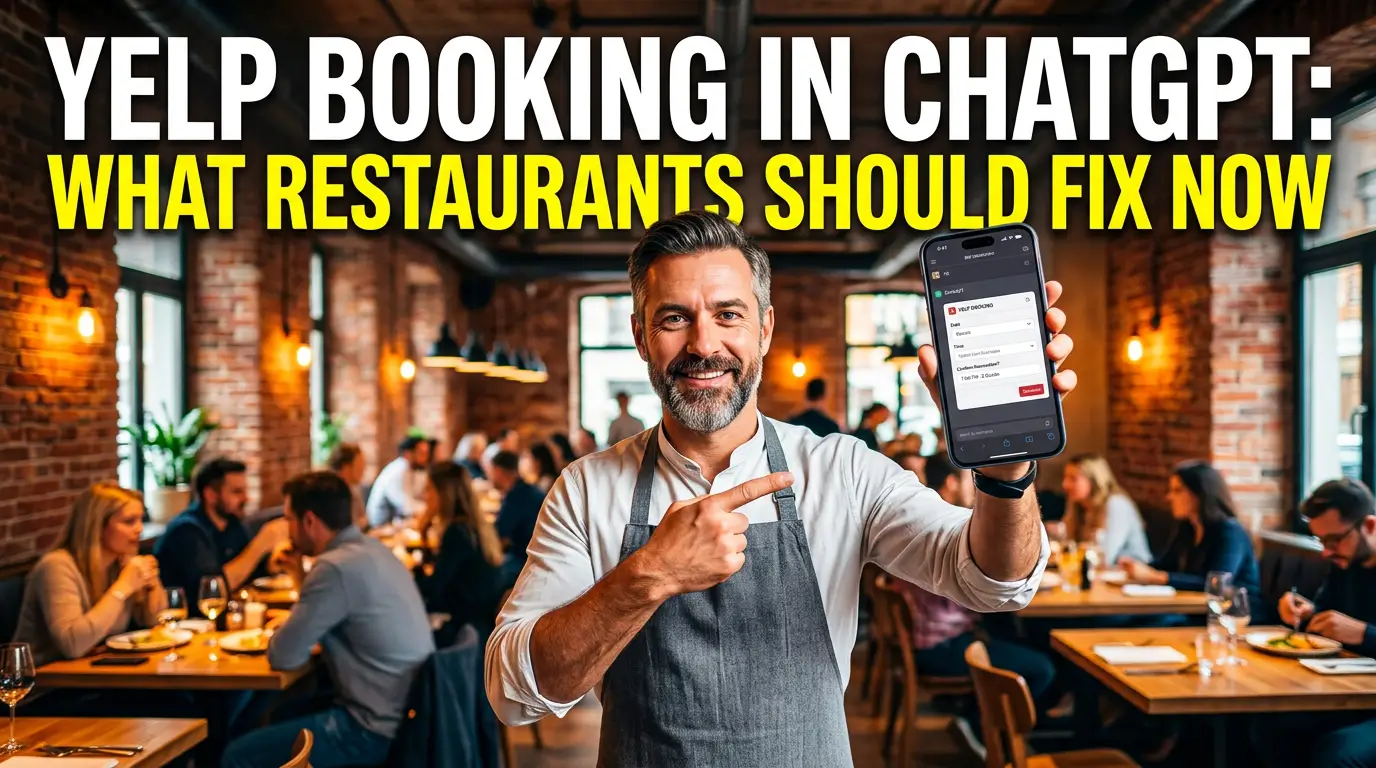
A customer asks ChatGPT for a good Italian restaurant with outdoor seating, a table for four, and an opening at 7:00 tonight. ChatGPT recommends a few options. The customer books one without opening Google, visiting the restaurant’s website, or calling the host stand.
That path is no longer hypothetical.
On August 10, Yelp announced that Yelp Reservations and Waitlist are now available inside ChatGPT. People can discover a restaurant, check availability, reserve a table, or join a waitlist while staying in the ChatGPT conversation. Yelp says the integration is rolling out first in the United States on ChatGPT’s mobile apps and website.
For restaurant owners, this isn’t a reason to chase another trendy acronym. It is a reason to clean up the information that already determines whether a customer sees, trusts, and books your business.
What Actually Changed
ChatGPT has moved one step closer to being a transaction channel for local restaurants. It doesn’t just help someone brainstorm dinner ideas. Through Yelp, it can now move that person from a question to a confirmed reservation.
According to Yelp’s announcement, the integration supports searching for restaurants based on the user’s request and completing Yelp Reservations or Waitlist actions directly in ChatGPT. Yelp also says people can refine the search conversationally, such as asking for a certain neighborhood, cuisine, occasion, or time.
The practical change is simple:
- A diner describes what they want in normal language.
- ChatGPT uses available local business information to suggest options.
- The diner books through Yelp without starting a separate search process.
Each step removes friction for the customer. It also removes opportunities for the restaurant to correct weak or outdated information later. If your cuisine, hours, amenities, photos, or reservation availability are wrong at the point of recommendation, a beautiful website won’t rescue that interaction.
This Is Bigger Than One ChatGPT Feature
Local discovery is spreading across search engines, maps, review platforms, social apps, and AI assistants. Yelp’s ChatGPT booking feature matters because it connects discovery directly to an action with measurable business value: a reservation or waitlist entry.
Yelp had already described its broader direction in its 2025 annual report, including products that help consumers transact with local businesses rather than only read reviews. The ChatGPT integration extends that transaction model into a conversational interface.
OpenAI has been moving in the same direction. Its apps documentation explains that apps can bring outside services into ChatGPT so users can take actions during a conversation. Restaurant booking is an easy example of why that matters: the answer and the next step happen in the same place.
You shouldn’t assume this channel will replace Google, Yelp’s own app, your website, or phone calls. Yelp did not publish restaurant-level traffic or booking projections in its announcement. Treat this as an additional sales path, then measure it instead of guessing.
The Information ChatGPT Cannot Fix for You
An AI assistant can interpret a request. It cannot repair a bad business listing.
Suppose a customer asks for a quiet restaurant with vegan options and outdoor seating. Your dining room fits the request, but your Yelp categories are vague, the menu link is broken, and the patio appears only in an old customer photo. The assistant has less reliable evidence that your restaurant is a match.
This is why your first job is not to write “AI-optimized” copy. Your first job is to make the underlying facts accurate and specific.
Yelp’s own business page guidance tells owners to claim their pages, complete their business information, add photos, and respond to reviews. Those ordinary tasks now support a new booking path. They also help customers who still discover you directly through Yelp.
Audit these fields first:
- Restaurant name, address, phone number, current hours, and website URL
- Primary and secondary categories that accurately describe the food and service model
- Reservation or waitlist setup, party-size rules, lead times, and available time slots
- Menu URL, price range, dietary options, parking details, and accessibility information
- Amenities customers use to narrow choices, including outdoor seating, private dining, delivery, takeout, and family-friendly options
- Recent photos that show the dining room, exterior, signature dishes, bar, patio, and entrance
Don’t add an amenity because you want to appear in more searches. If customers arrive expecting a dog-friendly patio or gluten-free kitchen that you don’t have, the short-term click can become a bad review.
Your Website Still Has a Job
The direct booking path makes your website less necessary for one transaction, not less important to the business.
Some diners will book immediately. Others will still check your menu, parking instructions, private-event options, allergy policies, or atmosphere before committing. Your website is where you control that deeper proof.
Make sure the details on your site agree with Yelp. If Yelp says brunch begins at 9:00 a.m. but your website says 10:00, customers have to decide which source to trust. If your reservation page accepts parties up to eight but Yelp stops at six, staff should confirm whether that difference is intentional.
Create a short fact sheet for your restaurant and use it as the source of truth. It should include hours, holiday exceptions, cuisine labels, booking rules, service options, accessibility details, contact information, and the approved one-paragraph description. Compare that sheet with your website, Yelp, Google Business Profile, Apple Business Connect, and major delivery platforms once a month.
This isn’t glamorous work. It prevents lost covers.
Reviews Need Specificity, Not a Script
Yelp’s recommendations can draw on a large body of customer-written context. Reviews often mention dishes, service, noise, wait times, celebrations, dietary accommodations, and atmosphere in language a restaurant’s marketing copy never uses.
That does not give you permission to script reviews or pressure customers. Yelp’s content guidelines say reviews should reflect a person’s own experience, and Yelp’s recommendation software explanation says the platform uses automated systems to identify reviews it can confidently recommend.
The safe approach is operational:
Serve people well. Make it easy for them to find your Yelp page if they choose to write a review. Read recurring feedback and fix the underlying problem. Respond professionally when a review calls out an issue.
Avoid offering discounts for Yelp reviews, having employees review the business, or telling guests exactly what to write. Yelp’s guidance for businesses specifically tells businesses not to ask customers for reviews. That policy differs from some other platforms, so train staff on the distinction.
You can still encourage feedback through a private post-visit survey. Use those responses to improve the menu and service, not to filter customers into public review requests.
A 30-Minute Restaurant Audit
You can make meaningful progress before lunch service. Open Yelp, your website, and your reservation management screen side by side.
Minutes 1 Through 10: Verify the Basics
Check the name, address, phone, website, hours, price range, and categories. Test every link as if you were a customer on a phone. Confirm that the map pin points to the correct entrance, especially in a shopping center or hotel.
Minutes 11 Through 20: Test the Booking Path
Search several dates, times, and party sizes. Look for sold-out periods that should be available or open slots that the host stand cannot honor. If you use pacing rules, confirm they match your current staffing and table layout.
Then open ChatGPT and try realistic prompts. Ask for your cuisine in your neighborhood, then add filters customers care about. Do not treat one result as a ranking report. Use the exercise to spot missing facts, confusing descriptions, or booking failures.
Minutes 21 Through 30: Compare the Proof
Check the newest menu on your site against the menu diners can reach from Yelp. Review your first five photos and replace any that show old branding, discontinued dishes, or a remodeled space. Read the latest customer questions and reviews for repeated confusion.
Assign every correction to one person with a deadline. “Marketing will handle it” is not an owner or a date.
How to Measure Whether It Produces Revenue
Don’t judge this feature by whether it sounds futuristic. Judge it by booked covers, completed visits, and revenue.
Start by documenting a baseline for Yelp-originated reservations and waitlist joins before changing your listing. Record weekly bookings, completed covers, no-shows, cancellations, average party size, and average check if your systems can connect those figures legally and accurately.
Next, watch referral data and reservation-source reports. Yelp may change reporting as the integration matures, so use the most specific source label your booking system provides. If ChatGPT traffic arrives at your website, analytics tools may identify a referring domain, but direct in-chat bookings may never generate a website session.
Ask a neutral discovery question during checkout or in a post-visit survey: “How did you first hear about us?” Include ChatGPT or an AI assistant as an option. Self-reported attribution is imperfect, but it can reveal a channel your web analytics cannot see.
Review results after four to six weeks. Compare completed covers, not just reservation starts. A channel that creates many bookings but unusually high no-shows may need different confirmation rules.
What Non-Restaurant Businesses Should Learn
The current Yelp feature centers on Reservations and Waitlist, so a plumber, accountant, or auto repair shop cannot assume ChatGPT now completes the same transaction for them.
The broader lesson still applies. Business directories are becoming data and action layers inside AI products. OpenAI’s app system supports third-party services inside conversations, and Yelp has shown how local discovery can connect to a booking without a conventional website visit.
For any local business, keep directory facts accurate, make services specific, use consistent contact details, and ensure the website backs up important claims. If your industry gains an in-chat quote, appointment, or purchase flow next, you don’t want to begin with six months of listing cleanup.
What to Do This Week
Claim and verify your Yelp business page if you haven’t. Confirm that Reservations or Waitlist is configured correctly. Fix mismatched hours, dead menu links, vague categories, old photos, and missing amenities. Then test the experience like a customer with a specific need, not like an owner searching for the restaurant by name.
The businesses that benefit first won’t be the ones publishing the most commentary about AI. They’ll be the ones with accurate facts, clear proof, working inventory, and a booking path that doesn’t break.
Need your website and local listings to tell the same story? Get started and we’ll help you build a cleaner path from discovery to sale.