Most website problems are not caused by one big mistake.
They come from the sentence nobody wants to hear: “I thought someone else owned that.”
The form broke, but marketing thought the developer was watching it. The developer thought the CRM vendor was watching it. The owner thought the agency was watching it. The agency thought the internal team approved the change. By the time everyone figures it out, the business has lost leads and nobody has a clean timeline.
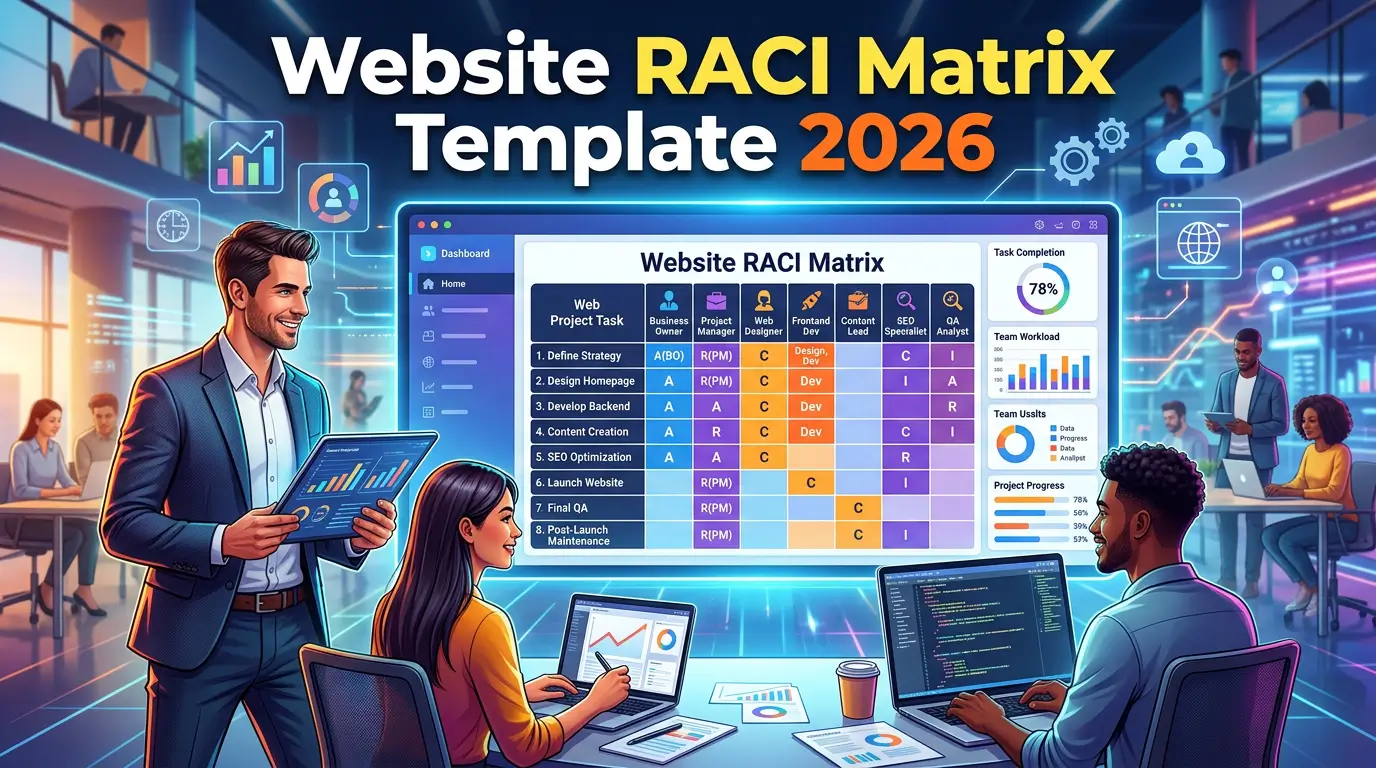
That is what a website RACI matrix fixes.
Atlassian defines a RACI chart as a responsibility assignment matrix that clarifies who is responsible, accountable, consulted, and informed for each project task. For websites, that clarity matters after launch, not just during the build. Your website has content, SEO, hosting, security, analytics, forms, integrations, legal pages, accessibility, vendors, and revenue paths. If those pieces do not have owners, they drift.
This guide gives you a working website RACI matrix you can copy, adapt, and use with your team or agency.
What RACI Means for a Website
A website RACI matrix assigns four kinds of involvement.
| RACI role | Meaning | Website example |
|---|---|---|
| Responsible | The person or team doing the work | Developer updates plugins, marketer edits a service page, analyst fixes a GA4 event |
| Accountable | The one owner who approves the outcome | Business owner approves a pricing page, marketing lead approves a landing page |
| Consulted | People who give input before the decision | Legal reviews privacy language, sales reviews lead quality, SEO reviews redirects |
| Informed | People who need to know after the decision | Support team learns a form changed, leadership sees a launch date, sales sees a new offer |
The useful rule is simple: one accountable owner per task. Multiple people can help, but one person needs to be answerable when the task stalls.
Project-management.com explains that the consulted role covers people whose input is needed before a task can progress. That distinction matters on websites because too many teams confuse “consulted” with “approves everything.” If legal, sales, operations, SEO, and the owner all have veto power on every change, the site slows down. If nobody has veto power, risky changes go live.
Why Websites Need Ownership After Launch
A website does not freeze after launch. Search engines crawl it. Customers use it. Staff edit it. Vendors add scripts. Platforms change APIs. Plugins and frameworks update. Privacy rules shift. Competitors publish new pages. Ads send paid traffic to it.
The data backs up the risk.
Portent analyzed more than 100 million page views and found B2B pages loading in 1 second converted 3x higher than pages loading in 5 seconds. HTTP Archive’s 2025 Page Weight chapter reported that the median mobile home page reached 2.6 MB and grew 8.4% from 2024. Verizon’s 2025 DBIR release reported that third-party involvement in breaches doubled to 30%. WebAIM’s 2026 Million found an average of 56.1 detectable accessibility errors on home pages. Google’s GA4 documentation explains that key events depend on correctly collected and configured events.
Those are not abstract web problems. They are ownership problems. Someone needs to own speed. Someone needs to own third-party scripts. Someone needs to own accessibility. Someone needs to own tracking. Someone needs to own the path from visitor to lead.
A RACI matrix does not do the work for you. It makes it much harder for work to disappear between departments.
The Website RACI Matrix Template
Use this as a starting point. Replace job titles with real names before you rely on it.
| Website area | Responsible | Accountable | Consulted | Informed |
|---|---|---|---|---|
| Domain registrar and DNS | Developer or IT | Business owner | Hosting provider, email provider | Marketing lead |
| Hosting and uptime | Developer or host | Business owner | Agency, IT | Marketing, sales |
| CMS updates and dependencies | Developer | Technical lead or owner | Host, plugin vendors | Marketing |
| Backups and restore tests | Developer or host | Business owner | Agency, IT | Operations |
| Security access and MFA | IT or developer | Business owner | Agency, legal if needed | All admin users |
| Service page content | Marketing | Business owner | Sales, SEO, subject expert | Customer support |
| Blog and resource content | Marketing | Marketing lead | SEO, sales, owner | Sales team |
| SEO titles, redirects, canonicals | SEO lead | Marketing lead | Developer, content lead | Owner |
| Forms and lead routing | Developer or CRM owner | Sales lead | Marketing, CRM vendor | Sales team |
| GA4 and conversion tracking | Analyst or marketer | Marketing lead | Developer, ad vendor | Owner |
| Accessibility checks | Developer or accessibility reviewer | Business owner | Designer, content lead | Marketing |
| Privacy, cookies, and legal pages | Legal or owner | Business owner | Developer, marketing | Support team |
| Third-party scripts | Developer | Marketing lead | Security, analytics, ad vendors | Owner |
| Design system and templates | Designer or developer | Marketing lead | SEO, accessibility reviewer | Content editors |
| Emergency fixes | Developer or host | Business owner | Agency, IT, affected vendor | Leadership, sales |
This matrix is intentionally plain. A small business does not need a giant governance ceremony. It needs names next to the things that can cost money.
If one person owns everything, the matrix still helps. It shows where the business has single-person risk. If an outside agency owns everything, the matrix helps even more because the owner can see which accounts, approvals, and reports should stay under the business’s control.
Role 1: The Business Owner
The business owner should be accountable for ownership decisions, access, budget, risk tolerance, and final approval on major website changes.
That does not mean the owner should edit every page or update every plugin. It means the owner should control the assets that define the business: domain, DNS access, hosting relationship, payment method, analytics property, Search Console access, source files, brand assets, and vendor contracts.
This matters because Google Search Console is the tool Google documents for monitoring indexing and crawling issues, and GA4 key events depend on correct event setup. If those accounts sit under a freelancer’s personal email, the business does not fully control its own measurement or search visibility.
The owner should also be accountable for risk tradeoffs. A developer can say a plugin is unsafe. A marketer can say a landing page is converting. Legal can say a privacy update is needed. The owner decides how much risk the business accepts and who pays to fix it.
Role 2: The Marketing Lead
The marketing lead should be accountable for messaging, conversion paths, campaigns, content priorities, analytics definitions, SEO priorities, and lead quality feedback.
Marketing owns the question: does the website bring the right people to the right action?
That includes service pages, landing pages, calls to action, case studies, offers, newsletter forms, tracking plans, and reporting. Google’s helpful content guidance says content should be useful, reliable, and people-first. That standard cannot be met by a developer alone because the content has to match the business, the customer, and the offer.
Marketing should be accountable for the tracking plan, not necessarily the technical implementation. The developer can install events. The analyst can QA reports. But marketing should define what counts as a lead, what counts as a qualified lead, which calls matter, which forms matter, and what should appear in monthly reporting.
Role 3: The Developer or Technical Lead
The developer should be responsible for technical implementation: templates, CMS updates, code changes, performance fixes, redirects, form wiring, integrations, deployment, backups, and technical QA.
The developer should not be the only accountable owner for the entire website unless they also own the business outcome. That is where many teams get sideways. A developer can build a form that works exactly as requested, but sales still needs to confirm the lead is useful and marketing still needs to confirm the conversion is tracked.
Technical ownership matters because performance and security change over time. HTTP Archive explains that page weight includes images, JavaScript, CSS, fonts, HTML, and third-party scripts. Verizon’s 2025 DBIR release says credential abuse and vulnerability exploitation were leading initial attack vectors. Those are technical concerns, but they are business risks.
A good RACI matrix lets the developer say, “I can fix this, but I need approval because it affects budget, design, tracking, or sales.”
Role 4: Sales and Customer Support
Sales and support should be consulted on pages and systems that shape customer expectations.
Sales knows which questions prospects ask before they buy. Support knows where customers get confused after they buy. Those inputs belong in service pages, FAQ pages, contact pages, pricing pages, onboarding pages, thank-you pages, and quote request flows.
Baymard Institute tracks average ecommerce cart abandonment at about 70%, and its checkout research shows how friction near the buying moment can hurt completion. Lead-generation sites have the same pattern, just with forms and calls instead of carts. If sales says a form field scares off good prospects, that is not an opinion to bury in Slack. It is input for the RACI matrix.
Support should also be informed when website content changes customer expectations. If a service page promises a 24-hour response, the people answering the phone need to know.
Role 5: Legal, Compliance, and Accessibility Reviewers
Legal and accessibility reviewers are usually consulted, not responsible for every website change.
They should review privacy policies, cookie notices, terms, regulated claims, accessibility issues, data collection changes, and high-risk landing pages. WebAIM’s 2026 Million found detectable accessibility failures on 95.9% of tested home pages, which shows why accessibility cannot be left to visual review alone. Google’s page experience documentation also includes HTTPS and user experience signals as part of creating good page experiences.
The goal is not to make legal approve a typo fix. The goal is to define when legal or accessibility input is required before a change goes live.
Good triggers include new tracking tools, new payment flows, health or finance claims, location-specific compliance language, forms collecting sensitive data, major design template changes, video captions, downloadable PDFs, and popups that block navigation.
How to Build Your Website RACI in 45 Minutes
Do this in one meeting with the owner, marketing lead, developer or agency, sales lead, and whoever controls analytics.
First, list the top 20 website activities that matter to the business. Include lead forms, domain access, CMS updates, security, backups, landing pages, SEO changes, analytics, third-party scripts, legal pages, accessibility, and emergency fixes.
Second, assign one accountable owner for each activity. If two people both claim accountability, pick one. Atlassian’s RACI guidance centers the chart on clarifying ownership across tasks, and the matrix loses value when every cell becomes a committee.
Third, assign responsible roles. These are the people doing the work. The owner can be accountable without being responsible.
Fourth, add consulted roles only where input changes the outcome. Sales does not need to review every image crop. Legal does not need to approve every blog update. SEO does need to be consulted before large URL changes because Google’s canonicalization guidance says clear URL signals help consolidate duplicate pages.
Fifth, decide who gets informed after changes. This prevents the classic problem where a page changes, ads keep sending traffic to the old offer, and sales has no idea what prospects are referencing.
The Approval Rules That Prevent Bottlenecks
A RACI matrix gets heavy if every change needs a meeting. Set thresholds.
Low-risk changes can go straight through: typo fixes, image replacements that do not change meaning, staff bio updates, simple blog edits, and broken link fixes.
Medium-risk changes need one accountable approval: service page edits, new landing pages, form field changes, title tag changes, major homepage edits, pricing language, and navigation updates.
High-risk changes need consultation before launch: domain changes, DNS changes, migration changes, tracking stack changes, payment flow changes, privacy changes, legal claims, accessibility-impacting template changes, and emergency security fixes.
This is how you keep the site moving without letting risky changes sneak through.
Common Website RACI Mistakes
The first mistake is making the agency accountable for business decisions. An agency can recommend, build, QA, and report, but the business should own final calls on budget, offers, risk, and access.
The second mistake is making the owner responsible for every small task. That creates delay. The owner should approve important outcomes, not become the bottleneck for every content edit.
The third mistake is leaving analytics without an owner. Google’s GA4 documentation makes clear that events and key events require intentional configuration. If nobody owns definitions, the team argues about numbers instead of improving results.
The fourth mistake is excluding sales and support. They hear the real objections, bad-fit leads, repeated questions, and confusing promises. Their input makes the website sharper.
The fifth mistake is treating security as a technical footnote. IBM reported the 2025 global average cost of a data breach at $4.4 million, and Verizon reported the median ransom payment at US$115,000 in its 2025 DBIR release. Even if a small business never sees those exact numbers, the direction is clear: unclear ownership is expensive when something goes wrong.
Copy This Starter RACI Policy
Use this short policy in your website SOP or agency agreement:
“Every website system, revenue path, and high-risk change must have one accountable owner. The responsible person completes the work, consulted people provide input before launch when required, and informed people are notified after changes that affect customers, sales, support, analytics, search visibility, privacy, security, or uptime. Domain, DNS, hosting, analytics, Search Console, and source access remain controlled by the business owner or an authorized company account.”
That paragraph will not solve every problem, but it gives your team a clear default when something is unclear.
Final Takeaway
A good website RACI matrix is not bureaucracy. It is a guardrail.
It tells the developer when to move, the marketer when to approve, sales when to speak up, legal when to review, and the owner where the real risk sits. More importantly, it keeps expensive website problems from hiding behind “I thought someone else had it.”
If your website has grown beyond one person keeping it all in their head, build the matrix now. The best time to assign ownership is before the form breaks, before the migration starts, before the plugin fails, and before paid traffic lands on the wrong page.
Need help sorting website ownership, technical risk, and lead flow? Start here: /get-started/.