AI search didn’t kill local SEO. It made weak local SEO easier to spot.
If your business has thin service pages, old reviews, missing photos, and a Google Business Profile you haven’t touched in months, AI-powered search results are not going to save you. They may make the problem worse. Google is answering more questions directly in search, review platforms are spreading out across more places, and customers are checking more proof before they call.
That doesn’t mean small businesses should panic. It means the job has changed. You can’t depend on ranking for one blog post and collecting easy clicks forever. You need to make your business easy to understand, easy to trust, and easy to contact across Google, your website, review sites, social platforms, and AI tools.
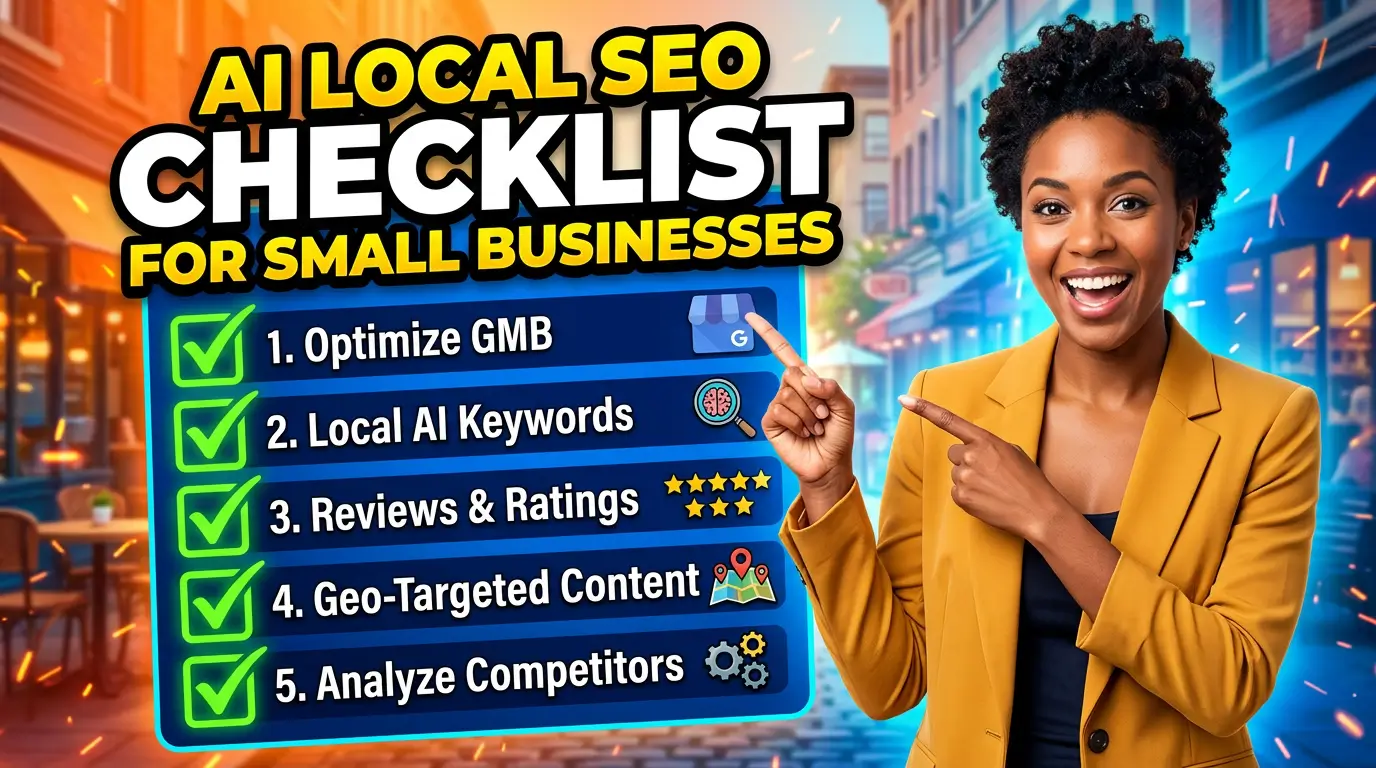
Here is the practical checklist I would use if I owned a local service business and wanted to stay visible in 2026.
Why local SEO feels harder now
The biggest change is not that people stopped searching. They still search. The issue is that fewer searches turn into simple website clicks.
Google rolled AI Overviews out broadly in the U.S. in 2024 and said it expected more than a billion people to have access by the end of that year, according to Google’s own Search announcement. Since then, studies have shown real pressure on organic click-through rates. Ahrefs analyzed 300,000 keywords and found that AI Overviews correlated with a 34.5% lower click-through rate for the top-ranking page in March 2025. When Ahrefs reran the study using December 2025 data, the estimated drop grew to 58% for position one results.
Seer Interactive found a similar pattern. In a study of 3,119 search terms across 42 client organizations, Seer reported that queries with AI Overviews where the brand was not cited saw organic CTR down 65.2% year over year. Even when a brand was cited, organic CTR was still down 49.4% year over year.
Local results are changing too. Sterling Sky reported that AI-powered local packs appeared on about 7% of tracked keywords in its 2026 local SEO analysis, but those packs showed only one or two businesses and did not include call buttons. The same analysis found AI local packs surfaced about 32% as many unique businesses as traditional three-packs.
That is the plain-English problem: you may still rank, but fewer people may see your listing, click your site, or tap the call button. Your marketing has to prove you are the right choice wherever the customer checks.
The AI local SEO checklist
1. Make your Google Business Profile complete and current
Start with the boring work because it still pays. Your Google Business Profile should have the right business name, address, phone number, hours, categories, services, photos, appointment links, and website link.
This is not optional housekeeping. BrightLocal’s 2025 SMB Marketing Report found that only 35% of SMBs have a Google Business Profile, even though 72% of SMBs said SEO has a medium-high impact on their business. That gap is an opening. If your competitors are asleep here, you can look more legitimate before the customer even reaches your site.
Do these first:
- Add every real service you offer, using plain customer language.
- Upload recent photos of your team, vehicles, jobs, office, showroom, or finished work.
- Check hours, holiday hours, service areas, booking links, and phone numbers monthly.
- Add products or services with short descriptions if your category allows it.
- Post updates when you add a service, run a seasonal offer, complete a notable job, or publish a useful guide.
Don’t stuff the profile with keywords. Make it accurate. AI systems and customers both need consistent business facts.
2. Build service pages that answer real buying questions
A lot of small business websites have one weak “Services” page. That used to be passable in low-competition markets. It is not enough now.
Each core service needs its own page. A plumber should not depend on one general plumbing page to rank for water heater replacement, drain cleaning, sewer line repair, leak detection, and emergency plumbing. Those are different problems with different urgency, pricing questions, photos, and proof. If you need a deeper structure, use this guide to build service pages that win in AI and local search.
Google’s helpful content guidance says content should provide original information, show first-hand expertise, and leave readers feeling they learned enough to achieve their goal. Google also says trust is the most important part of E-E-A-T, its experience, expertise, authoritativeness, and trust framework in its helpful content documentation.
A useful service page should answer the questions a customer asks before calling: What do you fix? What does it usually cost? How long does it take? What areas do you serve? What can go wrong if they wait? What makes your process different? What proof do you have?
If you are a roofer, show real roof photos from your market. If you are a dentist, explain insurance and appointment timing. If you are a manufacturer, show tolerances, equipment, industries served, and lead times. Generic copy is not proof. Specifics are proof.
3. Treat reviews as conversion assets, not just stars
Reviews now work harder than they used to. Customers read them, Google uses them, and AI tools may summarize them.
BrightLocal’s 2026 Local Consumer Review Survey found that 97% of consumers read reviews for local businesses. It also found that 41% of consumers always read reviews when browsing for businesses, up from 29% the prior year. The same report said consumers use an average of six review sites when choosing businesses, and that use of ChatGPT and other generative AI tools for local recommendations rose from 6% to 45% in one year.
That means a review strategy limited to “please leave us five stars on Google” is too thin. You need steady, recent, specific reviews across the places your buyers actually check; this reviews-everywhere local AI search strategy shows how to turn that proof into visibility.
Ask for reviews after the customer has a good outcome. Make the request simple. Give them the right link. Then respond like a real person. Slow, canned replies make a business look unattended.
A strong review mentions the service, city, problem, outcome, and team member. You cannot script that for customers, but you can ask better questions: “Would you be willing to mention what we helped with and what the experience was like?” That gives future customers more useful proof than a plain “great service” review.
4. Keep your name, address, phone, and service facts consistent
AI search depends on pattern matching and corroboration. If your website says one address, Google says another, Facebook has an old phone number, and Yelp lists services you no longer provide, you are making the machine work harder. Worse, you are making customers doubt you.
BrightLocal’s review survey shows customers are using more sources, not fewer. Google is still ahead for reviews, but the report says Facebook, Tripadvisor, BBB, Apple Maps, Trustpilot, Healthgrades, Yellow Pages, and Angi all saw increased usage in the prior 12 months. Apple Maps usage nearly doubled from 14% in 2025 to 27% in 2026, according to BrightLocal’s survey.
You do not need to obsess over every directory on earth. You do need the major profiles in your industry to agree on the basics.
Check your business name, address, phone, hours, website, services, and description on Google, Bing Places, Apple Business Connect, Facebook, Yelp, BBB, industry directories, local chamber pages, and any niche sites that matter in your field. If you are a home service company, sites like Angi may matter. If you are healthcare, Healthgrades may matter. If you are hospitality, Tripadvisor may matter.
5. Add proof that AI cannot invent
AI summaries are good at repeating common information. They are bad at replacing first-hand proof from your business.
Your site should include evidence that only your company can provide:
- Before and after photos with city or neighborhood context.
- Short case studies with the problem, work performed, timeline, and result.
- Team bios that explain experience, certifications, licenses, and specialties.
- Real project pages for larger jobs, especially if they show constraints and decisions.
- Pricing ranges, warranty terms, process steps, and what customers should expect.
This type of content helps people decide, and it gives search engines more original information to work with. It also protects you from sounding like every other company in town.
If every HVAC website says “fast, reliable service,” nobody stands out. If your page explains how your team replaced a failed 3-ton unit in a 1970s ranch home in Lancaster, what the homeowner noticed, what code issue had to be fixed, and what the final warranty covered, you sound real because you are real.
6. Track calls, forms, rankings, and AI referrals separately
If you only track total traffic, you will miss what is happening.
Sterling Sky’s 2026 local SEO analysis reported declining clicks-to-call from Google Business Profiles across 179 profiles from 34 U.S. law firms, while website clicks from profiles did not show the same decline. The same report said Local Services Ads rose from roughly 11% of tracked queries at the beginning of 2025 to 31% by November 2025, and local pack ads rose from 1% to almost 22% of mobile reports in the same period.
That matters because your lead mix can change even when total visibility looks okay. Calls may drop while website visits hold. Organic leads may shrink while paid calls rise. AI referral traffic may grow, but still be too small to replace Google.
Set up separate tracking for website forms, phone calls from the site, calls from Google Business Profile, paid ads, Local Services Ads, and newsletter or CRM leads. In analytics, watch referral traffic from tools like ChatGPT, Perplexity, Gemini, and Copilot, but do not overreact to small numbers. Sterling Sky noted that one large multi-location client saw ChatGPT traffic rise from 0.1% of Google traffic to 2%, which is growth, but still a small slice compared with Google.
7. Build pages for revenue, not vanity traffic
Informational traffic is the easiest traffic for AI to absorb. That does not mean blog content is useless. It means the blog has to support revenue pages.
A post like “how often should I replace my roof” may get fewer clicks than it did three years ago. But if it links to your roof replacement page, includes local examples, shows real photos, and answers questions your sales team hears every week, it still has value. It helps buyers who are closer to calling. It supports internal linking. It gives you material for email, social, and sales follow-up.
Stop publishing generic posts just because a keyword tool shows volume. Publish content that helps a real customer take the next step. For most small businesses, that means fewer, better pages tied to services, locations, objections, proof, and pricing.
What to do this month
If this feels like a lot, don’t try to fix everything in one weekend. Pick the work that affects trust and leads first.
For the next 30 days, do this in order:
- Clean up your Google Business Profile and add recent photos.
- Ask your last 20 happy customers for reviews, then respond to every new review.
- Build or improve one service page that drives real revenue.
- Check your top directories for wrong phone numbers, hours, addresses, and service descriptions.
- Add one real case study or project example to your site.
- Make sure calls and forms are tracked before you judge performance.
That is enough to create momentum. It puts your business on firmer ground than another generic blog post ever could.
AI search is raising the bar for local businesses. The winners will have the clearest information, freshest proof, strongest reputation, and easiest path from search result to sales conversation.
If your website and local SEO are not pulling their weight, we can help you fix the pieces that actually lead to calls, forms, and booked work. Start here: get a practical plan for your website and search visibility.