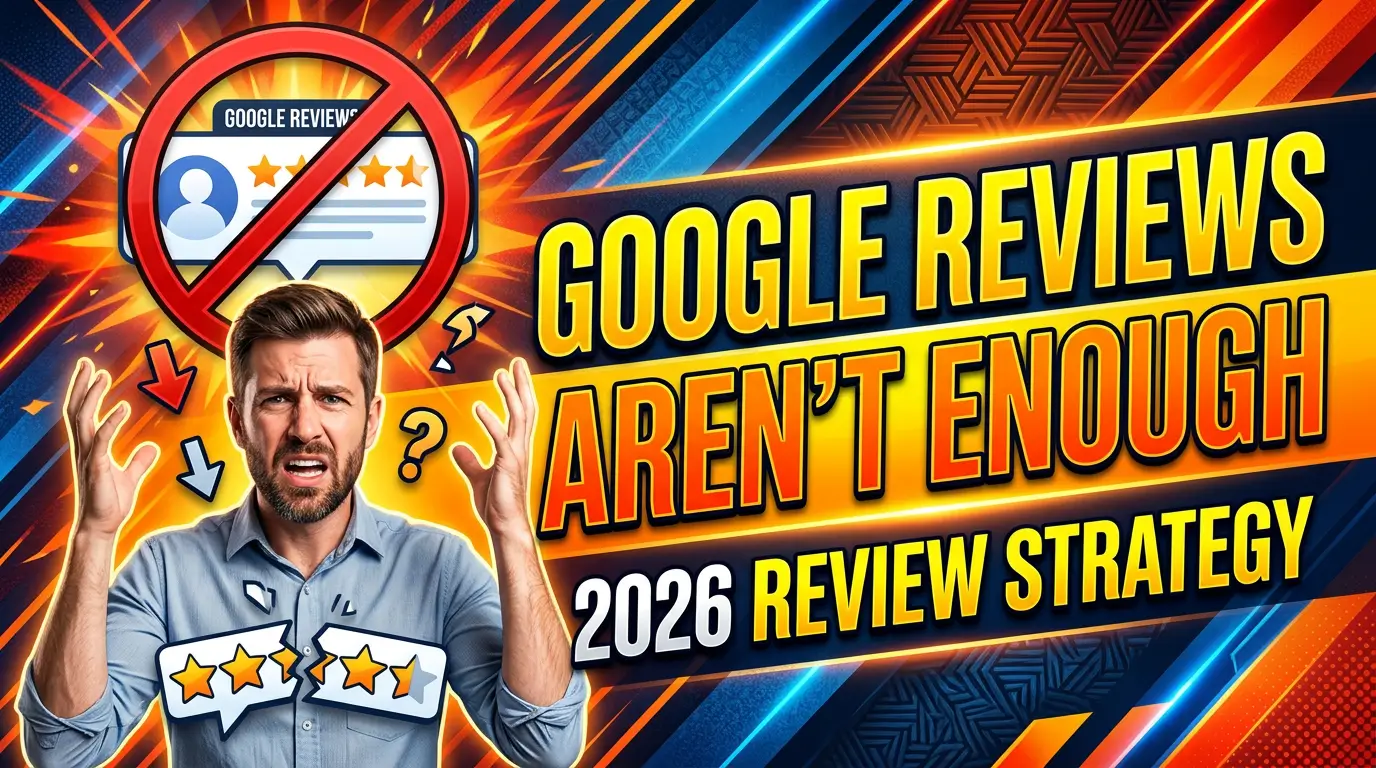
If your whole reputation strategy is “get more Google reviews,” you’re standing on one leg.
Google reviews still matter. A lot. But buyers are not checking one box anymore. They’re looking at your Google Business Profile, your website, Facebook, Yelp, BBB, industry directories, videos, social profiles, and now AI tools before they decide whether you’re worth the call.
That shift is not theory. BrightLocal’s 2026 Local Consumer Review Survey found that 97% of consumers read reviews for local businesses, and the average consumer uses six different review sites when choosing a business. The same research found that Google’s review-platform share fell from 83% in 2025 to 71% in 2026, while ChatGPT and other AI tools rose from 6% to 45% as sources for local recommendations.
For a small business, the takeaway is simple: keep building Google reviews, but stop treating Google like the only public proof that matters.
Why one review platform is now a weak setup
A single-platform review strategy creates three problems.
First, it limits where customers can trust you. BrightLocal reports that consumers now use an average of six review sites in 2026. If your business has 128 Google reviews but nothing credible on Facebook, Yelp, BBB, Angi, Healthgrades, TripAdvisor, Avvo, Houzz, or your industry’s equivalent, some buyers will see an incomplete picture.
Second, it creates risk. If your Google Business Profile gets suspended, merged, filtered, review-bombed, or hit by a competitor complaint, you lose the only reputation asset you bothered to build. That is like running your whole lead pipeline through one phone line and hoping nobody cuts it.
Third, it gives AI systems less clean evidence to work with. Google’s own guidance for generative AI features says AI Overviews and AI Mode are rooted in Google’s core Search ranking and quality systems, including retrieval from web pages in Google’s Search index and query fan-out across related searches. In plain English, Google says AI features pull from indexed web content and still rely on foundational SEO. If your reputation only lives inside one profile, your business gives search systems fewer corroborating signals.
What buyers are actually checking before they contact you
A buyer rarely says, “I am now performing reputation due diligence.” They just open tabs. An HVAC customer may check Google Maps, Facebook comments, Yelp complaints, and recent installation videos. A dentist patient may check Google, Healthgrades, insurance directories, and before-and-after photos.
BrightLocal’s 2026 survey found that Google, Facebook, and AI tools like ChatGPT are now among the most commonly used sources for local recommendations. It also reported increased usage across traditional review sites including TripAdvisor, Better Business Bureau, Healthgrades, Apple Maps, Trustpilot, Yellow Pages, and Angi.
That does not mean every small business needs to chase every platform. A plumber does not need to worry about Healthgrades. A medical practice probably does. A restaurant should care about TripAdvisor and Yelp more than a B2B machine shop would. The right move is not “be everywhere.” The right move is “be credible where your buyers already check.”
Start with your review platform map
Before asking for more reviews, make a review platform map. This is a one-page list of the places a buyer might check before doing business with you.
Track four things: platform name, current rating and review count, last review date, and whether your business information is accurate.
A local service business might include Google Business Profile, Facebook, Yelp, Apple Maps, BBB, Angi, Nextdoor, the local chamber, and one or two industry directories. A professional service firm might include LinkedIn, Clutch, G2, Capterra, UpCity, BBB, and niche directories. Health, wellness, and legal businesses should add vertical platforms like Healthgrades, Zocdoc, Psychology Today, Avvo, Martindale, or FindLaw.
Do not overbuild the spreadsheet. You are looking for obvious holes. If your Google profile has 200 reviews but your Apple Maps listing has the wrong phone number, fix that before you write another blog post.
Keep Google strong, but do not make it carry everything
Google should still be the first reputation asset for most local businesses. BrightLocal’s 2026 data still shows Google as the leading review source at 71% usage. For local intent searches like “emergency electrician near me” or “family dentist in Springfield,” the Google Business Profile often sits between the buyer and your phone number.
Your Google profile needs three things before you spread attention elsewhere.
Start with accuracy. Name, address, phone, hours, services, appointment URL, service area, and categories all need to match reality. Then keep reviews fresh. BrightLocal found that 74% of consumers only care about reviews written in the last three months, and 44% consider whether a review was posted within the last month. Finally, respond. BrightLocal’s survey found that 37% of consumers consider whether the business owner responded to a review when evaluating trust.
Build the second layer: Facebook, Apple Maps, and BBB
Once Google is clean and active, build the second layer. For many small businesses, that means Facebook, Apple Maps, and BBB.
Facebook still matters because customers use it as a trust check. BrightLocal lists Facebook as one of the most commonly used sources for local recommendations in 2026, so an abandoned page with old hours is not harmless.
Apple Maps matters because iPhone users often search from the device in their hand. BrightLocal reported that Apple Maps nearly doubled in usage, from 14% in 2025 to 27% in 2026. BBB matters in industries where trust and complaint history influence the sale, especially contractors, home services, financial services, senior care, legal services, and higher-ticket local businesses.
Add industry-specific proof where buyers compare vendors
Industry review platforms work because they match how buyers shop.
A homeowner choosing a remodeler may compare Houzz photos before calling. A patient looking for a specialist may check Healthgrades. A software buyer may read G2 or Capterra. A traveler may trust TripAdvisor more than a business’s own website. A homeowner looking for a local pro may check Angi, Thumbtack, or Nextdoor.
This is where small businesses often waste effort. They ask every happy customer for a Google review, then ignore the platform where serious buyers in their category actually compare options.
Look at your last 20 good customers. Ask two questions: where did they first find you, and where did they check you before contacting you? If three customers mention the same third-party site, that site belongs on your review platform map.
Make your website the proof hub
Your website should not just say you’re trustworthy. It should collect and organize the evidence.
Google’s LocalBusiness structured data documentation says you can add LocalBusiness structured data to pages that contain business information. Structured data is not magic, but it helps organize facts like business name, address, phone number, opening hours, and business type.
Your proof hub should include:
- A testimonials or reviews page with recent customer quotes, project types, and locations
- Service pages that include relevant reviews for that specific service
- Links to active third-party profiles where buyers can verify your reputation
If you install garage doors, put repair reviews on the repair page and new installation reviews on the installation page. If you serve multiple towns, include location-specific proof where it is honest and useful.
The goal is not to stuff pages with stars. The goal is to help a skeptical buyer answer, “Have they solved my kind of problem for someone like me?”
Prepare for AI recommendations without chasing hype
AI search is growing, but it is not a reason to throw away basic marketing discipline.
WordStream’s 2026 SEO trends report argues that AI Overviews and AI Mode will keep expanding, while traditional SEO remains a major source of high-intent traffic. The practical response is to strengthen the fundamentals that help both normal search and AI-driven discovery.
For review diversification, that means keeping your business facts consistent across the web. If your website says you serve Columbus, your Google profile says you serve all of Ohio, your Yelp page lists an old address, and your Facebook page has a dead phone number, you are making every system work harder. Customers notice that mess too.
Use the same business name, phone number, service descriptions, and hours everywhere possible. Keep your profiles updated, add recent photos, publish clear service pages, and link to credible third-party proof.
A 30-day review diversification plan
Do this in order. Do not try to fix 20 platforms in one afternoon.
Week 1: Audit the obvious places
Search your business name, phone number, owner name, and top service plus city. Record profiles that appear on page one and page two, including Google, Facebook, Apple Maps, Yelp, BBB, and your top industry directory.
Fix wrong phone numbers, dead links, old hours, duplicate listings, and missing website URLs first. Bad information costs leads before review count ever matters.
Week 2: Pick your top three non-Google platforms
Choose three platforms based on buyer behavior, not vanity. A roofing company might choose Facebook, BBB, and Angi. A restaurant might choose Yelp, TripAdvisor, and Apple Maps. A B2B service firm might choose LinkedIn, Clutch, and Google partners or local directories.
Fill out each profile properly with services, photos, service areas, appointment links, and a description that sounds like your business, not a keyword dump.
Week 3: Ask recent happy customers for platform-specific reviews
Do not blast everyone with the same generic link. Match the request to the customer.
If someone found you through Apple Maps, ask for an Apple Maps review. If a customer came from Facebook, ask there. If a commercial client would be a strong LinkedIn recommendation, ask for that instead of another Google review.
Keep the request short: “Would you be willing to leave a quick review about the repair and how our team handled the scheduling? It helps other local customers know what to expect.”
Week 4: Add proof to your website
Pull the best recent proof into the pages where it helps buyers decide. Add a short testimonial to the service page. Add a project photo. Link to the third-party review profile. Update your reviews page so it does not look like it was last touched two years ago.
Then set a monthly rhythm: check profile accuracy, respond to new reviews, request reviews from recent happy customers, and refresh website proof.
What not to do
Do not buy reviews. The Federal Trade Commission says businesses cannot write, sell, buy, or spread fake consumer reviews or testimonials. Do not ignore negative reviews on smaller platforms either. A two-star BBB complaint or angry Yelp review can show up right when a buyer searches your business name plus “reviews.” Respond calmly, state the facts, and move the conversation toward resolution.
The bottom line
Google reviews are still the foundation for most local businesses. They are not the whole building.
Small business buyers now check more platforms, expect fresher proof, use AI tools for recommendations, and compare signals across the web before they contact you. The businesses that win will have accurate listings, recent reviews, real responses, and visible proof in the places their buyers already trust.
If your review presence feels scattered, we can help you clean it up, prioritize the right platforms, and turn your website into a stronger trust hub. Get started here.