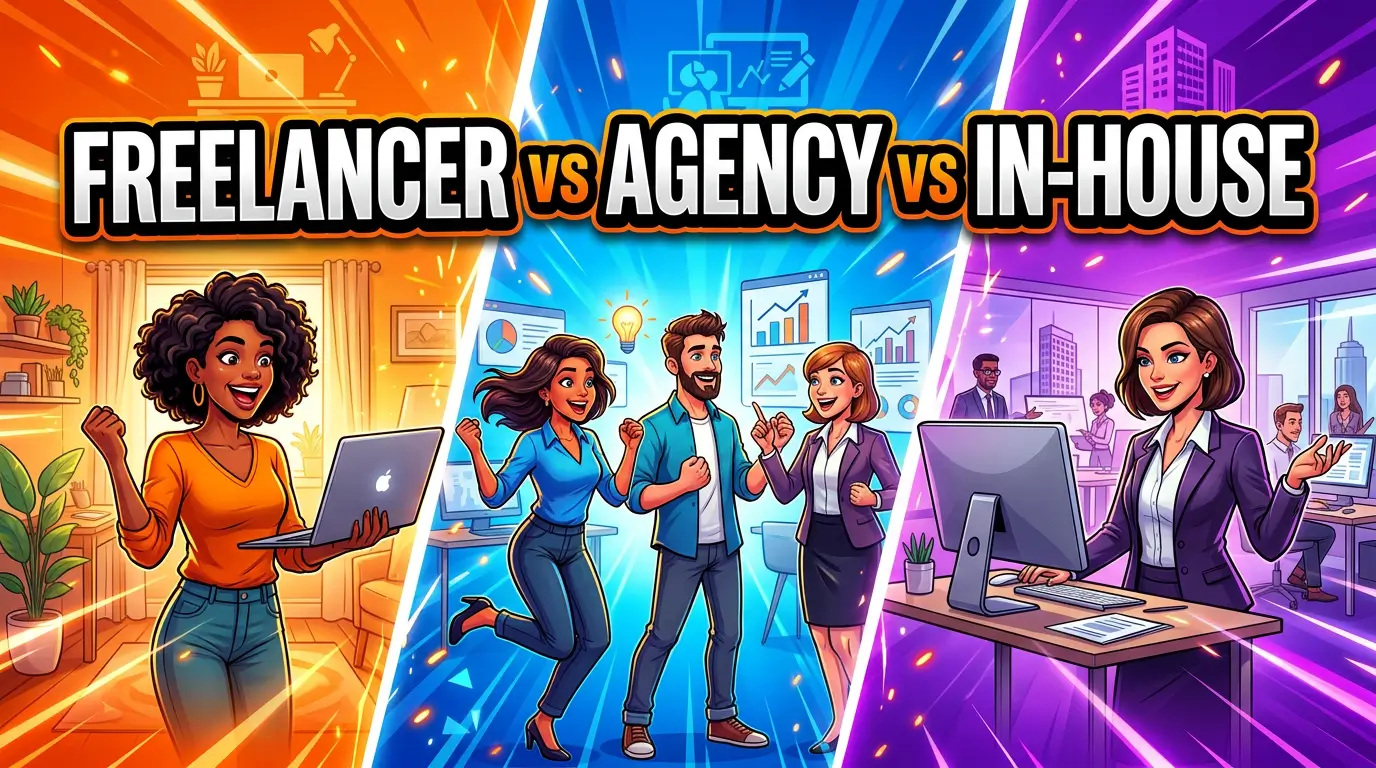
Picking who builds or manages your website is not a design decision. It’s an operating decision.
A freelancer can move fast and keep the bill lean. An agency can bring process, backup coverage, and specialists. An in-house hire can protect institutional knowledge and move with your business every week. The wrong choice can turn a normal website project into a slow drip of missed deadlines, unclear ownership, plugin problems, tracking gaps, and expensive fixes.
This comparison is built for owners, marketing leads, and operators who need a practical answer: should you hire a freelancer, an agency, or build an internal website team in 2026?
The short answer: most small businesses should not start with a full-time in-house web hire. They should use a strong freelancer for simple, tightly scoped work, use an agency when the site affects revenue, compliance, integrations, or search visibility, and move in-house only when website work becomes a steady weekly workload.
The 2026 Cost Snapshot
Here is the quick math before we talk about fit.
| Option | Typical cost signal | Best fit | Main risk |
|---|---|---|---|
| Freelancer | Upwork lists web developers at a $30 median hourly rate, typically $15 to $50 per hour | Small builds, fixes, landing pages, audits | One person may not cover strategy, UX, SEO, copy, QA, and support |
| Agency | Clutch lists web design company pricing commonly at $100 to $149 per hour | Revenue-critical sites, redesigns, SEO migrations, complex builds | Higher cost, more process, possible over-scoping |
| In-house hire | BLS reports web developers earned a $90,930 median annual wage in May 2024 | Companies with ongoing web work every week | Salary is only part of the real cost |
| Hybrid | Maintenance, freelancer, and agency support combined | Most small businesses after launch | Requires clear ownership and documentation |
The mistake is comparing hourly rates as if all hours buy the same thing. A $40 freelance hour can be a bargain if the work is focused and the person is good. A $140 agency hour can be cheaper if it prevents a botched SEO migration or catches broken checkout tracking before launch. An in-house salary can make sense if your website is part of daily operations, but it can be wasteful if the person spends half the month waiting for tasks.
What Each Option Actually Buys
A website project is not one job. It includes planning, design, development, content, SEO, analytics, accessibility, performance, security, hosting, backups, QA, launch support, and maintenance. WordPress alone has a large surface area, with the official plugin directory described by WordPress as the largest directory of free and open source WordPress plugins, and that means there are a lot of moving parts to own.
A freelancer usually gives you one person’s skill stack. That might be enough for a five-page local service site, a Webflow build, a WordPress cleanup, or a landing page. It is not automatically enough for an ecommerce migration, multi-location SEO structure, conversion strategy, copywriting, CRM routing, and post-launch reporting.
An agency gives you a system. You are usually paying for more than the person clicking buttons. You are paying for discovery, project management, design review, QA, backups, multiple skill sets, and someone to answer if the main developer is sick, booked, or stuck.
An in-house hire gives you speed of access and company context. The upside is obvious: they know the business, they hear sales objections, they can update pages quickly, and they can improve systems over time. The downside is just as real: one hire rarely covers every web discipline at a high level.
When a Freelancer Is the Right Choice
Hire a freelancer when the work is clear, bounded, and easy to verify.
Good freelance projects include a service page refresh, a homepage redesign using an existing brand, a landing page for one campaign, speed cleanup, a WordPress bug fix, a contact form rebuild, or a simple five to ten page brochure site.
The strongest freelancer projects have a written brief, a short list of deliverables, a defined tech stack, a launch checklist, and one decision-maker. That sounds boring. It saves money.
Freelancers are also a good fit when the business owner already knows what needs to be done. If you can say, “We need these 12 pages rebuilt in WordPress, these forms connected to HubSpot, these redirects preserved, and these analytics events tested,” a freelancer can price the work clearly. If you are saying, “Our website just isn’t working,” you probably need diagnosis before production.
Use freelancer support when:
- The site is not the main source of revenue.
- The scope can fit into a few weeks.
- You have a specific deliverable, not a vague business problem.
- You can review the work or hire someone to QA it.
- You are comfortable being the project manager.
The cost advantage is real. Upwork’s public marketplace data puts the median web developer rate at $30 per hour, while Clutch’s web design company pricing guide puts many agencies in the $100 to $149 per hour range. But the lower hourly rate only helps if the work is scoped well.
When an Agency Is the Right Choice
Hire an agency when the website has business risk attached to it.
That risk can be revenue, search traffic, compliance, paid ad tracking, ecommerce checkout, booking systems, membership access, lead routing, or multi-location visibility. If a broken launch can cost more than the vendor fee, you need more process.
Agencies are usually better for redesigns where multiple jobs have to happen at the same time: UX, copy, development, redirects, analytics, forms, QA, hosting, performance, and launch planning. GoodFirms says its 2025 web development cost survey reviewed more than 100 web development companies, which is a useful reminder that vendor pricing reflects different scopes, team sizes, and delivery models, not just design taste.
A good agency should slow you down at the beginning. That is not a bad thing. They should ask about revenue, lead quality, sales process, SEO history, CRM usage, content ownership, page priorities, and what happens after launch. If they jump straight to colors and templates, they may be selling production without understanding the job.
Agency support makes sense when:
- Organic search traffic matters.
- Paid ads depend on accurate landing pages and tracking.
- The site uses forms, booking, payments, or CRM routing.
- Multiple stakeholders need alignment.
- The launch has to be planned, tested, and documented.
- You need design, development, copy, SEO, and QA together.
The agency tradeoff is cost and complexity. More people means more communication. More process means more meetings. That can feel slow. But for a business-critical website, the process is often what keeps the project from drifting.
When In-House Makes Sense
An in-house website hire makes sense when the website has become a working system, not a project.
If your team needs weekly landing pages, regular conversion tests, product updates, campaign pages, SEO refreshes, analytics cleanup, support documentation, integrations, and reporting, a full-time person can pay for themselves. If your site only needs a few updates per month, in-house is probably too much.
The salary number is only the beginning. The Bureau of Labor Statistics reports a $90,930 median annual wage for web developers. BLS also reports that employer benefit costs accounted for 38.3% of total compensation costs in private industry in its December 2025 data. That means the real cost of hiring is not just salary. You also need taxes, benefits, software, management time, training, and coverage when the person is unavailable.
In-house works best when you have enough work for at least 25 to 30 productive web hours every week. That does not mean 30 hours of random edits. It means meaningful work tied to revenue, support, operations, or customer experience.
The danger is hiring one “website person” and expecting them to be a designer, developer, copywriter, SEO, analyst, accessibility specialist, security admin, and project manager. Some people are versatile. Nobody is excellent at everything.
The Hidden Risk: Ownership
The biggest website vendor problem is not price. It is ownership.
Who owns the domain login? Who controls DNS? Who can access hosting? Where are backups stored? Who owns the theme, custom code, design files, analytics accounts, paid plugin licenses, and stock images? What happens if the vendor relationship ends?
This is where cheap work can become expensive. A freelancer who builds fast but leaves no documentation can create lock-in by accident. An agency with a closed hosting stack can create lock-in by design. An in-house employee who keeps everything in their personal notes can create risk when they leave.
Before you hire anyone, ask for the ownership plan. You want admin access, documented logins, a list of paid tools, a backup process, a handoff checklist, and a simple record of how the site is built. This does not have to be fancy. It has to exist.
Security ownership matters too. Patchstack’s WordPress vulnerability statistics show that plugins make up the large majority of tracked WordPress vulnerabilities, with its database reporting 34,609 plugin vulnerabilities versus 2,882 theme vulnerabilities at the time of publication. If your site depends on plugins, someone has to own updates, testing, backups, and rollback.
The Scorecard: How to Choose
Use this scoring model before you talk to vendors. Give each factor a score from 1 to 5, where 1 is low and 5 is high.
| Factor | If score is low | If score is high |
|---|---|---|
| Revenue dependence | Freelancer or light support may work | Agency or hybrid support is safer |
| Scope clarity | You need strategy before production | Freelancer can execute faster |
| Technical complexity | Template or simple CMS is fine | Agency or specialist team is safer |
| Update frequency | Retainer or as-needed help works | In-house or hybrid may make sense |
| SEO risk | Basic launch process is enough | Migration planning is required |
| Internal project management | You can manage a freelancer | Agency process may be worth the cost |
| Need for speed | Freelancer may move fastest | In-house wins if work is constant |
Add the scores. If you land under 18, a freelancer or small studio is probably fine. From 18 to 27, consider an agency or a strong hybrid setup. Above 27, the website is probably important enough to justify an agency now and possibly in-house support later.
This is not math from a lab. It is a forcing function. It makes you talk about risk before you are staring at proposals.
Best Setup for Most Small Businesses: Hybrid
For many small businesses, the best answer is not freelancer vs agency vs in-house. It is a hybrid.
A practical hybrid model looks like this: use an agency or senior specialist for strategy, architecture, redesigns, SEO migrations, and high-risk launches. Use a trusted freelancer for focused production work and monthly improvements. Keep internal ownership of logins, priorities, approvals, content knowledge, and business goals.
This works because website needs are uneven. You may need a heavy lift for eight weeks, then only five hours per month for updates. Later you may need another serious project, like a booking system, new location pages, or a paid ad funnel. Hiring a full-time person for uneven work can waste money. Hiring a new vendor every time can waste context.
A hybrid model also protects you from single-vendor dependence. One person can leave. One agency can change direction. One internal employee can quit. Documentation and shared ownership keep the business from being trapped.
Questions to Ask Before You Hire
Ask these before you sign anything:
- What work is included, and what is excluded?
- Who will own the domain, hosting, CMS, code, design files, analytics, and paid tools?
- What happens if the project runs long?
- How are change requests priced?
- Who handles redirects, forms, analytics, backups, and launch QA?
- What support is included after launch?
- What documentation will we receive?
- Who is responsible if a plugin update breaks the site?
- Can we leave with a working copy of the site?
- What does success look like 90 days after launch?
The answers matter more than the polish of the sales call. A vendor who gives clear boundaries is usually safer than one who says yes to everything.
Red Flags by Vendor Type
With freelancers, watch for vague scope, no testing plan, personal accounts used for business assets, no backup process, and no written handoff. A good freelancer will not be offended by documentation requests. The pros already work that way.
With agencies, watch for bloated discovery, unclear ownership, proprietary systems you cannot leave, weak post-launch support, and proposals that focus on page count instead of business outcomes. Higher cost is not automatically a problem. Unclear cost is.
With in-house hires, watch for unrealistic job descriptions. If the posting asks for brand strategy, front-end development, back-end development, SEO, paid ads, analytics, copywriting, video editing, cybersecurity, and IT support in one person, you are not hiring a website team. You are writing a wish list.
A Simple Decision Framework
Choose a freelancer if the work is specific, contained, and low-risk.
Choose an agency if the work affects revenue, search traffic, integrations, compliance, or launch risk.
Choose in-house if the website needs steady weekly attention and the business can support that person with tools, priorities, and backup specialists.
Choose hybrid if your needs spike and dip, which is where most small businesses live.
The right choice should reduce stress, not just reduce the invoice. A cheap project that leaves you stuck is not cheap. A higher-priced project that gives you a faster site, cleaner analytics, fewer missed leads, and less operational risk can be the better deal.
If you want help figuring out which model fits your site, start with a quick conversation. Tell us what you have, what is broken, and what the website needs to do next. We can help you sort the work, the risk, and the right level of support at yourwebteam.io.
FAQ
Is a freelancer cheaper than an agency?
Usually, yes on hourly rate. Upwork lists a $30 median hourly rate for web developers, while Clutch lists many web design companies at $100 to $149 per hour. The better question is whether the project needs one skill set or a coordinated team.
Should a small business hire an in-house web developer?
Only if there is steady work. BLS reports web developers earned a $90,930 median annual wage, and employer costs include benefits, tools, taxes, and management time. If you only need occasional updates, outside support is usually a better fit.
What is the safest option for a website redesign?
For a revenue-critical redesign, an agency or senior-led hybrid team is usually safest. The risk is not just design quality. It is redirects, analytics, content, forms, performance, accessibility, hosting, backups, and launch QA.
What should I own after a website project?
You should own or control the domain, DNS, hosting, CMS admin account, source files or theme, design files, analytics, form destinations, paid plugin licenses, and backups. You should also receive documentation that explains how the site is maintained.