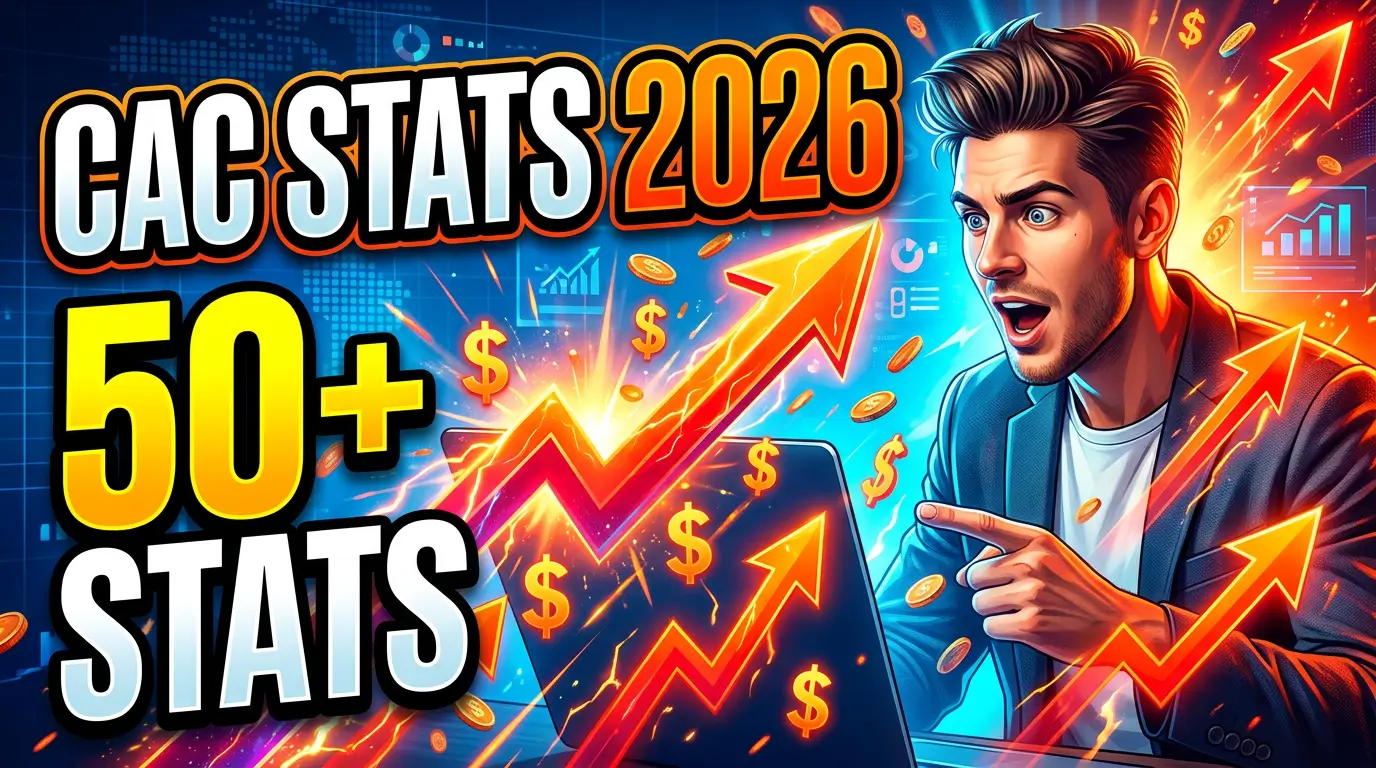
Getting a new customer has never been more expensive.
Customer acquisition costs (CAC) have increased by 60% over the past five years, and in some industries, they’ve more than tripled. If you’re a business owner or marketing leader, you feel this every time you check your ad spend dashboard.
But here’s what most CAC roundups miss: your website is one of the single biggest levers you have to reduce acquisition costs. A faster, better-converting website means every dollar you spend on ads, SEO, and content marketing goes further. A poor website means you’re paying for traffic that bounces.
We’ve compiled 50+ customer acquisition cost statistics for 2026 — organized to help you understand not just what CAC looks like across industries and channels, but how your website strategy directly impacts it.
Overall CAC Benchmarks
Before you start optimizing, you need to know the baseline. These numbers set the stage.
-
The average customer acquisition cost across all industries is $395. This includes both organic and paid channels. (HubSpot via GrowSurf)
-
Customer acquisition costs have increased by 60% over the past five years, primarily driven by rising paid media costs. (ProfitWell via GrowSurf)
-
Over an eight-year period, CAC has compounded by 222%, according to ProfitWell’s benchmarking report analyzing data from 14,800 companies. (Amra and Elma)
-
CAC rose approximately 40% between 2023 and 2026, driven by increased platform competition, privacy changes, and market saturation. (Deliberate Directions)
-
The average financial loss from acquiring a new customer grew from $9 in 2013 to $29 in 2025, signaling a widening gap between marketing spend and monetization effectiveness. (Amra and Elma)
-
Bottom-quartile companies spend nearly triple what top performers invest for identical revenue outcomes. The efficiency gap keeps widening. (Benchmarkit via Genesys Growth)
CAC Benchmarks by Industry
Not all industries face the same acquisition costs. Where you sit on this spectrum determines how aggressively you need to optimize.
-
Financial services companies have the highest average CAC at $644. (HubSpot via GrowSurf)
-
Fintech companies face an average CAC of up to $1,672 — the highest of any segment tracked. (Amra and Elma)
-
Healthcare companies average a CAC of $560 for patient acquisition. (Accenture Health via GrowSurf)
-
Technology companies average a CAC of $395, with enterprise software between $500 and $800. (ProfitWell via GrowSurf)
-
B2B SaaS companies have an average CAC of $205 for organic channels and $341 for paid channels. That’s a 66% premium for paid acquisition. (ProfitWell via GrowSurf)
-
The baseline CAC for B2B SaaS averages $702 per customer, though it varies dramatically by company stage and vertical. (GTM 80/20)
-
Travel and hospitality companies average a CAC of $395. (HubSpot via GrowSurf)
-
Telecommunications companies average a CAC of $315 for consumer plans. (Deloitte via GrowSurf)
-
Education and edtech companies average a CAC of $245. (HubSpot via GrowSurf)
-
E-commerce direct-to-consumer brands average a CAC of $45–$70, the lowest among major business models. (Shopify via GrowSurf)
-
Arts and entertainment has the lowest tracked CAC at just $21. (Amra and Elma)
CAC by Marketing Channel
Where you spend your marketing dollars matters enormously. The channel mix gap is striking — and it’s where website optimization enters the picture.
-
Referral marketing delivers the lowest CAC of any active acquisition channel at $15–$50 per customer. (Invesp via GrowSurf)
-
Organic search has the lowest scalable CAC at $70–$120 per customer. (HubSpot via GrowSurf)
-
Content marketing CAC averages $92 per customer, making it one of the most cost-efficient channels when done well. (Content Marketing Institute via GrowSurf)
-
Email marketing delivers a CAC of $85–$150 for cold outreach campaigns. (Mailchimp via GrowSurf)
-
Affiliate marketing CAC averages $100–$200 per customer. (Forrester Research via GrowSurf)
-
Paid social advertising averages a CAC of $150–$300. (Statista via GrowSurf)
-
Paid search (Google Ads) averages a CAC of $200–$350. (WordStream via GrowSurf)
-
Display advertising has the highest CAC at $300–$500, with declining effectiveness. (eMarketer via GrowSurf)
-
Trade shows and events average a CAC of $500–$800 per qualified lead. (CEIR via GrowSurf)
The pattern is clear: channels that depend on your website converting well (organic search, content, referrals) have the lowest CAC. Channels where you’re paying for every impression regardless of website quality have the highest.
Rising Paid Advertising Costs
If you rely heavily on paid channels, the trendline is alarming.
-
Facebook CPMs have increased by 89% since 2020. (Statista via GrowSurf)
-
Google Ads CPC has increased by 15–20% year-over-year in competitive verticals. (WordStream via GrowSurf)
-
iOS privacy changes increased mobile acquisition costs by 30–40% for affected advertisers. (AppsFlyer via GrowSurf)
-
Third-party cookie deprecation is expected to increase display advertising CAC by 25–40%. (eMarketer via GrowSurf)
-
Companies that rely primarily on paid channels have seen CAC increase 2x faster than those with diversified channel mixes. (Forrester Research via GrowSurf)
-
Organic and referral channels have seen only 5–10% CAC increases over the same five-year period. (HubSpot via GrowSurf)
-
Some industries report a 15% increase in paid advertising CAC year-over-year as competition heats up. (Fasturtle)
CAC-to-LTV Ratio: The Number That Actually Matters
Raw CAC means nothing without context. It’s the ratio between what you spend to acquire a customer and what that customer is worth over their lifetime that determines whether your business is sustainable.
-
The ideal CAC-to-LTV ratio is 1:3 or better — meaning each customer should be worth at least 3x what you spent to acquire them. (David Skok / For Entrepreneurs via GrowSurf)
-
SaaS companies average a CAC-to-LTV ratio of 1:3.5. (ProfitWell via GrowSurf)
-
E-commerce companies with repeat purchase models average a 1:2.5 CAC-to-LTV ratio, which is below the ideal threshold. (Shopify via GrowSurf)
-
Top-quartile SaaS companies achieve CAC-to-LTV ratios of 1:5 or better. (OpenView Partners via GrowSurf)
-
Companies with a ratio above 1:5 are typically under-investing in growth — they could afford to spend more on acquisition. (Bessemer Venture Partners via GrowSurf)
-
Companies with a ratio below 1:1 are unprofitable and unsustainable. (Bessemer Venture Partners via GrowSurf)
-
Referred customers have a CAC-to-LTV ratio 2.5x better than paid-acquired customers. (Wharton School of Business via GrowSurf)
-
Omnichannel customers deliver a 30% CLV premium over single-channel customers. (Genesys Growth)
CAC Payback Period
It’s not just about how much you spend — it’s about how quickly you earn it back.
-
The average SaaS CAC payback period is 12–18 months. (ProfitWell via GrowSurf)
-
Top-performing SaaS companies recover CAC within 5–7 months. (Bessemer Venture Partners via GrowSurf)
-
E-commerce companies average a CAC payback period of 2–6 months. (Shopify via GrowSurf)
-
Referral-acquired customers have a 40% shorter CAC payback period than paid-acquired customers. (McKinsey & Company via GrowSurf)
-
Companies with payback periods over 18 months face significant cash flow challenges. (OpenView Partners via GrowSurf)
-
A $500 CAC that pays back in 6 months is healthier than a $200 CAC that takes 24 months. Payback speed matters as much as raw cost. (Prospeo)
How Your Website Directly Impacts CAC
This is the section most CAC articles miss entirely. Your website isn’t just a destination — it’s a conversion machine that either amplifies or wastes every marketing dollar.
-
Doubling your website’s conversion rate cuts your effective CAC in half. If you’re spending $100 per visitor and converting 1%, your CAC is $10,000. At 2%, it’s $5,000 — same traffic, half the cost. (Linear Design)
-
AI-driven personalized recommendations increase conversion rates by 15–20%, directly lowering the cost per acquisition from existing traffic. (Cropink)
-
AI-powered optimization can lower client acquisition costs by up to 50%. (Cropink)
-
AI-driven strategies have reduced CAC by an average of 47.3% across companies that implement them. (Amra and Elma)
-
Personalization excellence drives 40% revenue gains, effectively improving the LTV side of the CAC-to-LTV equation. (Genesys Growth)
-
CRO doesn’t just improve one-time purchases — it optimizes the experience to foster repeat customers, increasing lifetime value and reducing the constant need for new acquisition. (WordStream)
-
A confusing pricing page or slow onboarding flow is a CAC problem, not a marketing problem. Product experience directly impacts acquisition efficiency. (Prospeo)
-
Optimizing page load speed and simplifying checkout processes are among the highest-impact CAC reduction tactics, because they reduce drop-off from traffic you’ve already paid for. (Enhencer)
Reducing CAC: What the Data Says Works
-
Referral programs reduce blended CAC by 35–45% when they account for 20%+ of acquisition. (Deloitte Digital via GrowSurf)
-
Companies that add a referral channel see overall CAC decrease by 15–25% within the first year. (Forrester Research via GrowSurf)
-
Referred customers cost 3–5x less to acquire than paid channel customers. (Invesp via GrowSurf)
-
Companies combining referral programs with customer success see the largest CAC reductions of 40–55%. (Gainsight via GrowSurf)
-
Referral programs scale with near-zero marginal cost as the customer base grows. (McKinsey & Company via GrowSurf)
-
A 5% annual retention improvement is the target benchmark for meaningfully impacting CLV and CAC efficiency. (Genesys Growth)
What This Means for Your Business
The data tells a consistent story:
Paid acquisition costs are rising fast, and they’re not coming back down. Privacy changes, platform competition, and ad fatigue are structural forces — not temporary blips.
The businesses with the lowest CAC are the ones with the best websites. They convert organic traffic efficiently. They turn referrals into customers without friction. They don’t leak leads through slow pages, confusing navigation, or weak calls to action.
Every percentage point improvement in your website’s conversion rate directly reduces your CAC. It’s not abstract — it’s math. The same traffic, converting better, means lower cost per customer.
Here’s what to prioritize:
- Speed: Every second of load time costs you conversions and inflates your effective CAC.
- Clarity: Confusing messaging, buried CTAs, and complex navigation all increase the cost of turning a visitor into a customer.
- Trust signals: Reviews, testimonials, case studies, and professional design reduce the “conversion tax” on every visitor.
- Mobile optimization: If half your traffic is mobile and your mobile experience is poor, you’re effectively doubling your CAC on that segment.
- Conversion tracking: You can’t reduce CAC if you don’t know where visitors drop off.
The most cost-efficient growth strategy in 2026 isn’t spending more on ads. It’s making your website work harder with the traffic you already have.
Ready to Lower Your CAC?
Your website is either working for you or against you when it comes to customer acquisition costs. If your conversion rates are below industry averages, you’re overpaying for every customer.
Get a free website assessment → and find out where your site is leaking leads — and what it’s costing you.
- customer acquisition cost
- CAC
- website statistics
- conversion rate optimization
- marketing ROI
- lead generation

Richard Kastl
Founder & Lead EngineerRichard Kastl has spent 14 years engineering websites that generate revenue. He combines expertise in web development, SEO, digital marketing, and conversion optimization to build sites that make the phone ring. His work has helped generate over $30M in pipeline for clients ranging from industrial manufacturers to SaaS companies.