Something fundamental has changed about how people find businesses online. And if you haven’t noticed yet, you’re already falling behind.
Your potential customers are no longer typing queries into Google and clicking through ten blue links. Instead, they’re asking ChatGPT, Perplexity, and Google’s AI Overviews for direct answers — and those AI systems are synthesizing responses from a handful of trusted sources. If your business isn’t one of those sources, you’re invisible in the fastest-growing discovery channel of 2026.
This isn’t theoretical. ChatGPT now processes over 2.5 billion prompts per day, with 800 million weekly active users. Google’s AI Mode has hit 75 million users. And according to Semrush’s AI Overviews study, AI Overviews now appear in 88% of informational search queries.
The old playbook of keyword stuffing and link building won’t cut it. Welcome to the era of AI Search Optimization.
What Is AI Search Optimization (and Why Should You Care)?
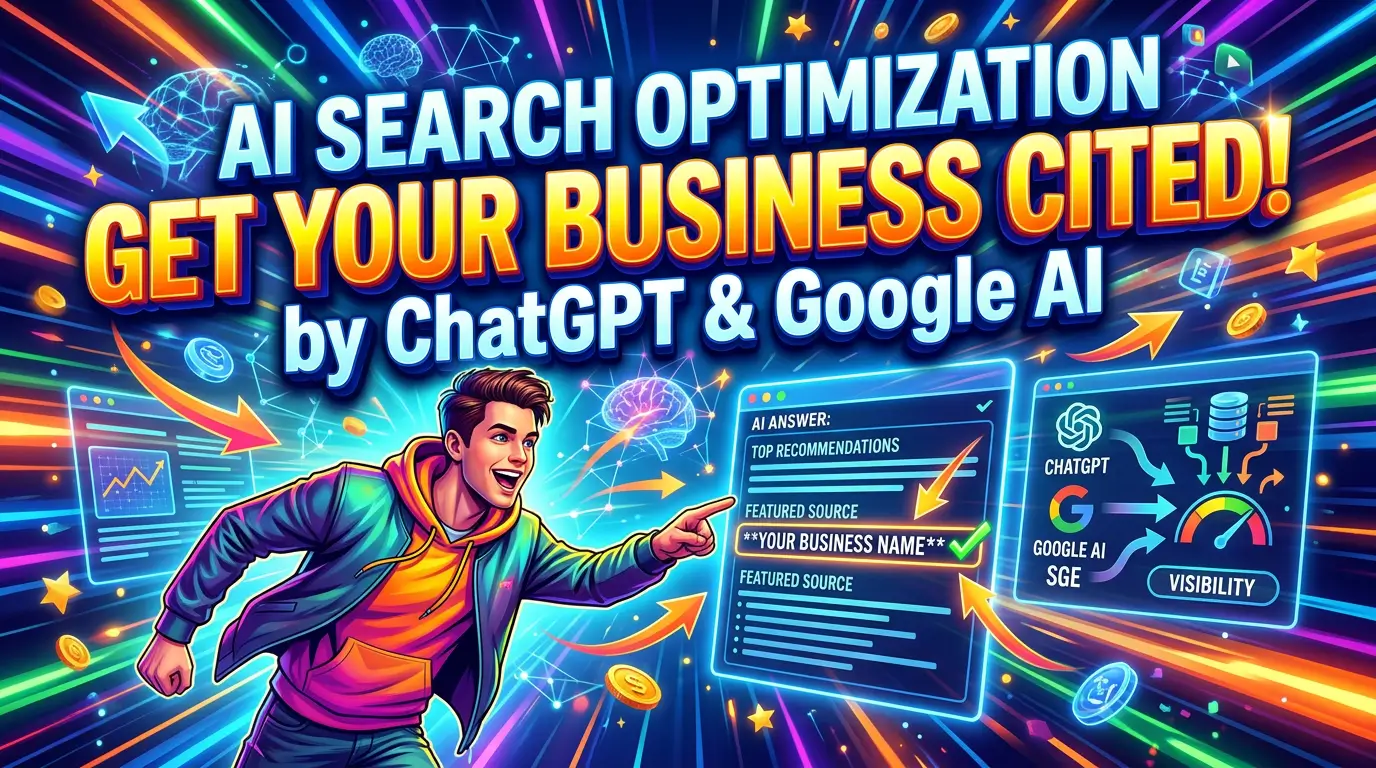
AI search optimization — sometimes called Generative Engine Optimization (GEO), Answer Engine Optimization (AEO), or Large Language Model Optimization (LLMO) — is the practice of structuring your content so AI systems cite it in their responses.
Here’s the critical difference: Google ranks pages. AI cites statements. That single shift changes everything about how you need to write, structure, and distribute content.
When someone asks ChatGPT “what’s the best web designer near me” or asks Perplexity “how much should a small business website cost,” these AI systems don’t show a list of links. They synthesize one answer, pulling from sources they trust. If your business is one of those sources, you get mentioned by name — often with a direct link.
According to Position Digital’s AI SEO statistics report, when your brand is cited in a Google AI Overview, your organic click-through rate is 35% higher than normal. But here’s the flip side: organic CTR has dropped 61% for queries where an AI Overview appears and you’re not cited.
The takeaway is simple: being cited by AI isn’t a nice-to-have. It’s becoming the primary driver of online visibility.
How AI Search Engines Decide What to Cite
Before you can optimize, you need to understand how these systems choose sources. AI search engines don’t work like Google’s traditional algorithm. They use different signals to determine what gets cited.
1. Entity Authority Over Keyword Matching
AI systems think in entities — people, businesses, concepts — not keywords. They want to understand what your business is and why it’s authoritative on a topic.
Entrepreneur-Resources reports that structured data and entity clarity increase brand appearances in AI summaries by 36% and citations by 4.1 times. That means your business needs to be clearly defined across the web — not just on your own website.
2. Content Structure and Extractability
AI systems need to be able to extract clean, quotable statements from your content. According to Position Digital, 44.2% of all LLM citations come from the first 30% of a page’s text. Your intro matters more than ever.
Content that uses clear headings, structured lists, FAQ formats, and direct answer statements is significantly more likely to be cited. AI doesn’t want to parse walls of text — it wants clean, structured, factual content it can pull from.
3. Third-Party Mentions and Brand Citations
Here’s a stat that should change how you think about marketing: brands are 6.5 times more likely to be cited through third-party sources than their own domains. That means getting mentioned on industry blogs, directories, review sites, and publications matters more than ever.
As Entrepreneur’s Neil Patel writes, “Brand citations, sentiment and freshness now carry more weight than backlinks alone. Ongoing mentions across trusted sources beat legacy authority.”
4. Freshness and Regular Updates
AI systems favor recently published or updated content, especially in fast-changing industries. If your last blog post was from 2024, you’re essentially invisible to AI search. Regular publishing signals that your business is active, relevant, and authoritative.
5. E-E-A-T on Steroids
Google’s Experience, Expertise, Authoritativeness, and Trustworthiness (E-E-A-T) framework matters even more for AI citations. As Google explicitly states, helpful, high-quality content with clear authorship, strong topical focus, and full crawlability is most likely to appear in AI Overviews.
For small businesses, this means: use real author names, show credentials, share original data and firsthand experience, and make sure your site is technically sound.
The 8-Step AI Search Optimization Playbook for Small Businesses
Now for the practical part. Here’s exactly what you need to do to start getting cited by AI search engines.
Step 1: Nail Your Entity Identity
AI needs to know exactly what your business is, what you do, and where you operate. Start with these fundamentals:
- Claim and fully optimize your Google Business Profile with complete, accurate information
- Add Organization schema markup to your website with your business name, description, address, and services
- Ensure NAP consistency (Name, Address, Phone) across every directory, social profile, and mention online
- Create a comprehensive About page that clearly establishes your expertise and authority
The goal: when an AI system encounters your brand name, it should be able to instantly understand what you do and why you’re credible.
Step 2: Structure Content for AI Extraction
Rewrite your key pages with AI citation in mind:
- Lead with direct answers. Start blog posts and service pages with a clear, concise answer to the main question. Remember — 44.2% of citations come from the first third of the page.
- Use descriptive H2 and H3 headings that match how people phrase questions to AI assistants
- Include FAQ sections with schema markup on every major page
- Write in quotable statements. Think: “The average small business website costs between $3,000 and $15,000” — not vague generalities
- Use bullet points and numbered lists for processes, features, and comparisons
Step 3: Implement Schema Markup Aggressively
Schema markup helps AI systems parse your content accurately. At minimum, implement:
- Article schema on all blog posts
- LocalBusiness schema on your homepage
- FAQPage schema on service and FAQ pages
- HowTo schema on tutorial content
- Review/AggregateRating schema if applicable
Semrush notes that while some SEOs debate schema’s direct impact, it supports the clarity and extractability that AI systems need to cite you accurately.
Step 4: Build Third-Party Brand Mentions
Since brands get cited 6.5x more through third-party sources, you need a deliberate strategy:
- Get listed in industry-specific directories (not just generic ones)
- Contribute guest posts to relevant industry publications
- Encourage customer reviews on Google, Yelp, and industry-specific platforms
- Get mentioned in local news and business publications
- Participate in industry forums and communities like Reddit, Quora, and niche Facebook groups
- Create data and research that others will reference and link to
Every mention of your brand on a trusted source is a signal to AI systems that you’re worth citing.
Step 5: Create Content That Answers the First Question
Position Digital’s research reveals that bottom-funnel content like case studies and pricing pages get the highest AI referral traffic, while top-funnel “what is” guides have seen massive traffic drops.
This makes sense: AI handles the basic “what is” questions itself. What it struggles with is specific, original, experience-based content. Focus on:
- Case studies with specific results and numbers
- Pricing guides with real cost breakdowns
- Comparison content that evaluates specific options
- Original data and surveys from your industry
- Process breakdowns from your actual experience
Step 6: Publish Consistently and Update Relentlessly
Freshness is a major citation signal. Create a publishing schedule and stick to it:
- Publish at least 2-4 blog posts per month on topics relevant to your expertise
- Update existing content quarterly with new data, examples, and insights
- Add publication and “last updated” dates to all content
- Remove or consolidate outdated content that could confuse AI systems
Step 7: Optimize for Conversational Queries
People talk to AI differently than they type into Google. They use natural language, ask follow-up questions, and expect conversational answers. Optimize for this by:
- Researching conversational query patterns using tools like AnswerThePublic or Semrush’s Keyword Magic Tool
- Writing in a natural, conversational tone (not stiff corporate speak)
- Addressing follow-up questions within your content
- Using the exact phrasing people use when asking AI assistants about your industry
Step 8: Monitor Your AI Visibility
You can’t improve what you don’t measure. Start tracking:
- Manually search for your brand in ChatGPT, Perplexity, and Google AI Mode monthly
- Search for your key services (“best [your service] in [your city]”) across AI platforms
- Track referral traffic from AI sources in Google Analytics
- Monitor brand mentions using tools like Google Alerts or Mention
- Use specialized tools like Otterly.ai or Profound to track AI citations at scale
What This Means for Small Businesses Right Now
Here’s the good news: according to Entrepreneur, AI actually levels the playing field. “Smaller teams move faster than big ones. Strategy matters more than execution volume.”
Most businesses — including your competitors — are still running a 2020 SEO playbook. They’re chasing keywords and building backlinks while AI is fundamentally reshaping how customers discover businesses. The window to establish AI authority is open right now, but it’s closing fast.
Generative engine visitors convert 4.4 times better than traditional organic traffic because they arrive with high intent. When ChatGPT recommends your business, that recommendation carries significant trust.
But the most important stat of all: 75% of AI Mode sessions end without external visits. If you’re not being cited in the AI response itself, there is no click to capture. The battle for visibility is won or lost inside the AI’s answer.
Start Today, Not Tomorrow
AI search optimization isn’t a future concern — it’s a right-now priority. Every day you wait is another day your competitors could be establishing themselves as the go-to source AI systems trust.
Here’s your immediate action plan:
- This week: Audit your Google Business Profile, add schema markup to your homepage, and update your About page with clear expertise signals
- This month: Restructure your top 5 pages for AI extractability — lead with direct answers, add FAQ sections, implement schema
- This quarter: Launch a consistent publishing schedule and start building third-party mentions through guest posts and directory listings
The businesses that figure out AI search optimization now will dominate their markets for the next decade. Everyone else will wonder where their traffic went.
Ready to make your business visible in AI search? We help small businesses optimize their websites for the new era of AI-driven discovery. Get started with a free consultation →

Richard Kastl
Founder & Lead EngineerRichard Kastl has spent 14 years engineering websites that generate revenue. He combines expertise in web development, SEO, digital marketing, and conversion optimization to build sites that make the phone ring. His work has helped generate over $30M in pipeline for clients ranging from industrial manufacturers to SaaS companies.