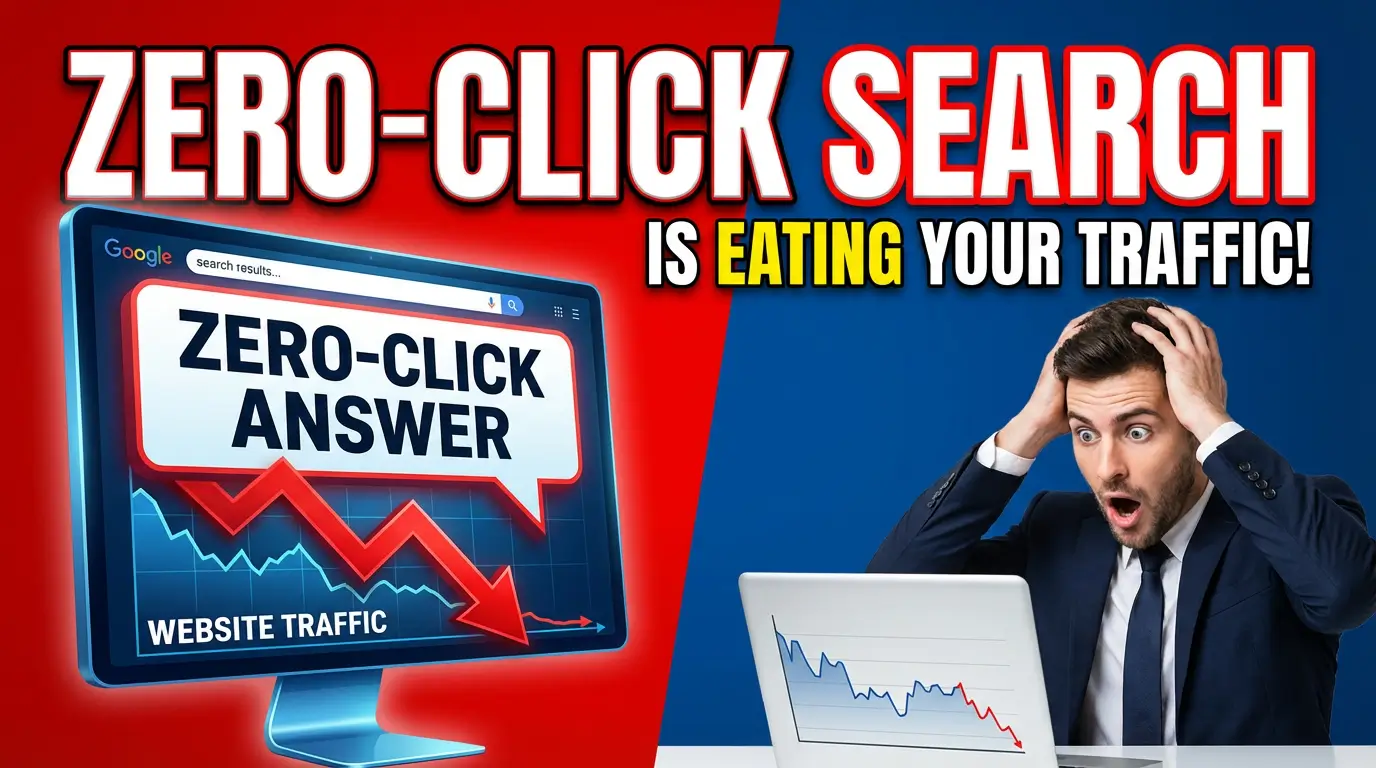
Something strange is happening in Google Search Console dashboards across the country. Impressions are climbing. More people are seeing your content than ever before. But clicks? Clicks are falling off a cliff.
The culprit has a name: zero-click search.
A 2024 study by SparkToro found that 58.5% of Google searches in the U.S. now end without a click to any website. In the E.U., it’s even worse at 59.7%. For every 1,000 searches, only 374 clicks reach the open web.
And it’s getting worse. Google’s AI Overviews, the AI-generated summaries that now appear at the top of results, were triggered on 13.14% of all queries in March 2025, up from 6.49% just two months earlier. That number has only grown since.
If your business depends on organic search traffic, you can’t afford to ignore this shift. But here’s the part most people miss: zero-click doesn’t mean zero opportunity.
What Zero-Click Search Actually Looks Like
When someone Googles “best pizza near me” and picks a restaurant from the local pack without ever visiting a website, that’s a zero-click search. When someone asks “how to remove mold from grout” and gets step-by-step instructions right in the search results, that’s a zero-click search too.
Google has been building toward this for years. Featured snippets, knowledge panels, People Also Ask boxes, local packs, image carousels, and now AI Overviews all serve the same purpose: keep the user on Google.
The Search Engine Journal’s SEO Trends 2026 report calls this the “zero-click search environment” and identifies it as one of the biggest challenges facing businesses this year. Their panel of experts, including Dan Taylor from SALT.agency and the SEJ editorial team, emphasize that gaining visibility now requires strategies that go beyond just ranking for keywords.
For business owners, this creates an uncomfortable question: if Google is answering your customers’ questions before they ever reach your site, what exactly is your website for?
The Answer Is More Important Than You Think
Your website hasn’t become irrelevant. It’s become differently relevant.
Think about it this way. A zero-click search can still expose someone to your brand. If your business appears in an AI Overview, a featured snippet, or a local pack result, you’ve just gotten free advertising to someone with buying intent. They saw your name. They registered your existence. And the next time they need what you sell, there’s a decent chance they’ll come looking for you directly.
SEO professional Ankush Gupta noted this exact pattern in his clients’ Search Console data: “Their impressions kept increasing, but their CTR dropped sharply over the last few months. Google now shows your content inside AI answers. So impressions go up, but clicks go down because users get their answer right there.”
The traffic is shrinking, but the visibility isn’t. That distinction matters.
So the real strategy isn’t to fight zero-click search. It’s to make sure your brand shows up in those zero-click results, and then make your website so compelling that when people do click, they convert.
How to Win Visibility in a Zero-Click World
The traditional SEO playbook, where you write a 2,000-word article targeting a keyword and hope for a top-three ranking, is no longer enough on its own. You need a layered approach.
Structure Your Content for AI Extraction
Google’s AI Overviews pull from pages that provide clear, direct answers. That means your content needs to answer specific questions in a concise format before expanding into deeper context. Use clear headings. Put the answer near the top of the section. Use structured data markup where it makes sense.
Semrush’s research on zero-click strategy describes this as the shift from traditional SEO to “answer engine optimization” (AEO). Traditional SEO targets rankings and clicks. AEO targets citations and brand mentions in AI-generated answers. Your content now needs to work in two contexts: as a resource on your site and as source material that AI engines can reference.
Double Down on Local SEO
Here’s something that works in your favor: local searches are some of the most commercially valuable queries, and local packs are themselves a form of zero-click result where your business can still win. If someone searches “web designer near me” and your company shows up in the local three-pack with 47 five-star reviews, you’ve won the click, or at the very least, a phone call.
BrightLocal’s 2026 Local Consumer Review Survey found that 97% of consumers read reviews for local businesses, and the average consumer checks six different review sites before choosing. Google, Facebook, and (increasingly) AI tools like ChatGPT are the most common platforms for finding local business recommendations. Your Google Business Profile is now a conversion tool, not just a listing.
Build Brand Recognition, Not Just Rankings
When someone sees your brand name in an AI Overview but doesn’t click, you haven’t lost. You’ve planted a seed. The next time that person needs your service, they’re more likely to search your brand directly. Direct brand searches can’t be zero-clicked away from you.
This means investing in things that build name recognition: consistent branding across every platform, reviews that mention your company by name, original research and data that other sites want to cite, and content so distinctive that it’s clearly yours.
Your Website Becomes the Conversion Engine
If fewer people are clicking through from search results, every visit to your site matters more. The math is simple: if you used to get 10,000 organic visits a month and converted 2% of them (200 leads), and now zero-click search has dropped your traffic to 6,000, you need to convert at 3.3% just to break even.
That’s not unreasonable. In fact, it’s a better use of your energy than trying to claw back every lost click.
Portent’s research on site speed and conversions found that a B2B site loading in one second converts at a rate 3x higher than one loading in five seconds. And it’s 5x higher compared to a site loading in ten seconds. Speed alone can dramatically change your conversion math.
Google’s Core Web Vitals provide the specific benchmarks: your Largest Contentful Paint should be under 2.5 seconds, Interaction to Next Paint under 200 milliseconds, and Cumulative Layout Shift below 0.1. These aren’t suggestions. They’re the bar Google has set for a “good” user experience, and they directly affect both your rankings and your ability to convert visitors once they arrive.
So if you’re losing traffic to zero-click search, the move isn’t just to get more traffic. It’s to get more value from the traffic you still have. Better landing pages. Faster load times. Clearer calls to action. Fewer form fields. More trust signals.
The Content Strategy That Still Works
Not all searches are created equal. Informational queries like “what is SEO” are ripe for zero-click answers. Google can handle those in a snippet or AI Overview. But commercial queries, the ones where someone is comparing options, evaluating providers, or getting ready to buy, are harder to answer in a summary box.
The content that still drives clicks tends to be original, detailed, and opinionated. Think case studies with real numbers. Comparison guides that take a clear stance. Tools and calculators that require interaction. Content that’s impossible to summarize in three sentences because the value comes from the depth, the specifics, the real experience behind it.
Generic, surface-level blog posts are exactly the type of content that AI Overviews replace. If Google can rewrite your article in a paragraph, why would anyone click through to read the whole thing?
Write content that can’t be summarized. That’s your moat.
What This Means for Small Business Websites
If you’re a small or mid-sized business, zero-click search can actually level the playing field in unexpected ways. You don’t need a massive content operation to show up in a local pack or get cited in an AI Overview. You need a well-structured site, active review management, and content that answers specific questions your customers actually ask.
Here’s a practical checklist:
- Claim and fully optimize your Google Business Profile. Fill out every field. Post weekly updates. Respond to every review within 24 hours.
- Structure your website content to answer specific questions clearly. Use FAQ sections with proper schema markup.
- Build pages around commercial intent keywords, not just informational ones. “Custom web design for restaurants” beats “what is web design” every time.
The businesses that adapt to zero-click search won’t just survive this shift. They’ll end up with higher-quality traffic and better conversion rates than they had before, because they’ll stop chasing vanity metrics like raw traffic numbers and start focusing on the visits that actually turn into revenue.
What Comes Next
Google isn’t going to reverse course on AI Overviews. If anything, they’ll expand. The zero-click trend will accelerate as more query types get AI-generated answers. Rand Fishkin and the SparkToro team have been tracking this trajectory for years, and every data point suggests we’re only in the early stages.
That’s not doom and gloom. It’s a signal to adapt.
The businesses that win in 2026 and beyond will be the ones that treat their website as a conversion engine rather than a traffic magnet. They’ll invest in brand-building that works across every platform, including inside AI-generated answers. They’ll create content that AI can cite but not replace. And they’ll measure success by leads and revenue, not just pageviews.
If your website isn’t pulling its weight, or if your organic traffic has been quietly declining and you’re not sure why, it might be time to rethink your approach. Get in touch with our team to audit your site’s zero-click readiness and build a strategy that works in this new search reality.

Richard Kastl
Founder & Lead EngineerRichard Kastl has spent 14 years engineering websites that generate revenue. He combines expertise in web development, SEO, digital marketing, and conversion optimization to build sites that make the phone ring. His work has helped generate over $30M in pipeline for clients ranging from industrial manufacturers to SaaS companies.