A lot of small business owners think their Google Business Profile is the finish line.
It isn’t. It’s the handoff.
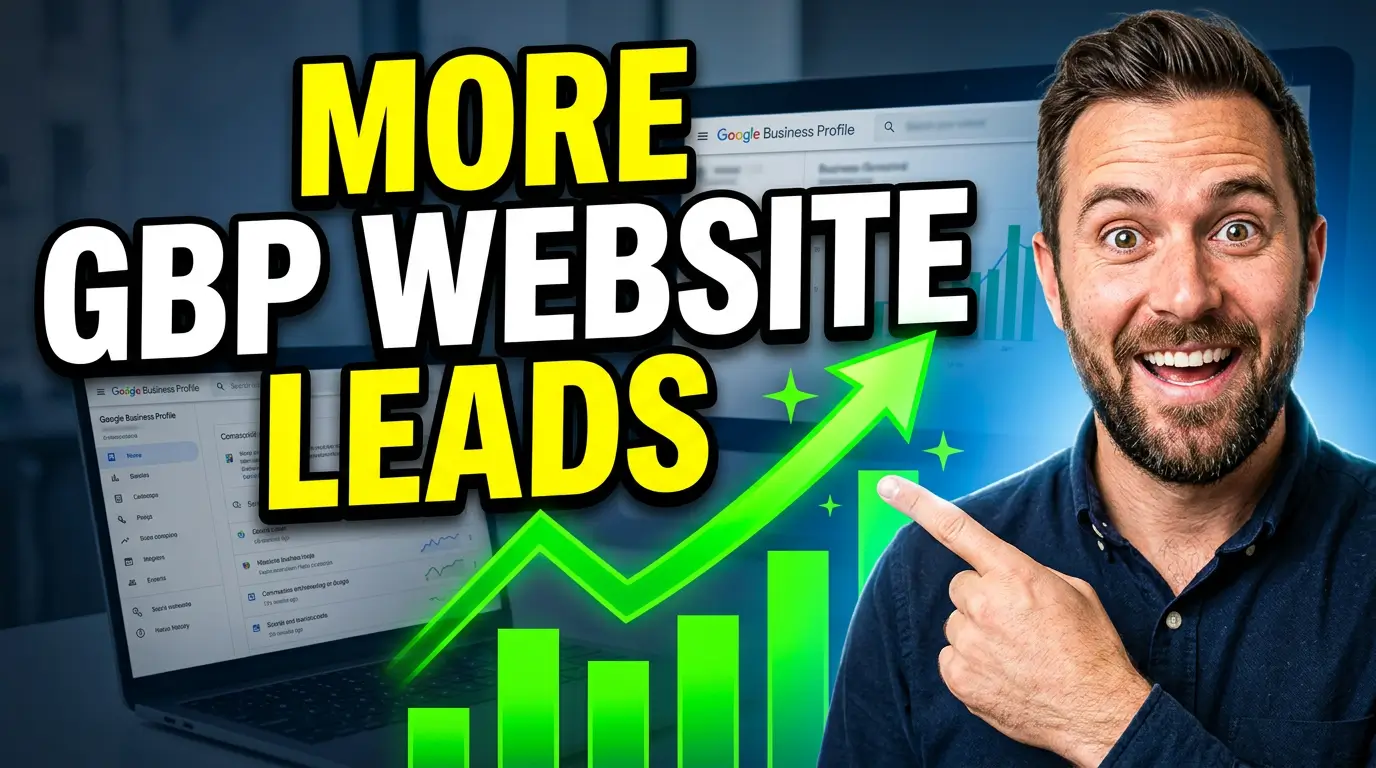
Google defines a Business Profile website click as the moment someone clicks the website link on your profile, and Google tracks that alongside calls, directions, and other interactions in Business Profile performance reporting (Google Business Profile Help). That means you can get visibility in local search and still lose the lead in the next 10 seconds if the page they land on feels generic, slow, thin, or mismatched.
That gap matters more now because local discovery is spread across search, maps, reviews, and AI-assisted search behavior. Google says AI Overviews and AI Mode surface links to help people explore supporting websites, and that the same core SEO fundamentals still apply, including internal links, page experience, text content, and keeping your Business Profile information up to date (Google Search Central). In other words, your profile and your website are now one system.
If you want more leads from local search in 2026, don’t just optimize the listing. Fix the handoff.
1. Send profile traffic to the right page, not always the homepage
Most small businesses still link their Google Business Profile to the homepage. Sometimes that’s fine. Often it’s lazy.
If your profile is ranking because someone searched for a specific service plus a city, the click should usually land on the page that matches that exact intent. A roofing company should not send “emergency roof repair” traffic to a homepage that talks broadly about family-owned service since 1998. A law firm should not send “estate planning attorney” traffic to a generic brand page with six practice areas and no clear next step.
Google’s guidance for AI search says important content should be available in textual form and easily findable through internal links (Google Search Central). I take that as a practical warning for local businesses: if the service page is buried or weak, Google may still show your profile, but your site won’t close the gap once the visitor clicks.
A better setup looks like this:
- Homepage link if you have one location and broad branded demand
- Location page link if people mostly search for your business name plus city
- Service page link if one service clearly drives the bulk of your leads
This is not a set-it-and-forget-it decision. Review your profile search terms and website conversions together, then point traffic where it has the best chance to convert.
2. Make sure your business details match everywhere
This sounds boring. It still costs businesses leads every week.
SOCi’s Consumer Behavior Index recap says its research surveyed more than 1,000 U.S. consumers, and found that 63% had encountered inaccuracies in business listings on major platforms while 47% said inaccurate online information pushed them to choose a competitor instead (SOCi). If your profile says one thing and your website says another, that trust break happens before your sales process even starts.
For a local business, consistency means more than name, address, and phone number. It also includes:
- service area wording
- hours
- booking or contact links
- primary service descriptions
- review signals and recent activity
Google’s own AI search documentation specifically says site owners should make sure Business Profile information is up to date (Google Search Central). So if your profile says you serve Tampa and St. Petersburg, but your site only mentions Tampa, you are making both users and search systems do extra work.
My rule is simple: if a prospect checks your profile, clicks your site, and can’t immediately confirm they are in the right place, you have a leak.
3. Treat review recency like a lead-generation input, not a reputation side project
Reviews do not just help you look credible. They influence whether the next click happens at all.
BrightLocal says its 2025 Local Consumer Review Survey used a representative panel of 1,026 U.S. adult consumers via SurveyMonkey (BrightLocal). In that same study, BrightLocal reports that only 4% of consumers say they never read online business reviews, and it notes that Google remained the top platform consumers use to find reviews (BrightLocal). That is a big reason stale reviews hurt twice: they weaken both ranking potential and click confidence.
Whitespark’s Darren Shaw argues that review recency has become one of the most important local ranking factors in practice, and points to a case study showing rankings dropped when new reviews slowed down and recovered when review flow resumed (Whitespark). Whether you agree with his exact ranking, the lesson is hard to miss. A neglected profile tends to act like a neglected business.
What I recommend:
- Ask for reviews continuously, not in bursts every few months
- Ask soon after the job is done or the customer sees the result
- Build review requests into your normal workflow, not a once-a-quarter scramble
- Respond to reviews so prospects see an active business, not an abandoned listing
If you want more website leads, fresh reviews are part of the input. They help more people trust the click before they ever reach your site.
4. Build a landing page that feels like the exact business they expected
This is where many local SEO wins die.
A person clicking from your profile is usually trying to answer a short list of questions fast: Do you do the exact thing I need? Do you serve my area? Can I trust you? How do I contact you? If the page fails any of those in the first screen or two, the session is probably gone.
Google says pages eligible for AI features must already be indexable and able to appear in normal Search, and that helpful, reliable, people-first content still matters (Google Search Central). For a small business page, that usually means the basics matter more than clever design.
A high-converting local landing page should usually show, above the fold:
- the exact service
- the city or service area
- a trust signal, like review count, certifications, or years in business
- one clear CTA
- a real phone number or form path
Then it should answer the obvious questions without fluff. Show your process. Show proof. Show who you help. Show what happens next.
I would much rather see a plain service page with a strong headline, three tight proof blocks, and a visible CTA than a polished homepage slider with stock photos and vague copy.
5. Tighten the path between profile click and contact action
Google can report website clicks. It cannot fix what happens after the click for you (Google Business Profile Help). That part is yours.
If your site gets profile traffic but not many leads, check the path with no ego:
- Does the page load fast on mobile?
- Is the phone number tap-to-call?
- Is the main CTA visible before a long scroll?
- Does the form ask for too much?
- Does the page say when you’ll respond?
- Is there proof near the CTA, not buried at the bottom?
These are not glamorous fixes. They are revenue fixes.
Google’s documentation says page experience still matters for AI search visibility and supporting links (Google Search Central). That lines up with what we see in the field: people coming from local search are impatient and high intent. If they have to hunt for the phone number, decode your offer, or fill out an eight-field form just to ask a question, many of them will bounce and call the next business.
Small businesses usually do better when they remove friction instead of adding persuasion. Shorter forms. Stronger headlines. Fewer CTA choices. More proof near the point of action.
6. Give searchers a reason to trust you after the click
A Google Business Profile can earn the first bit of trust. Your website has to finish the job.
BrightLocal’s 2025 survey says consumers are happy to read both positive and negative reviews to form their own opinions, and that consumers are looking for facts and objectivity when researching businesses (BrightLocal). That means your website should not feel like pure self-promotion. It should feel verifiable.
Good trust elements include:
- recent reviews pulled from real platforms
- photos of your actual team, shop, office, or completed work
- clear service area details
- licensing or certifications when relevant
- simple expectations around turnaround time, pricing process, or next steps
SOCi’s research also found that consumers use multiple platforms for local research, with Google Search and Google Maps leading the way while social platforms also play a role (SOCi). That means your website is rarely being judged alone. People are comparing what they saw on Google with what they see on your site, your reviews, and sometimes your social presence. Any mismatch creates drag.
The businesses that convert best usually feel consistent everywhere. Same tone. Same offer. Same service area. Same proof.
7. Measure the full handoff, not just profile impressions
Too many businesses celebrate profile visibility and ignore the handoff metrics that actually predict revenue.
Google says Business Profile owners can review views, clicks, and customer interactions across Search and Maps (Google Business Profile Help). That is useful, but by itself it is not enough. You need to compare profile activity with website behavior and actual lead volume.
At minimum, I would track these together every month:
- Business Profile website clicks
- calls from profile and website
- top landing pages for local traffic
- form submissions by landing page
- close rate by service or location page
Once you do that, patterns show up fast. Maybe your profile gets plenty of clicks but your location page has weak trust signals. Maybe one service page converts twice as well as the homepage and should become the primary website link. Maybe your reviews are strong but the site still looks dated and thin.
That is how local SEO gets practical. Not more dashboards. Better handoffs.
FAQ
Should I link my Google Business Profile to my homepage or a service page?
If your demand is mostly branded, the homepage may be fine. If one service or one location drives most local-intent searches, send the click to the page that best matches that intent. Google says important content should be easily findable through internal links and available in text form, which is another reason the destination page needs to be specific and complete (Google Search Central).
Do fresh reviews really affect local SEO and lead generation?
They can affect both. BrightLocal’s 2025 review survey says review behavior still plays a major role in how consumers research businesses online (BrightLocal). Whitespark also points to case-study evidence that rankings improved with a steady flow of new reviews and slipped when review activity stopped (Whitespark).
What is the biggest mistake small businesses make after a profile click?
Usually, it’s sending people to a generic page that does not match the searcher’s intent. If someone clicked because they wanted one specific service in one specific area, a vague homepage often wastes that intent. Your site needs to confirm the match fast, prove trust fast, and make contact easy.
Your Google Business Profile can create the opportunity. Your website still has to close it.
If you want help tightening that handoff, improving your local landing pages, and turning more search traffic into leads, talk with Your Web Team.

Richard Kastl
Founder & Lead EngineerRichard Kastl has spent 14 years engineering websites that generate revenue. He combines expertise in web development, SEO, digital marketing, and conversion optimization to build sites that make the phone ring. His work has helped generate over $30M in pipeline for clients ranging from industrial manufacturers to SaaS companies.