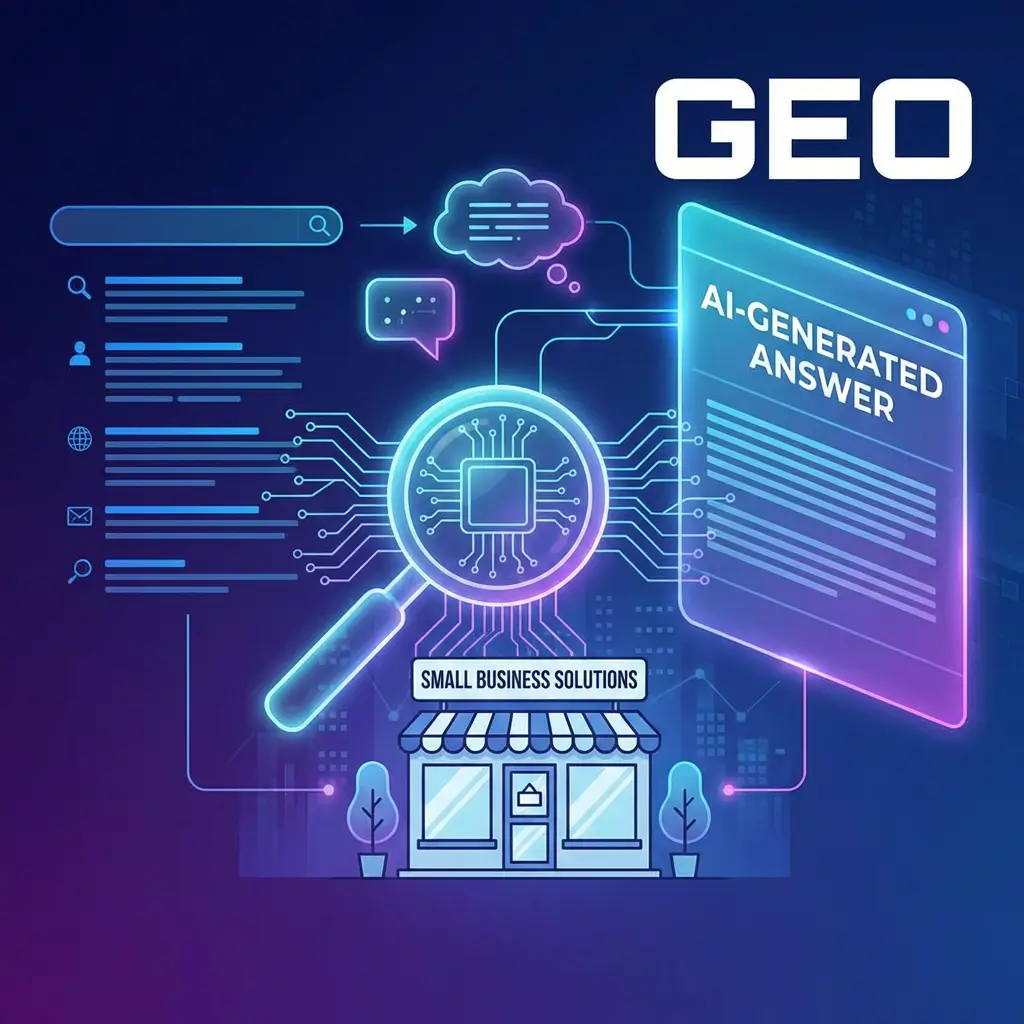
Your customers aren’t just Googling anymore. They’re asking ChatGPT, Perplexity, and Google’s own AI features for recommendations — and getting direct answers instead of a list of links.
If your business isn’t showing up in those AI-generated responses, you’re invisible to a growing segment of your audience.
This shift has given rise to Generative Engine Optimization (GEO) — the practice of making your brand and content easy for AI systems to find, understand, and cite. And while it might sound like something only enterprise companies need to worry about, small businesses actually have a significant advantage here.
Let’s break down what GEO is, why it matters right now, and exactly how to start implementing it — even on a tight budget.
What Is Generative Engine Optimization?
GEO is the process of positioning your content so that AI-powered platforms — like ChatGPT, Google AI Overviews, Perplexity, and Google’s Gemini — cite, reference, or recommend your business when users ask questions.
Unlike traditional SEO, where the goal is to rank on a search results page and earn a click, GEO focuses on getting your brand mentioned directly in AI-generated answers.
Here’s the practical difference:
- Traditional SEO: “Here are 10 web designers near you” → User clicks your listing → Visits your website.
- GEO: “Based on reviews and expertise, these are the top web designers in your area…” → Your business is mentioned with key details → User becomes aware of you, even without clicking.
Both matter. But as AI-driven search grows, businesses that ignore GEO risk losing visibility to competitors who don’t.
Why GEO Matters Right Now
The numbers tell the story. ChatGPT now reaches over 800 million weekly users, and Google’s AI Overviews are appearing in at least 16% of all searches — significantly higher for comparison and high-intent queries.
According to WordStream’s analysis, AI Overviews triggered on 794 of the top 1,000 “What is” queries by the end of 2025, up from just 312 at the start of that year. That’s a 154% increase in less than 12 months.
Meanwhile, research from GWI found that 31% of Gen Z users already turn to AI platforms as their primary way to find information online. And Semrush predicts that LLM traffic will surpass traditional Google search by the end of 2027.
For small businesses, the message is clear: the window to establish your presence in AI search is open right now. Early movers will have a significant advantage as the space becomes more competitive.
But Don’t Abandon Traditional SEO
Here’s the important nuance: GEO is not a replacement for SEO. It’s an extension of it.
Studies show that websites currently generate roughly 34x more traffic from traditional search engines than from AI chatbots. Traditional SEO is still the primary driver of high-intent traffic.
However, AI referral traffic to small business websites increased by 123% in recent months, according to Search Engine Land. The trajectory is undeniable.
The smart strategy? Do both. If you’re already doing SEO well, you’re most of the way to effective GEO.
How GEO Differs from Traditional SEO
According to Search Engine Land’s comprehensive GEO guide, the core principles behind effective SEO still apply to GEO. You still need quality content, technical accessibility, and credible trust signals.
What changes is how you apply those principles:
1. Where You Need Presence
Traditional SEO focuses on your website and blog. GEO benefits from strategic presence across platforms where AI tools discover information:
- Reddit threads where your target audience asks questions
- YouTube videos demonstrating your expertise
- Industry publications establishing your authority
- Review sites where customers discuss your services
- Social platforms where relevant conversations happen
AI systems don’t just crawl your website. They pull from across the internet to build answers. The more consistently your brand appears across trusted platforms, the more likely you are to be cited.
2. How You Structure Content
AI systems extract specific passages from your content to construct answers. They pull a paragraph here, a statistic there, and weave them together.
This means your content structure needs to shift:
- Make paragraphs self-contained. Each key point should make sense on its own, without requiring the surrounding context.
- Use clear, descriptive headings. AI systems use headings to identify which section answers which question.
- Put answers early in sections. Don’t bury the lead — AI extracts content that directly and immediately addresses a query.
- Include specific facts, numbers, and definitions. AI systems prefer concrete, citable information over vague commentary.
3. What You Measure
Traditional SEO metrics like rankings and clicks still matter. But GEO introduces new measurements, as Moz’s Chima Mmeje explains:
- AI visibility score: How often your brand appears in AI-generated answers
- LLM citation depth: How near the top you appear in AI citations (position matters here, just like in traditional search)
- Branded demand: Increases in branded search, direct traffic, and branded impressions — signals that AI mentions are driving awareness
- Session quality signals: What users do after they reach your site from an AI referral
As Mmeje notes, LLMs function more as an influence channel than a pure traffic channel. Tracking branded demand helps you see the full picture.
7 Practical GEO Strategies for Small Businesses
Here’s where we get tactical. These are steps you can implement this month, without a dedicated GEO team or a massive budget.
1. Build Entity Clusters, Not Just Keyword Pages
Entity clusters are the 2026 evolution of topic clusters. Instead of building content around individual keywords, you build interconnected content around entities — your brand, your services, your expertise areas.
According to Moz, the key is mapping content to buyer intent stages:
- Awareness: Educational content about problems you solve
- Comparison: “Best of” and alternatives content
- Evaluation: Case studies, detailed service pages
- Decision: Pricing, testimonials, contact information
Link these pages together with clear internal linking. This helps AI systems understand the relationships between your content and builds the entity authority that drives GEO citations.
2. Optimize Your Schema Markup
Structured data is one of the most powerful — and underused — tools for GEO. Schema markup helps AI systems understand exactly what your content means, not just what it says.
Priority schema types for small businesses:
- LocalBusiness — Your name, address, phone number, hours, service area
- FAQPage — Frequently asked questions with clear answers
- HowTo — Step-by-step processes
- Review/AggregateRating — Customer ratings and reviews
- Service — Descriptions of what you offer
- Person — Author/expert credentials
Use Google’s Structured Data Testing Tool to validate your markup. Every piece of structured data makes your content more extractable for AI systems.
3. Create FAQ Content That AI Can Extract
FAQ pages are GEO gold. When someone asks an AI assistant a question, the AI looks for content that directly answers that question in a clear, concise format.
Create FAQ pages for:
- Your core services (“How much does web design cost for a small business?”)
- Your industry (“What’s the difference between SEO and GEO?”)
- Your location (“Who is the best [service] in [city]?”)
Format each Q&A so the answer paragraph works as a standalone response. That’s what AI systems will extract and cite.
4. Dominate Your Google Business Profile
For local businesses, your Google Business Profile is arguably the most important GEO asset you have. AI systems — including Google’s own — heavily weight GBP data for local queries.
Optimize by:
- Completing every field (services, products, attributes, business description)
- Posting weekly updates with relevant content
- Responding to every review (positive and negative)
- Adding photos regularly
- Using the Q&A feature to pre-answer common questions
According to HubSpot’s GEO guide for small businesses, NAP (Name, Address, Phone) consistency across your web presence is critical. AI systems cross-reference multiple sources to verify business information. Inconsistencies reduce your chances of being cited.
5. Earn Reviews and Mentions Across Platforms
AI systems evaluate your credibility partly based on what others say about you across the web. This makes reviews and third-party mentions more valuable than ever.
Focus on:
- Google Reviews — Still the most impactful for local GEO
- Industry-specific review sites — Clutch, G2, Yelp, or whatever’s relevant to your niche
- Reddit mentions — AI systems heavily reference Reddit discussions
- Social media mentions — Consistent positive mentions build entity authority
Don’t game this. Genuine reviews and organic mentions carry far more weight with AI systems than manufactured ones.
6. Publish Content with Citable Statistics and Original Data
AI systems love concrete, citable information. If your content includes original research, specific statistics, or unique data points, you’re far more likely to be cited.
Ways to create citable content:
- Run a customer survey and publish the results
- Aggregate publicly available data for your industry or local market
- Document case studies with specific metrics (e.g., “We increased organic traffic by 215% in 6 months”)
- Create definitive guides with clear, factual statements
Every statistic or finding should link to its source — this builds the credibility signals AI systems look for.
7. Ensure AI Crawlers Can Access Your Content
Technical accessibility matters for GEO just as much as for traditional SEO. Make sure:
- Your
robots.txtdoesn’t block AI crawlers (check for GPTBot, ClaudeBot, PerplexityBot, and others) - Your pages load quickly — AI systems may deprioritize slow-loading content
- Your site uses clean HTML with proper heading hierarchy
- Your content isn’t locked behind login walls, heavy JavaScript, or interstitials
Review your server logs to see which AI crawlers are visiting your site and whether they’re successfully accessing your content.
What to Measure: GEO Metrics That Matter
Tracking GEO performance requires expanding your measurement toolkit beyond traditional SEO metrics. Here’s what to monitor:
| Metric | What It Tells You | How to Track |
|---|---|---|
| AI referral traffic | Direct visits from AI platforms | Google Analytics (check referral sources for chat.openai.com, perplexity.ai, etc.) |
| Branded search volume | Whether AI mentions drive brand awareness | Google Search Console |
| Direct traffic trends | Increases from AI-driven discovery | Google Analytics |
| Citation monitoring | Whether AI tools mention your brand | Manually query ChatGPT, Perplexity, and Google AI with relevant prompts |
| Review sentiment | How your online reputation appears to AI | Monitor Google Reviews, Yelp, Reddit |
HubSpot’s State of Marketing 2026 found that over 92% of marketers are already optimizing for both traditional and AI-powered search. If you’re not measuring your AI visibility, you’re flying blind while your competitors adapt.
Common GEO Mistakes to Avoid
As WordStream warns, bad GEO advice is running rampant. Here are the pitfalls to watch for:
- Abandoning SEO for GEO. Traditional search still drives 34x more traffic than AI chatbots. Do both.
- Stuffing content with AI-bait phrases. Writing “As an AI, I recommend…” or similar tricks doesn’t work. AI systems evaluate content quality, not keyword tricks.
- Ignoring your existing audience. GEO should enhance your content, not make it robotic. Write for humans first, then optimize structure for AI extraction.
- Spamming Reddit and review sites. AI systems — and the platforms themselves — are getting better at detecting manufactured mentions. Focus on genuine participation.
- Expecting overnight results. Like traditional SEO, GEO is a long-term strategy. Most businesses see initial results within 4-8 weeks, with compounding returns over time.
Your GEO Action Plan: Start This Week
You don’t need to overhaul everything at once. Here’s a prioritized action plan:
Week 1: Audit your Google Business Profile for completeness and NAP consistency. Add FAQPage schema to your most important service pages.
Week 2: Rewrite your top 3 service page introductions to be self-contained, fact-rich paragraphs that work as standalone answers.
Week 3: Check your robots.txt to ensure AI crawlers aren’t blocked. Set up tracking for AI referral sources in Google Analytics.
Week 4: Create one comprehensive FAQ page targeting the top 10 questions your customers ask. Add proper schema markup.
Ongoing: Encourage customer reviews, publish content with specific data points, and participate genuinely in community discussions where your audience spends time.
The Bottom Line
Generative Engine Optimization isn’t a completely new discipline. It’s the natural evolution of the SEO work you’re likely already doing. The businesses that adapt their content strategy now — making it more structured, more citable, and more visible across multiple platforms — will have a significant head start as AI search continues to grow.
The good news? Small businesses often have an advantage here. You can move faster than big companies, you have authentic customer relationships that generate genuine reviews, and you can dominate local and niche queries that larger competitors overlook.
Don’t wait until AI search becomes the default. Start optimizing today.
Ready to make sure your business shows up in AI search? Get in touch with us to audit your current visibility and build a GEO strategy that works alongside your existing SEO efforts.

Richard Kastl
Founder & Lead EngineerRichard Kastl has spent 14 years engineering websites that generate revenue. He combines expertise in web development, SEO, digital marketing, and conversion optimization to build sites that make the phone ring. His work has helped generate over $30M in pipeline for clients ranging from industrial manufacturers to SaaS companies.