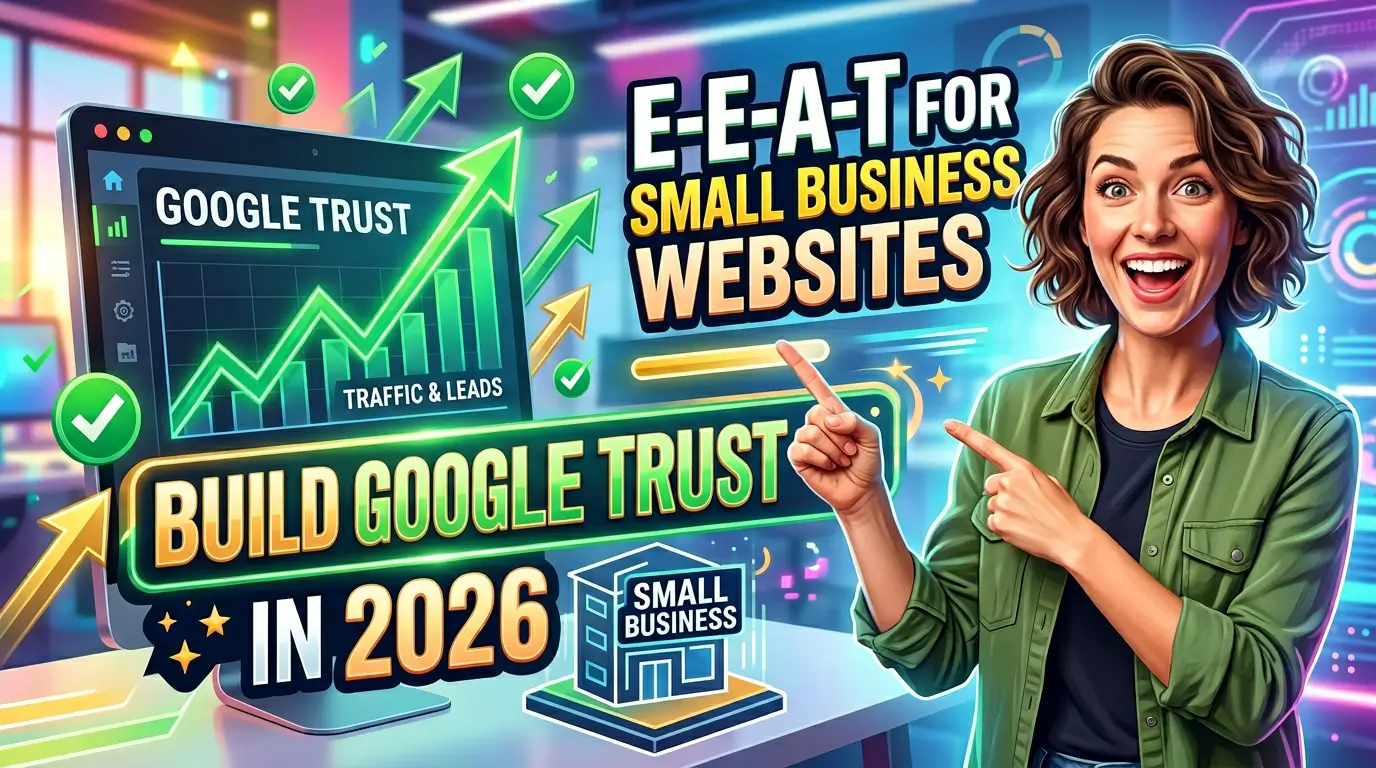
If your website traffic dropped after March 2026, you’re not alone. Google’s March 2026 core update hit generic, impersonal content hard — and rewarded something a lot of small businesses already have but rarely show: real experience.
According to Digital Applied’s analysis, 68% of sites with strong E-E-A-T signals gained rankings after that update. Meanwhile, 41% of sites producing mostly AI-generated content with no firsthand proof lost organic traffic. The gap between those two groups comes down to one framework: E-E-A-T.
For small businesses, this is good news. You’ve spent years building actual expertise in your field. The problem is your website probably doesn’t show it.
What Is E-E-A-T?
E-E-A-T stands for Experience, Expertise, Authoritativeness, and Trustworthiness. It’s the framework Google’s Quality Raters use to evaluate whether content is worth ranking — and it directly influences how your pages perform.
It started as E-A-T back in 2014. Google added the first “E” for Experience in December 2022, recognizing that someone who has actually done the thing produces better content than someone who just researched it. Google’s Search Quality Rater Guidelines make this explicit.
E-E-A-T isn’t a single ranking factor you can toggle. It’s a collection of signals that help Google answer: Who made this? Do they know what they’re talking about? Can I trust them?
Here’s a quick breakdown of each component before we get into what you actually need to do:
- Experience — Have you personally done this? Firsthand knowledge beats research every time.
- Expertise — Do you demonstrate real depth? Credentials, track record, accurate details.
- Authoritativeness — Do others recognize you? Mentions, links, citations from credible sources.
- Trustworthiness — Can people verify who you are? Transparency about your business, contact info, policies.
A 2024 SEMrush study found pages with strong E-E-A-T signals had a 30% higher chance of ranking in the top 3 positions compared to pages with weak signals. That was before March 2026 sharpened those requirements further.
Experience: Prove You’ve Actually Done the Work
This is where most small business websites fail, and it’s the one most within your control to fix.
Think about your typical service page. It probably says something like: “We provide professional [service] tailored to your business needs.” That tells Google nothing. It tells your visitors nothing either.
What would prove experience? Real projects. Actual numbers. Before-and-after results. The client whose problem you solved and what you did to solve it.
A plumbing company that writes about fixing a specific type of pipe corrosion they encountered three times in older Chicago homes is demonstrating experience. A landscaper who shares photos of an actual drainage project they completed — with notes on the soil conditions and what went wrong at first — is demonstrating experience. Generic “we take pride in our work” copy does not.
CodeGuys UK summarizes it well: “Ask yourself: does the page simply describe what you do, or does it prove you have done it?”
Practical ways to show experience on your website:
- Real project photos (not stock images)
- Specific case studies with client names, problems, and results
- Behind-the-scenes process explanations that only someone who’s done the work would know
- Data from your own jobs: timelines, outcomes, complications you worked through
Digital Applied notes that sites recovering from the March 2026 update averaged just 12 days to regain rankings once they added proper experience signals. That’s fast — because the content itself becomes the signal.
Expertise: Show That You Know Your Field
Expertise is about depth and accuracy. Google doesn’t need you to have a PhD. It needs to see that you understand your topic well enough to be genuinely helpful.
For a small business, expertise shows up in several places:
Author bios matter more than you think. Digital Applied’s data shows author bios have a 3x impact on page authority compared to pages without them. If your blog posts don’t have a byline and a short bio, fix that today. It doesn’t need to be formal — something like “Richard has been building Webflow sites for 8 years and has worked with 200+ small businesses” is enough.
Use specific, accurate language. Generic copy signals generic content. A page about HVAC installation that mentions specific BTU calculations, regional code requirements, and brand-specific considerations reads as expertise. A page that says “we do all types of heating and cooling” does not.
Cite your sources. Every claim you make that uses data or research should link to where it came from. This isn’t just good practice — it’s a trust signal that tells Google you’re not making things up.
Authoritativeness: Get Others to Vouch for You
You can’t manufacture this one with on-page edits. Authoritativeness comes from what other credible sources say about you. But small businesses have more paths here than they often use.
Local press and mentions. Getting quoted in a local news article, a neighborhood Facebook group, or a regional business publication builds authoritativeness signals. It doesn’t have to be the Wall Street Journal.
Industry directories and associations. Being listed on the Better Business Bureau, your local Chamber of Commerce website, industry trade associations, or licensed contractor databases sends signals that you’re a real, recognized business in your field.
Guest content. Writing an article for an industry publication or a local business blog gets you a link from an authoritative source. One genuinely useful piece for the right publication is worth more than dozens of mediocre directory listings.
Customer reviews on third-party platforms. Google Reviews, Yelp, industry-specific review sites — these are external signals that real customers have validated your business. A steady flow of detailed, specific reviews (not just “great service!”) reinforces authority.
T-Ranks notes that in 2026, E-E-A-T signals don’t just influence Google rankings — they affect whether AI tools like ChatGPT and Perplexity cite your business when someone asks a relevant question. That’s becoming a second visibility channel worth caring about.
Trustworthiness: The Foundation That Everything Else Sits On
Trust is the one E-E-A-T component where technical details actually matter. Google is looking for proof that your business is real and transparent.
The basics that many small business websites still get wrong:
Secure, functional site. An HTTPS certificate isn’t optional. Broken links, outdated copyright dates, and 404 errors signal neglect, and neglect signals low trustworthiness.
Clear contact information. A physical address (even a service area), a phone number, a real email address — not just a contact form. The easier it is to reach you, the more Google trusts you.
Transparent policies. A privacy policy that reflects how you actually handle data. Clear service terms. A refund or guarantee policy if relevant. These aren’t legal formalities — they’re trust signals.
About page with real people. Your about page is one of the highest-trust pages on your site. Show the faces behind the business. Name the owner. Explain why you started. This is information only a real business can provide.
Consistent NAP across the web. Name, Address, Phone number should be identical on your website, Google Business Profile, social media, and any directory listings. Inconsistency signals unreliability.
Where Most Small Business Websites Fall Short
Here’s what a quick audit of most small business sites reveals:
- Service pages that describe the service but show no proof of having delivered it
- Blog posts with no author attribution
- About pages that say “we are a team of passionate professionals” with no names or faces
- No case studies or real client results anywhere on the site
- All photos are stock images
- Contact page has only a form with no address or phone number
None of these are expensive to fix. They’re mostly content and structural decisions that get overlooked because owners focus on getting the site live and move on.
What to Fix First
You don’t need to overhaul your entire site. Start with the highest-traffic pages and work from there.
On service pages: Add at least one real project example. A photo, a brief description of the challenge, and the outcome. Two or three paragraphs is enough.
On your blog: Add author bios to every post. Even if it’s just you, write two to three sentences describing your experience and link to your about page.
On your about page: Replace stock headshots with real photos. Name the people in your business. Include how long you’ve been doing this and what you’ve delivered.
Across the site: Make your phone number and address visible in your header or footer. Update your copyright year. Fix any broken links.
On an ongoing basis: Publish content about things you’ve actually done. A project recap. A problem you solved. A client result. Real content beats generic informational posts every time.
A site that does these things consistently will, over time, look very different from a site full of generic AI-generated content — and Google is getting better at telling the difference.
FAQ
Does E-E-A-T apply to every type of small business? Yes. While Google scrutinizes health, finance, and legal content most closely (these are “Your Money Your Life” categories), E-E-A-T signals matter for every business competing for organic search traffic. Local service businesses, e-commerce stores, consultants, and agencies all benefit from stronger trust signals.
Can AI-generated content hurt my E-E-A-T? Generic, impersonal AI content with no firsthand context can hurt your rankings — that’s what the March 2026 update targeted. AI tools used to help a human expert produce content faster are fine. The problem is content that sounds authoritative but provides no actual firsthand proof or insight.
How long does it take to see results after improving E-E-A-T? According to Digital Applied’s post-update analysis, sites that added experience signals recovered rankings in about 12 days on average. Results vary by industry and competition, but meaningful improvements are usually visible within four to eight weeks.
Is E-E-A-T a direct ranking factor? Google has stated E-E-A-T itself isn’t a direct algorithmic signal, but the signals that demonstrate E-E-A-T — author bios, backlinks, structured data, reviews, content depth — absolutely are. It’s a framework for thinking about trustworthiness, not a checkbox.
What’s the single most impactful change I can make today? Add real project examples with photos and outcomes to your top-performing service pages. That single change addresses the Experience component most directly and is what the March 2026 update rewarded most clearly.
If your website is working against your E-E-A-T instead of supporting it, we can help you fix that. We build websites designed to rank and convert — with the trust signals built in from the start. Get started here.

Richard Kastl
Founder & Lead EngineerRichard Kastl has spent 14 years engineering websites that generate revenue. He combines expertise in web development, SEO, digital marketing, and conversion optimization to build sites that make the phone ring. His work has helped generate over $30M in pipeline for clients ranging from industrial manufacturers to SaaS companies.