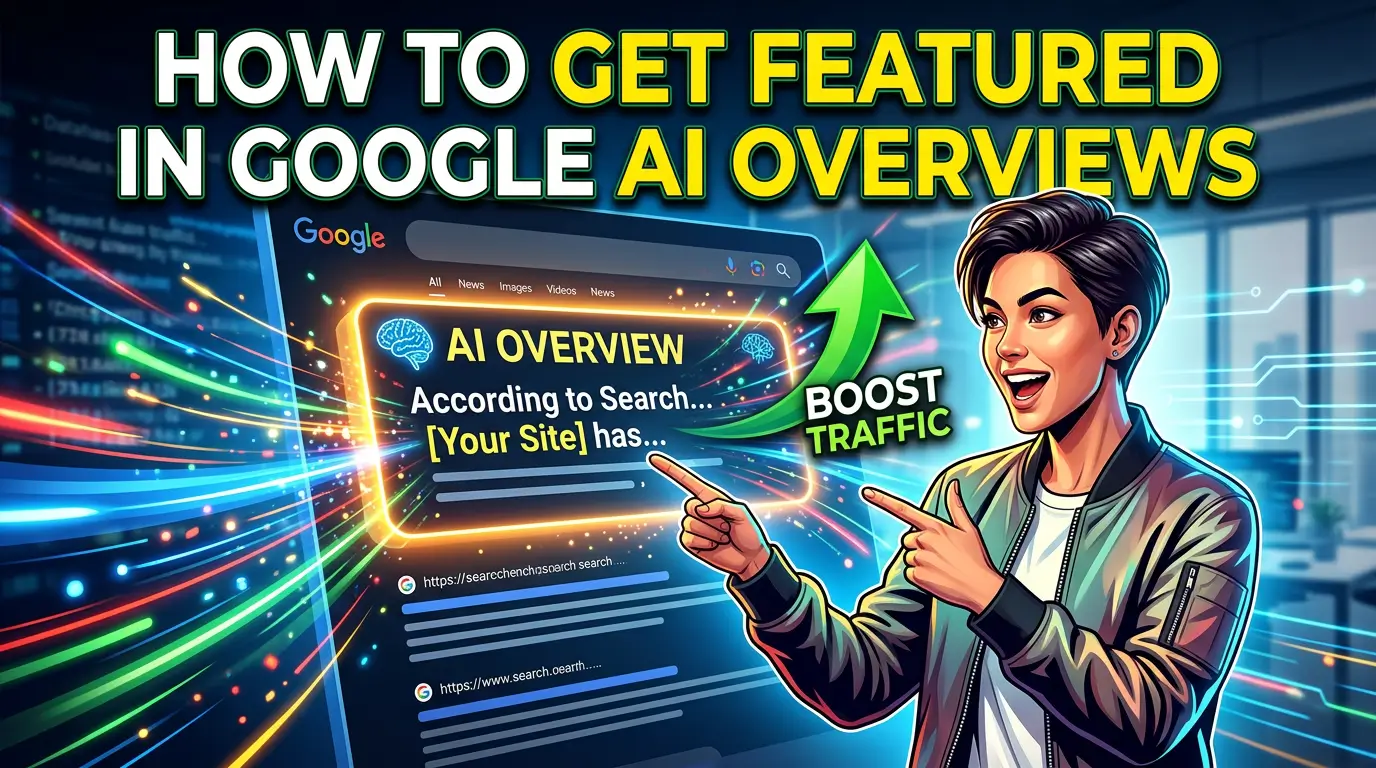
A customer searches Google for “best HVAC company near me” or “how do I choose a plumber.” Before they even see a list of websites, they get a confident, AI-generated answer — citing a few trusted sources right at the top of the page.
That’s Google’s AI Overview. And if your small business isn’t one of those cited sources, you’re invisible to a growing chunk of your market.
Google AI Overviews now appear in over 50% of search results, up dramatically from a year ago. According to WordStream’s analysis of search data, 794 of the top 1,000 “What is” queries triggered AI Overviews in December 2025 — compared to just 312 in January 2025. The trend is only accelerating.
The good news? You don’t need to be ranking #1 to get featured. Studies show that 48% of AI Overview citations come from pages outside the top 10. Google’s AI evaluates content quality and relevance independently of traditional rank. That’s an enormous opening for small businesses willing to optimize the right way.
This guide breaks down exactly how to get your business into those AI-generated answers — and why it matters even if no one clicks.
Why AI Overviews Matter Even When No One Clicks
Here’s a stat that should grab your attention: 92% of users who see AI summaries never click through to a website.
Sounds alarming — until you flip your thinking.
If Google’s AI cites your business as the answer to a question, your brand name appears in front of a highly motivated searcher right at the top of the page. That’s brand exposure you’d normally pay a lot to get. When that person is ready to hire someone — tomorrow, next week, next month — they’ll remember the business Google already vouched for.
This is a visibility game, not just a click game. And for local businesses in particular, appearing in AI-cited results and the map pack builds awareness even without direct click-throughs. The brands that get cited consistently will compound authority over time.
AI referral traffic is also growing fast. AI-referred sessions to small business websites jumped 527% in 2025, and AI traffic to SMB websites increased 123% in just a few months. This isn’t a future trend — it’s happening now.
Step 1: Answer Questions Directly and Concisely
Google’s AI doesn’t quote walls of text. It pulls short, clear answers that directly address a specific question.
Research recommends writing 50-70 word direct answer summaries near the top of each page or section. Here’s the formula:
- Lead with the answer, not the backstory
- Use plain language a non-expert would understand
- Keep sentences short and declarative
- Follow the direct answer with supporting detail
Example: Instead of starting a page with “At ABC Plumbing, we’ve been serving the Denver metro area for over 20 years…” — start with “Emergency plumbers in Denver typically cost $150–$300 for after-hours calls. Here’s what affects the price and how to choose the right company.”
That second version is what AI Overviews want. The first version is what every competitor is writing.
Do this on your service pages, your FAQ page, and any blog posts where you’re answering a specific question.
Step 2: Add FAQ Schema Markup to Your Key Pages
This is probably the single highest-leverage technical change you can make right now.
Pages with FAQPage schema markup are 3.2x more likely to appear in Google AI Overviews. Another study found pages with FAQ schema are 60% more likely to be featured compared to pages without any structured data.
FAQ schema tells Google’s AI exactly which questions your page answers — and what the answers are. It’s machine-readable context that makes your content dramatically easier for AI systems to cite.
Here’s how to add it to any page:
{
  "@context": "https://schema.org",
  "@type": "FAQPage",
  "mainEntity": [{
    "@type": "Question",
    "name": "How much does a website redesign cost for a small business?",
    "acceptedAnswer": {
      "@type": "Answer",
      "text": "A professional website redesign for a small business typically costs between $3,000 and $15,000 depending on the scope, number of pages, and features required."
    }
  }]
}
Add this as a JSON-LD script block to the <head> of your pages, or use a plugin (like Yoast or RankMath for WordPress) to generate it automatically.
Target the questions your customers actually ask. Not keyword-stuffed phrases — real questions. Things like “How long does it take to…”, “What’s the difference between X and Y”, “Do I need a permit to…”
Single Grain recommends layering multiple schema types — FAQ, HowTo, Article, and Organization — to maximize AI visibility across different query types.
Step 3: Build E-E-A-T Signals Throughout Your Site
E-E-A-T stands for Experience, Expertise, Authoritativeness, and Trustworthiness — Google’s framework for evaluating content quality. It’s more important than ever for AI Overviews, because Google’s AI prioritizes sources that demonstrate credible, hands-on knowledge.
Here’s what that looks like in practice for a small business:
Experience: Include real case studies, before/after results, photos from actual jobs, and specific outcomes (“We helped a Denver bakery increase online orders by 40% in 3 months”). Generic content gets skipped.
Expertise: Write content that demonstrates you know your craft at a deep level. Don’t just explain what a service is — explain the nuances, the trade-offs, the things people get wrong.
Authoritativeness: Get mentioned (and linked to) by other reputable sites. Local press, industry directories, partnerships with suppliers, guest posts on trade blogs. Each citation builds domain authority.
Trustworthiness: Keep your NAP (Name, Address, Phone) consistent everywhere online. Publish reviews prominently. Include a physical address, business hours, and real team photos. HubSpot’s GEO guide emphasizes NAP consistency and Google Business Profile optimization as foundational GEO tactics.
One quick win: add author bios to your blog posts. A short bio that mentions credentials (“15+ years in residential HVAC” or “Certified Financial Planner”) signals human expertise that AI systems value.
Step 4: Target Question-Based Queries
Question-based queries trigger Google AI Overviews 99.2% of the time. Broad navigational queries (“best plumber Denver”) trigger them far less often.
This is a content strategy shift. Instead of writing blog posts optimized for short-tail keywords, focus on the specific questions your customers are typing into Google:
- “How do I know if my roof needs replacing?”
- “What’s included in a basic accounting package for small businesses?”
- “How long does a bathroom remodel take?”
- “Is it worth hiring a web designer or should I use Wix?”
Each of these is a potential AI Overview trigger. Each is an opportunity to be cited as the authoritative answer.
Use Google’s “People Also Ask” boxes as a content calendar. Every question in PAA is a potential AI Overview target. Answer them thoroughly but concisely on your site, using the 50-70 word direct answer format described above.
Step 5: Optimize Your Google Business Profile
For local service businesses, your Google Business Profile is AI bait.
Google’s AI pulls heavily from Business Profile data when answering local queries — your services list, your Q&A section, your reviews, and your posts. HubSpot identifies GBP optimization as one of the top GEO tactics for local businesses because it’s directly machine-readable structured data.
Specific things to do right now:
- Fill out every field completely — services, description, hours, attributes, website
- Add services with descriptions — write 150-200 word descriptions for each service using natural question-answer language
- Answer every question in Q&A — proactively add questions and answers yourself if customers haven’t asked yet
- Post weekly — fresh content signals active business and improves GBP authority
- Respond to every review — especially negative ones; response quality is a trust signal
Step 6: Create Content That’s Easy for AI to Parse
AI systems are essentially very sophisticated readers. They prefer content that’s well-organized, clearly labeled, and logically structured.
Some practical formatting upgrades:
- Use descriptive H2s and H3s that match actual questions (“How Much Does X Cost?” not “Pricing”)
- Use bullet points and numbered lists for multi-step processes — AI cites these frequently
- Keep paragraphs short (2-4 sentences max) with one idea per paragraph
- Define terms and abbreviations the first time you use them
- Include data and statistics with source links — AI systems value empirical claims backed by evidence
Content that reads like a textbook or a legal brief doesn’t get cited. Content that reads like a knowledgeable friend explaining something clearly and directly? That’s what AI picks up.
What Not to Do
A few common mistakes that will actively hurt your AI Overview visibility:
Don’t stuff keywords. Google’s AI evaluates semantic meaning, not keyword density. Over-optimized content reads as low-quality.
Don’t hide your answers. Some sites bury the answer deep in the content to keep people reading longer. AI systems see this as low-quality. Lead with the answer.
Don’t publish thin content. A 300-word service page with no real information signals low expertise. Depth matters.
Don’t ignore schema markup. Sites without proper structured data could lose up to 60% of their AI visibility as AI search expands. This is no longer optional.
The Small Business Advantage You’re Not Using
Here’s what’s underappreciated: small businesses have a structural advantage over large companies when it comes to local and niche AI queries.
A national company can’t write content that says “here’s exactly what it costs to hire a plumber in Boulder, Colorado in 2026 and here’s what to watch out for with older pipes in that area.” You can. That hyper-local, experience-based specificity is exactly what Google’s AI craves — and what your big-brand competitors can’t match.
74% of small businesses already invest in SEO. The ones winning in AI Overviews aren’t spending more — they’re spending smarter, focusing on content quality, structured data, and genuine expertise rather than outdated keyword tactics.
The window to establish yourself as the go-to cited source in your niche and market is open right now. Waiting means your competitor fills that slot first.
Ready to Show Up Where It Counts?
Getting into Google’s AI Overviews isn’t about gaming an algorithm. It’s about creating genuinely helpful, well-structured content that demonstrates you know your craft — and making it easy for Google’s AI to find, parse, and trust.
If your website isn’t set up to compete in this new AI-first search landscape — or if you’re not sure where you stand — that’s exactly what we help small businesses figure out.
Get a free website strategy session and we’ll show you exactly what’s holding your site back from AI visibility, and what to do about it.

Richard Kastl
Founder & Lead EngineerRichard Kastl has spent 14 years engineering websites that generate revenue. He combines expertise in web development, SEO, digital marketing, and conversion optimization to build sites that make the phone ring. His work has helped generate over $30M in pipeline for clients ranging from industrial manufacturers to SaaS companies.