Your newest customer knows something your analytics cannot tell you: why they trusted you enough to buy.
Pageviews show where people went. Conversion reports show what they did. Neither explains which sentence settled a concern, which competitor nearly won, or what almost stopped the sale. A short post-purchase survey can fill those gaps while the decision is still fresh.
The key word is short. Do not turn an order confirmation into unpaid market research. Ask one to three questions after checkout, booking, or contract signing. Rotate questions over time, then look for repeated language you can use to improve your website and sales process.
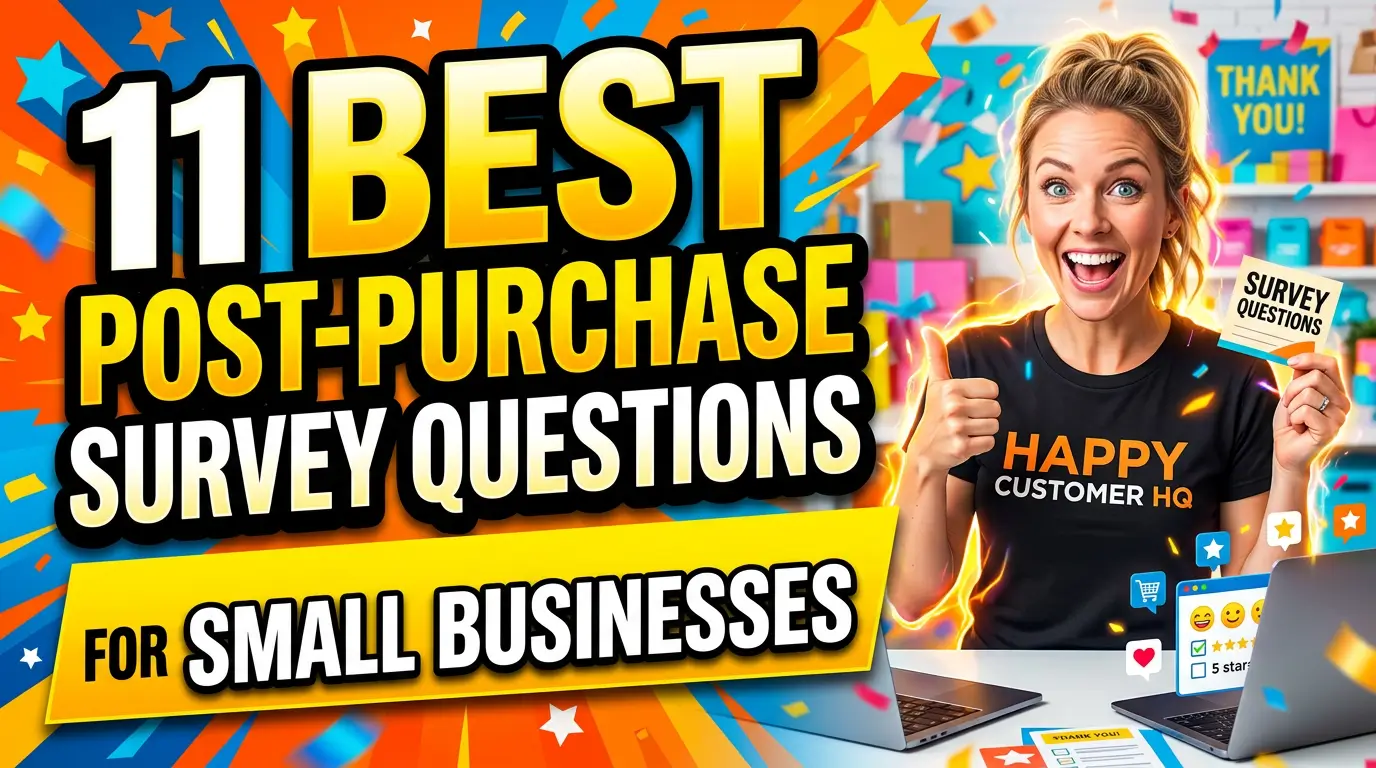
Here are 11 useful questions, plus what to do with the answers.
1. What nearly stopped you from buying?
This question finds the objection your website failed to resolve. Answers often point to price uncertainty, delivery times, confusing options, missing proof, an unclear guarantee, or concern about what happens after payment.
Ask it as an open text question. Do not lead customers with a list unless response volume is too high to review manually. Their exact wording is the valuable part.
For example, an HVAC company may hear, “I could not tell whether the diagnostic fee went toward the repair.” That answer should not sit in a spreadsheet. Put the policy beside the booking button and in the service FAQ. A software company might learn that buyers worried about importing old data, which is a clear reason to add a migration section to its pricing page.
Baymard Institute’s checkout research groups common abandonment reasons such as extra costs, forced account creation, and slow delivery. Your customers can tell you which version is happening on your site.
2. What made you choose us instead of another option?
Most businesses describe their differentiators from the inside. Customers describe them from the buying side. That distinction matters.
A plumbing company may think its advantage is 30 years in business, while new customers repeatedly mention the two-hour arrival window. A manufacturer may promote its equipment, but buyers choose it because an engineer answered a technical question before quoting. Those are stronger homepage messages because they reflect an actual decision.
Keep a running count of repeated answers. When one reason appears often, test it in your headline, ad copy, sales emails, and proposal. If nobody mentions a claim your homepage treats as important, it may be background information rather than a deciding factor.
3. Where did you first hear about us?
Analytics attribution breaks easily when a customer changes devices, blocks tracking, clicks an untagged link, or spends weeks researching before buying. A self-reported answer adds the human version of the journey and complements the patterns explained in our guide to marketing attribution models for small businesses.
Use a short multiple-choice list with options such as Google search, Google Maps, referral, social media, event, podcast, email, and “other.” Follow “other” with a text box. Keep the wording broad enough that customers recognize the source.
Imagine a roofing company’s reports credit paid search for a signed project, but the customer says a neighbor’s yard sign introduced the brand. Both facts are useful. The sign created awareness and search closed the gap. That can change how the company evaluates offline marketing.
Google Analytics documents the limits of attribution and how models assign credit. Self-reported attribution does not replace analytics, but it gives you evidence the tracking model cannot see.
4. What information did you look for before deciding?
This question shows what buyers consider essential. Common answers include price ranges, turnaround time, service area, compatibility, financing, credentials, return terms, case studies, and examples of finished work.
Compare the responses with what is easy to find on your website. If customers wanted pricing but had to call for it, consider publishing a starting range or explaining the factors that change cost. If they searched for certifications, place them near the claim they support instead of burying them in the footer.
A commercial cleaning company might learn that prospects wanted to know whether crews work after business hours. One clear sentence on the service page could remove that uncertainty for every future visitor.
5. Was anything on our website confusing?
Do not ask whether the website was “easy to use.” Many customers will say yes and move on. Asking what was confusing makes the question specific without assuming there was a problem.
Confusion may come from industry terms, similar service packages, inconsistent prices, an unfamiliar checkout field, or a button whose label does not match the next page. Sort responses by page and issue, then fix patterns before isolated preferences.
For example, a landscaping company may call one service “property enhancement” while customers search for “yard cleanup.” That is not only a copy problem. It affects navigation, search visibility, and how quickly a visitor recognizes the right offer.
Pair survey comments with recordings from Microsoft Clarity to see what happened on the page. A comment tells you what felt confusing. A recording can show repeated clicks, backtracking, or hesitation around the same element. Our Microsoft Clarity guide for small businesses explains how to turn those signals into practical website fixes.
6. Which page or detail helped you feel confident?
Businesses often cut or redesign pages without knowing which ones help close sales. This question identifies the proof customers actually used.
Answers might name a case study, staff biography, warranty explanation, comparison table, review, portfolio photo, process page, or detailed product specification. Protect those assets during a redesign. Then make them easier for similar buyers to find.
A remodeling contractor may discover that a page explaining dust control and daily cleanup mattered more than the photo gallery. That operational detail reduces a homeowner’s perceived risk. It belongs on relevant service pages, proposals, and pre-sale emails.
7. Did you consider another company or solution?
This is competitor research from people who reached the finish line. Make the question optional and avoid asking customers to justify their choice twice.
The answer may name a direct competitor, but it may also reveal a substitute. A bookkeeping firm competes with other firms, accounting software, a part-time hire, and doing nothing. A custom fabricator may compete with an off-the-shelf part or an internal workaround. Your comparison content should address the alternatives buyers actually consider.
If one competitor appears repeatedly, compare public facts such as service model, turnaround, minimum order, support, or contract terms. Do not create a cheap attack page. Build an honest comparison that helps the right buyer decide.
For example, a web agency learning that prospects also considered DIY builders could publish a clear “builder versus custom site” decision guide with cost, time, ownership, and maintenance tradeoffs.
8. How long did it take you to decide?
Offer useful ranges that fit the purchase: today, two to seven days, one to four weeks, one to three months, and longer than three months. The right ranges for a restaurant order will be different from those for industrial equipment.
Decision time helps you plan follow-up. If most buyers take three weeks, a three-email sequence sent in two days is too compressed. If emergency service customers decide in 20 minutes, a callback tomorrow is too late.
Longer decisions usually need materials customers can revisit and share, such as comparisons, case studies, technical documents, financing details, and implementation plans. A commercial insurance broker might learn that owners take six weeks because several partners review the proposal. A one-page summary built for internal sharing could shorten that process.
9. Who else was involved in the decision?
Many websites speak to one visitor even when several people influence the purchase. This question tells you whose concerns your content must answer.
A marketing manager may shortlist an agency, but the owner wants cost and revenue impact, finance wants payment terms, and IT wants security details. If the website only speaks to the marketer, the internal sale becomes harder.
Use broad answer choices such as spouse or partner, owner, manager, finance, technical team, procurement, and “I decided alone.” For a local home service, a spouse may be the missing audience. For B2B work, an operations manager or purchasing lead may be critical.
10. What would have made the decision easier?
This question asks customers to design the missing shortcut. It can uncover needs that no complaint would reveal.
You may hear “a price calculator,” “more photos of jobs like mine,” “a sample report,” “the ability to book online,” or “a simple explanation of the first 30 days.” Rank suggestions by frequency, effect on qualified sales, and effort. Do not build every requested feature.
For example, a payroll consultant may get repeated requests for a checklist of records needed for onboarding. Publishing that checklist can reduce uncertainty before the sale and reduce administrative work afterward. An ecommerce seller may learn that a dimension diagram would be more useful than another lifestyle photo.
11. What is one thing you would tell someone considering us?
This final question captures customer language before it gets polished into corporate copy. It can reveal the result, reassurance, or warning that future buyers most need to hear.
With permission, strong answers can become testimonials. Ask separately whether you may publish the quote, name, company, and photo. Do not hide consent inside the survey terms. If you need a clean follow-up process, adapt one of these testimonial request templates for small businesses.
A managed IT client might write, “They explained the risk without trying to scare us.” That sentence says more about the buying experience than “excellent service.” A bakery customer might mention reliable delivery rather than taste, showing what matters for corporate orders.
The U.S. Federal Trade Commission’s endorsement guidance says endorsements must reflect honest opinions and must not be misleading. Keep the customer’s meaning intact when editing for length or grammar.
How to use the answers
Review responses monthly and tag each one by issue, page, audience, and buying stage. Look for patterns across sales calls, support tickets, and lost-deal notes. Then assign a specific change with an owner and date.
Start with fixes that remove uncertainty close to the sale: unclear pricing, missing delivery details, weak proof, hidden policies, and broken handoffs. Measure whether the change reduces repetitive questions or improves qualified conversions.
A post-purchase survey should feel like a quick conversation, not homework. Ask fewer questions, act on the answers, and tell customers when their feedback produced a useful change.
If your website leaves buyers with questions your team keeps answering by hand, talk to YourWebTeam. We can turn those answers into a clearer, more effective sales path.