If your SEO strategy still revolves around stuffing individual keywords into individual pages, you’re playing a game that ended two years ago. Search engines — and the AI systems now built on top of them — have moved on. They don’t just match keywords anymore. They evaluate whether your website actually understands a topic.
That shift has a name, and it’s reshaping how small businesses compete online: topic clusters.
In this guide, we’ll break down exactly what topic clusters are, why they’ve become the dominant SEO strategy in 2026, and how you can implement them on your small business website — even if you’re starting from scratch.
Why Keywords Alone Are Dead
Let’s start with the uncomfortable truth. A study analyzing over 250,000 search results found that topical authority is now the strongest on-page ranking factor, surpassing even domain traffic. Meanwhile, another analysis of over 1,500 Google search results found no consistent correlation between keyword density and ranking.
What happened? Google’s algorithms — powered by natural language processing and machine learning — now understand context, intent, and the relationships between ideas. They don’t need you to repeat “best plumber in Dallas” seventeen times. They need you to demonstrate that you genuinely understand plumbing, home services, and the problems your customers face.
And it’s not just Google. Over 92% of marketers now align their SEO strategies with both traditional and AI-supported search engines like ChatGPT, Gemini, and Perplexity. With AI Overviews reaching 2 billion monthly users and 60% of searches now yielding zero clicks, the old playbook of ranking one page for one keyword is increasingly irrelevant.
The new playbook? Build topical depth. And the best framework for doing that is the topic cluster model.
What Is a Topic Cluster?
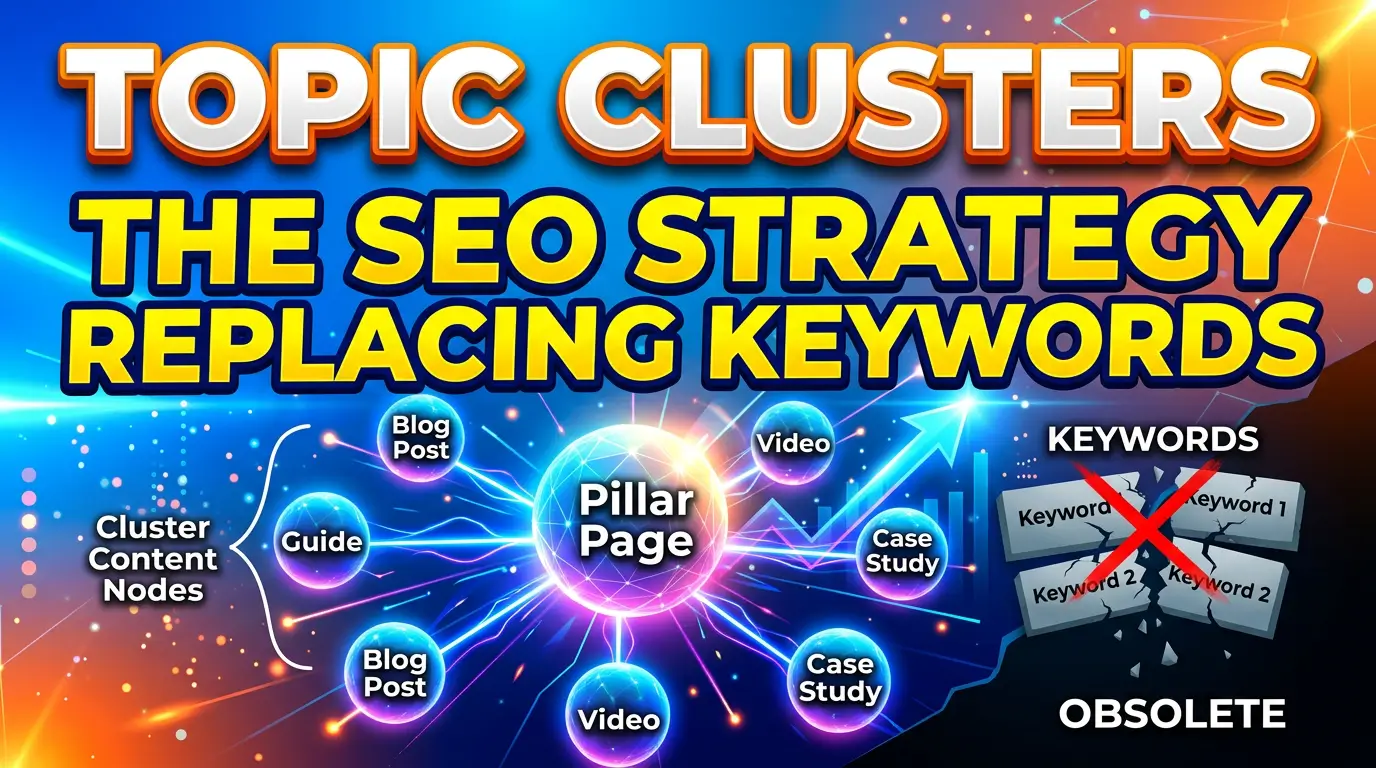
A topic cluster is a content structure where multiple related pages are organized around one central topic to build clear topical authority. It has three components:
1. The Pillar Page
This is your comprehensive, authoritative resource on a broad topic. Think of it as the “hub.” It typically runs 2,500 to 4,000 words and covers the subject at a high level, linking out to more detailed supporting content.
Example: “The Complete Guide to Local SEO for Small Businesses”
2. Cluster Pages
These are focused articles (800–1,500 words each) that dive deep into specific subtopics related to your pillar. Each one addresses a distinct question or angle.
Examples:
- “How to Optimize Your Google Business Profile”
- “Local Citation Building: A Step-by-Step Guide”
- “How Online Reviews Impact Local Search Rankings”
- “NAP Consistency: Why Your Business Info Must Match Everywhere”
3. Strategic Internal Links
Every cluster page links back to the pillar page, and the pillar page links out to every cluster page. This creates a web of semantic relationships that search engines and AI systems use to understand your site’s authority on a subject.
This isn’t just theory. According to HubSpot’s research, websites that implement topic clusters see an average increase of 43% in organic traffic compared to those that don’t. One e-commerce company using HubSpot’s topic cluster strategy grew organic blog traffic from 500 visitors per month to nearly 190,000 — a 37,900% increase.
Why Topic Clusters Matter Even More in 2026
Three major shifts make topic clusters essential right now:
AI Search Demands Topical Authority
Google’s AI Mode, ChatGPT, and other LLMs don’t just look at individual pages. They evaluate whether a website has comprehensive, interconnected coverage of a subject. As Moz’s 2026 SEO predictions report explains, SEO is evolving into “relevance engineering” — brands must build content ecosystems that demonstrate deep expertise across interconnected topics.
When an AI system needs to cite a source for an answer about local SEO, it’s more likely to reference a site that has a pillar page, twelve supporting articles, and clear internal linking — not a site with one thin blog post that happens to contain the right keyword.
Zero-Click Search Is Growing
With 60% of searches producing no clicks and only 8% of users clicking a traditional link when an AI summary appears, your content needs to serve double duty. Topic clusters help because:
- Pillar pages are more likely to be cited in AI Overviews and featured snippets due to their comprehensive coverage
- Cluster pages capture long-tail queries that AI summaries can’t fully answer, driving clicks from users who need more depth
- Internal linking passes authority across your entire cluster, improving rankings for all related pages
Third-Party Signals Are Expanding
According to Backlinko’s 2026 SEO analysis, third-party signals are now an SEO priority. LLMs pull from dozens of sources to compose answers. Topic clusters naturally generate more backlink opportunities because you’re creating more comprehensive, linkable content on related subjects — giving journalists, bloggers, and other sites more reasons to reference your work.
How to Build Topic Clusters for Your Small Business (Step by Step)
Here’s the practical playbook:
Step 1: Identify 3–5 Core Topics
Start with the main services or products your business offers. These become your pillar topics.
For a web design agency:
- Web Design
- SEO
- Website Performance
- Digital Marketing for Small Business
For a local plumber:
- Residential Plumbing
- Water Heater Services
- Drain Cleaning
- Bathroom Remodeling
Don’t pick too many. Three to five pillars is the sweet spot for small businesses. You want depth, not breadth.
Step 2: Map Subtopics With Search Intent
For each pillar, brainstorm 8–15 subtopics that your customers actually search for. Use tools like Google’s “People Also Ask,” Answer the Public, or even ChatGPT to generate ideas.
Critically, group subtopics by search intent:
- Informational: “What causes low water pressure?” (blog post)
- Commercial: “Best tankless water heaters 2026” (comparison guide)
- Transactional: “Water heater installation near me” (service page)
Covering all intent types within a cluster signals comprehensive authority to search engines.
Step 3: Create Your Pillar Page First
Your pillar page should:
- Cover the broad topic comprehensively (2,500–4,000 words)
- Include a table of contents for easy navigation
- Link to every cluster page (even ones you haven’t written yet — use placeholder links)
- Include a clear call-to-action
- Use headers that match common search queries
Pro tip: Don’t try to rank the pillar page for ultra-competitive short-tail keywords right away. Its primary job is to serve as the authoritative hub that lifts all cluster pages.
Step 4: Write Cluster Pages Strategically
Create each cluster page with these rules:
- One subtopic per page. Don’t try to cover multiple subtopics in one article.
- Link back to the pillar page naturally within the first few paragraphs.
- Link to 2–3 other cluster pages in the same topic cluster.
- Go deeper than the pillar page on your specific subtopic.
- Match the search intent. If users searching this query want a how-to guide, don’t give them a sales pitch.
Step 5: Build Your Internal Linking Structure
This is where most small businesses drop the ball. Your internal linking should be:
- Bidirectional: Pillar links to clusters, clusters link to pillar
- Contextual: Links should appear naturally within the content, not in a random list at the bottom
- Descriptive: Use anchor text that describes what the linked page is about (not “click here”)
A well-linked cluster creates what SEO experts call a “content ecosystem” — interconnected assets that reinforce each other’s authority and help search engines understand the relationships between your pages.
Step 6: Publish on a Schedule
Don’t publish everything at once. A sustainable cadence for small businesses:
- Week 1: Publish the pillar page
- Weeks 2–6: Publish one cluster page per week
- Ongoing: Add new cluster pages monthly as you identify new subtopics
This consistent publishing signals to search engines that your site is active and continuously building expertise.
A Real-World Example: Topic Cluster for a Small Business Website
Let’s say you run a small marketing agency. Here’s what a complete topic cluster might look like:
Pillar Page: “The Complete Guide to Small Business SEO”
Cluster Pages:
- “Google Business Profile Optimization: A Step-by-Step Guide”
- “How to Do Keyword Research for Local Businesses”
- “On-Page SEO Checklist for Small Business Websites”
- “Link Building Strategies That Actually Work for Small Businesses”
- “How to Track SEO Results: Metrics That Matter”
- “Mobile SEO: Why Your Site Must Be Mobile-First”
- “Schema Markup for Small Businesses: A Beginner’s Guide”
- “Content Marketing vs. SEO: How They Work Together”
- “How Long Does SEO Take? Realistic Timelines for Small Businesses”
- “DIY SEO vs. Hiring an Agency: What’s Right for You?”
Each cluster page links back to the pillar. The pillar links to all cluster pages. And cluster pages link to each other where it makes sense (e.g., the keyword research article links to the on-page SEO checklist).
The result? When Google or an AI system evaluates your site’s authority on “small business SEO,” it finds not one page, but an interconnected hub of ten detailed resources — all reinforcing each other.
Common Mistakes to Avoid
1. Creating Clusters That Are Too Broad
“Digital marketing” is too broad for a single cluster. Break it down: SEO is one cluster, social media marketing is another, email marketing is a third. Each needs its own pillar page and dedicated cluster content.
2. Ignoring Search Intent
A cluster page targeting “how much does SEO cost” should provide pricing information and comparisons — not a hard sales pitch. Match the format to what users actually want.
3. Weak Internal Linking
If your cluster pages don’t link back to the pillar (and vice versa), you’re not building a cluster — you’re just writing disconnected blog posts. The links are the strategy.
4. Never Updating Your Content
Topic clusters aren’t “set it and forget it.” Refresh your pillar page quarterly. Update cluster pages when new data emerges. Add new cluster pages as you discover gaps. 71% of potential customers start their research with a search engine — make sure they find current, accurate information when they land on your site.
5. Skipping the Measurement
Track performance at the cluster level, not just page by page. Monitor:
- Total organic traffic across all pages in the cluster
- Average rankings for cluster-related keywords
- Internal link click-through rates
- Conversions attributed to cluster pages
How Topic Clusters Future-Proof Your SEO
The beauty of topic clusters is that they align with every major direction search is heading:
- AI search? Topic clusters demonstrate the topical depth AI systems need to cite your content.
- Voice search? Cluster pages targeting conversational, question-based queries naturally capture voice searches.
- Zero-click results? Comprehensive pillar pages are more likely to be featured in AI Overviews and knowledge panels.
- LLM traffic? Traffic from LLMs rose 527% year over year according to the Previsible AI Traffic Report. Sites with clear topical authority are the ones getting cited.
No matter how search evolves, demonstrating genuine expertise through organized, interconnected content will remain valuable. That’s what topic clusters deliver.
Start Building Your First Topic Cluster Today
You don’t need to overhaul your entire website overnight. Start with one topic cluster:
- Pick your most important service or product
- Write a comprehensive pillar page
- Identify 8–10 supporting subtopics
- Publish one cluster page per week
- Link everything together strategically
Within three to six months, you’ll see that cluster climbing in search results — not just one page, but the entire group lifting together.
Need help building a topic cluster strategy that drives real leads? At Your Web Team, we build websites and content strategies designed to generate measurable results for small businesses. Get started today and let’s build your first topic cluster together.

Richard Kastl
Founder & Lead EngineerRichard Kastl has spent 14 years engineering websites that generate revenue. He combines expertise in web development, SEO, digital marketing, and conversion optimization to build sites that make the phone ring. His work has helped generate over $30M in pipeline for clients ranging from industrial manufacturers to SaaS companies.