Most visitors land on your website and immediately ask the same silent question: “Can I trust these people?”
They don’t know you. They haven’t worked with you. And they’ve probably been burned by a bad hire before. So before they ever fill out your contact form, they’re scanning your site for proof that you’re the real deal.
That’s what social proof is — evidence from other people that you’re worth trusting. And the data is hard to ignore: displaying customer reviews can increase conversion rates by up to 270% compared to having no reviews at all. Adding testimonials to a landing page alone lifts conversions by an average of 34%.
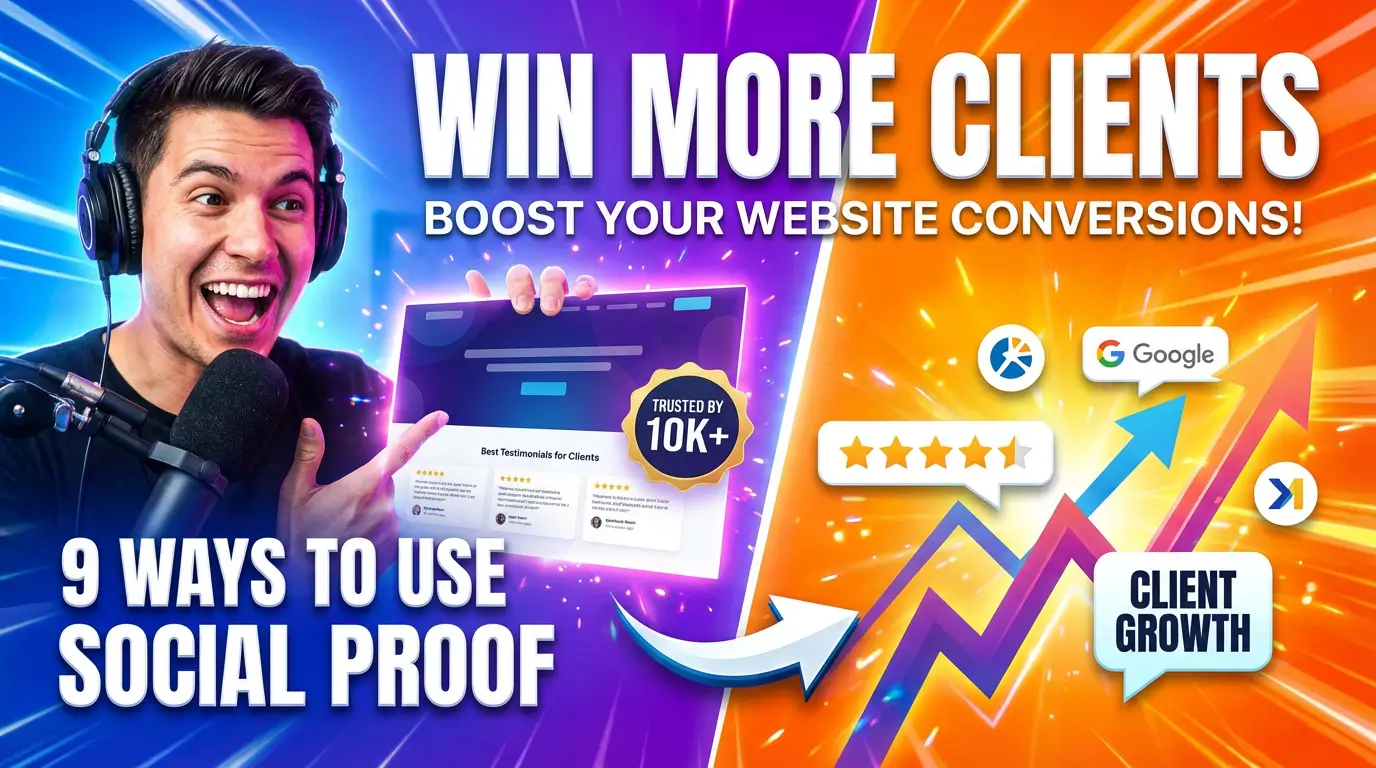
The question isn’t whether social proof works. It’s whether your website is using it well. Here are nine ways to do it right.
1. Customer Testimonials With Full Names and Photos
The most common mistake with testimonials? They’re generic, vague, and anonymous. “Great service!” — J.S. tells a visitor absolutely nothing.
A high-converting testimonial includes:
- A full name (not just initials)
- A photo of the real person
- Their company or role, if applicable
- A specific result or problem solved — not just a compliment
Instead of “They did a great job on our website,” aim for “After YourWebTeam redesigned our site, our monthly leads doubled within 60 days — and we finally stopped losing people to competitors.”
That specificity is what makes a reader think: That’s exactly my problem. These people can help me. Place your best testimonials near your calls to action, not buried at the bottom of a “Reviews” page no one clicks. For more on building pages that convert, see our list of landing page fixes that increase conversions.
2. Video Testimonials
If written testimonials are good, video testimonials are exceptional.
Video testimonials increase conversion rates by 80% compared to text-only reviews. Why? Because video is harder to fake. A real person, on camera, talking about real results carries far more emotional weight than a quote in a gray box.
You don’t need a film crew. A 60-second phone video recorded by a happy client — authentic, unscripted — outperforms a polished agency-style production in most tests. Send your best clients a quick email asking them to record a short video on their phone answering: “What was your situation before working with us, and what changed?”
Embed these on your homepage, service pages, and anywhere you’re asking visitors to take a next step.
3. Case Studies With Real Numbers
A case study is a testimonial with proof attached. It tells the full story: the client’s problem, what you did, and the specific results — with numbers.
“We increased traffic by 40%” is good. “We rebuilt Acme Plumbing’s website in six weeks, and within 90 days they went from 12 leads per month to 34 — a 183% increase, without spending a dollar more on ads” is what closes deals.
Case studies are especially powerful for B2B and service businesses where the sales cycle is longer and the stakes are higher. Even two or three well-written case studies, linked from your service pages, can dramatically reduce the friction in your sales process. Platforms like Notion or your own blog make it easy to publish and link to these.
4. Google Review Widgets
Your Google reviews are some of the most trusted social proof on the internet — because Google makes them very hard to fake and everyone knows it. For a complete strategy on collecting, managing, and responding to reviews, see our Google reviews guide for small businesses.
The problem is most businesses collect 30 five-star reviews and then hide them behind a link that nobody clicks. Instead, embed a live Google review widget directly on your homepage and your contact page.
Tools like Elfsight and EmbedReviews let you display your reviews dynamically in minutes, with automatic updates as new reviews come in. This way, every new visitor sees real, current proof — right on your site — without you lifting a finger.
5. Client Logos (“Trusted By” Section)
A row of recognizable client logos is one of the fastest credibility shortcuts on the web. Even if a visitor doesn’t recognize every name, the implied message — “real businesses have trusted these people” — registers instantly.
For B2B service providers, a “Trusted By” or “Clients We’ve Worked With” section can increase conversion rates by 20–35%. Place it prominently on your homepage — typically just below the hero section — to establish credibility within the first scroll.
If you’re newer and don’t have well-known clients yet, local brands still count. A dental office logo, a regional contractor, a known local restaurant — they’re real, and they signal that actual businesses have paid you to do real work.
6. Trust Badges and Certifications
Security and certification badges reduce the psychological risk of reaching out or making a purchase. Adding a prominent trust badge has been shown to boost conversions by 42% on average.
Relevant trust badges for web service businesses include:
- Google Partner badge (if applicable)
- BBB Accreditation
- SSL security indicator near contact forms
- Industry certifications or association memberships
- Award badges (like Clutch “Top Agency” or Expertise.com)
One important rule: only display badges you’ve genuinely earned. A badge without a real backing organization will be spotted by savvy buyers and will do more harm than good. Authenticity is everything with trust signals.
7. Real-Time Social Proof Notifications
You’ve seen those little pop-up notifications: “Sarah from Austin just booked a consultation — 4 minutes ago.” That’s real-time social proof, and it works by triggering FOMO and the bandwagon effect simultaneously.
Real-time activity notifications can boost conversions by up to 98%, though results vary heavily based on implementation. Tools like ProveSource and TrustPulse make it easy to add live notifications tied to real form submissions, purchases, or bookings.
For service businesses, even low-volume activity — one or two leads per day — can be displayed this way to signal that people are actively choosing to contact you. Keep the language honest and tied to real actions, not fabricated data.
8. Press Mentions and “As Seen In”
Third-party media validation is among the most powerful credibility signals available. Being mentioned in a trade publication, local business journal, or industry blog tells visitors that someone outside your company — with a reputation to protect — thought you were worth covering.
If you’ve earned any press mentions, create an “As Seen In” section with the outlet’s logo and a link to the article. Even a single mention in a respected local publication can shift how a visitor perceives your authority.
If you haven’t been featured anywhere yet, consider pitching a local business publication or contributing a guest article to an industry site. Tools like HARO (Help a Reporter Out) — now part of Connectively — connect you with journalists looking for expert sources. Getting quoted in an article gives you a legitimate “As Seen In” badge.
9. Social Media Feed Embeds and User-Generated Content
Embedding your Instagram, LinkedIn, or Facebook feed on your website shows two things at once: that you’re active, and that real people are engaging with your brand publicly.
A dead social media presence is a trust killer. But a live feed showing recent posts, comments, and shares signals ongoing credibility. Tools like Smash Balloon make it easy to embed clean, customizable social feeds without slowing down your site.
For service businesses, LinkedIn is often the highest-ROI platform to feature. A feed showing client shoutouts, project highlights, and industry expertise — visible right on your website — reinforces every other piece of social proof you’ve placed.
The Social Proof Audit: Where Does Your Site Stand?
Here’s a quick self-check. For each item, give yourself a point:
- ✅ You have at least 5 testimonials with full names and photos
- ✅ You have at least one video testimonial
- ✅ You have a published case study with real numbers
- ✅ Your Google reviews are embedded on your site
- ✅ You display a “Trusted By” logo section
- ✅ You show at least one legitimate trust badge
- ✅ You have a press mention or award displayed
- ✅ Your contact page has testimonials near the form
If you scored 5 or below, your website is likely costing you clients who would have said yes — if only they’d had enough reason to trust you first.
Your Website Should Do the Selling For You
Social proof isn’t a design element. It’s a sales tool. When used strategically, it answers your prospect’s biggest objections before they ever have a chance to voice them — and it keeps working 24 hours a day, 7 days a week, without a salesperson in the room.
If you’re not sure how your current site stacks up, start with our complete website redesign checklist to see where you stand overall. And if you want a team that builds social proof architecture into every project from day one — let’s talk. We’ll audit what you have, identify what’s missing, and help you build a website that converts skeptics into clients.

Richard Kastl
Founder & Lead EngineerRichard Kastl has spent 14 years engineering websites that generate revenue. He combines expertise in web development, SEO, digital marketing, and conversion optimization to build sites that make the phone ring. His work has helped generate over $30M in pipeline for clients ranging from industrial manufacturers to SaaS companies.