A small business can do a lot right in Google and still lose visibility.
That’s because your customers are no longer searching in one place.
They check Google. They scan Google Business Profile reviews. They ask ChatGPT for options. They watch a YouTube explainer. They compare businesses on Facebook, Yelp, Reddit, or Maps. Then they come back later and search your brand directly.
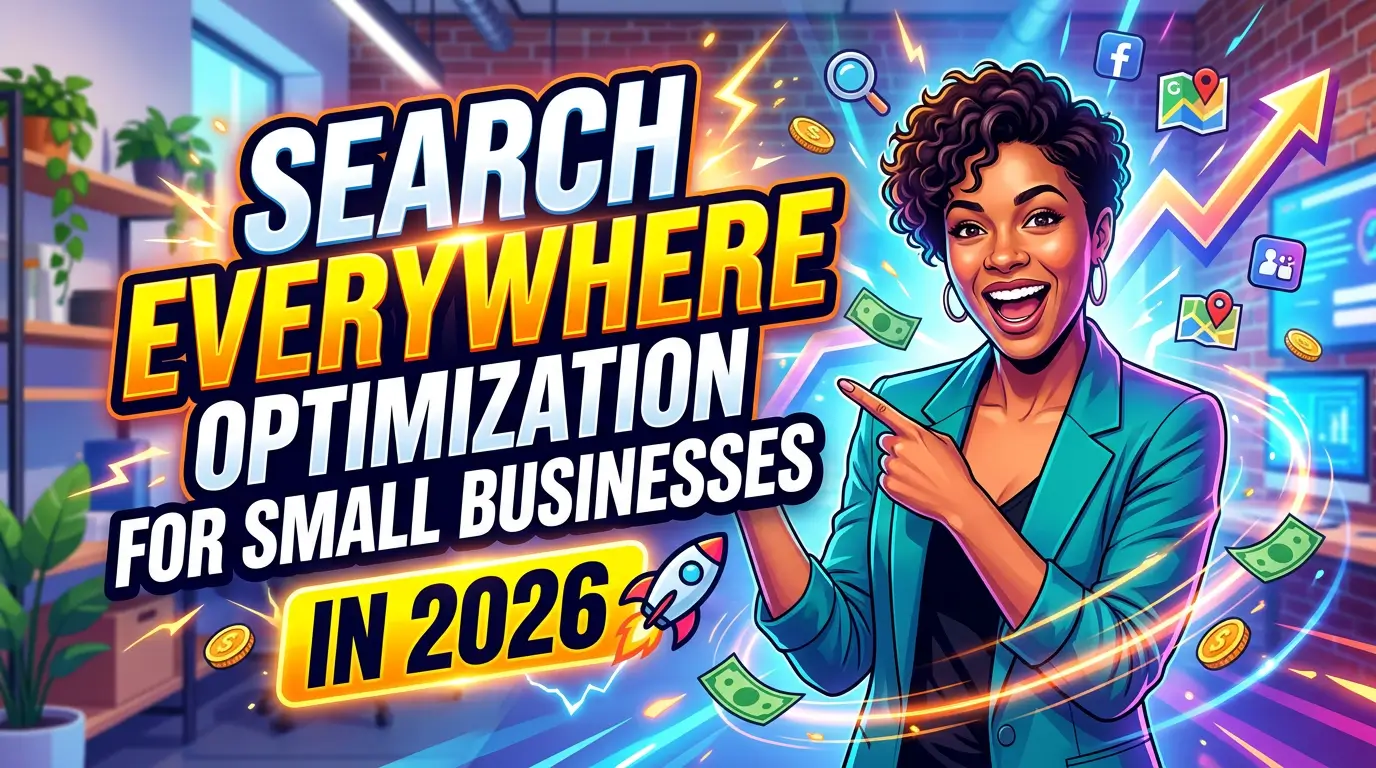
That shift is why more marketers are talking about search everywhere optimization.
Adobe describes it as a more holistic optimization and measurement strategy built to strengthen discovery across search, social, and AI. For a small business, the idea is simple. You are no longer trying to rank in one channel. You are trying to be discoverable wherever buying decisions actually start.
This is not a replacement for SEO. It is what SEO is turning into.
Why this matters now
The behavior change is real.
Google’s own documentation says AI Overviews and AI Mode create new opportunities for a wider and more diverse set of helpful links, and that people have been visiting a greater diversity of websites for more complex questions through these experiences.
At the same time, Adobe reported that web traffic from generative-AI-driven referrals in the U.S. increased more than 10 times from July 2024 to February 2025. Adobe also reported that by May 2025, AI referral traffic was converting at rates only 22% lower than non-AI traffic, which is a much smaller gap than most businesses assume.
That does not mean Google stopped mattering. It means Google is now one part of a wider discovery system.
For local businesses, reviews matter inside that system too. BrightLocal’s 2026 Local Consumer Review Survey found that 97% of consumers read reviews for local businesses, and BrightLocal also reports that 54% visit a business’s website after reading positive reviews.
Put those trends together and the picture gets clearer. Discovery now happens across search results, AI summaries, reviews, maps, video, and social proof. If your business only looks good in one of those places, you are easier to skip.
What search everywhere optimization actually means for a small business
For a Fortune 500 company, this can turn into a giant cross-channel measurement project.
For a small business, it should stay practical.
Search everywhere optimization means making sure your business is easy to find, easy to understand, and easy to trust across the main places people research before they contact you.
Usually that means improving six surfaces:
- Google organic search
- Google Business Profile and Maps
- AI-assisted search experiences
- Review platforms
- YouTube or short-form video search
- Brand mentions across social and community channels
You do not need to dominate every platform.
You do need consistency across the ones your customers actually use.
If you run a local service business, Google Business Profile, reviews, and service pages may matter most. If you sell a product with a longer evaluation cycle, YouTube, FAQs, and AI-friendly content structure may matter more. If you are a B2B service company, brand search, case studies, and comparison content may carry more weight.
The point is this: ranking one blog post is no longer the whole game.
1. Make your website the source of truth
This is still the foundation.
Google says there are no additional technical requirements to appear as a supporting link in AI Overviews or AI Mode beyond the normal requirements for being indexed and eligible to show with a snippet. The same guidance says the usual fundamentals still matter, including crawl access, internal links, page experience, text-based content, strong images, and structured data that matches the visible page.
That is a useful reminder. Before you chase platform-specific hacks, your site has to be clear.
Your homepage should explain who you help and what you do. Your service pages should answer real buying questions. Your contact paths should be obvious. Your business details should match what appears on your Google Business Profile and review platforms.
If your website is vague, every downstream platform gets weaker too.
2. Treat Google Business Profile like a revenue channel
A lot of small businesses still treat their profile like a listing they set once and forget.
That is a mistake.
Google’s AI-feature guidance specifically says businesses should keep their Merchant Center and Business Profile information up to date. That is not random advice. It reflects how important entity clarity is across modern search experiences.
If your Google Business Profile has inconsistent categories, outdated hours, weak photos, few recent reviews, or no service detail, you are making it harder for both customers and machines to trust what they see. If you need a practical cleanup plan, start with this Google Business Profile optimization checklist.
For most small businesses, the profile checklist is straightforward:
- correct primary and secondary categories
- accurate hours and contact information
- real photos of your work, team, location, or process
- current services and business description
- active review generation and owner replies
None of this is glamorous. It just works.
3. Build pages that answer comparison and decision-stage questions
This is where many small business sites fall short.
They have a homepage, a few generic service pages, and some blog posts aimed at top-of-funnel traffic. But buyers often need more before they call.
Google says AI Mode is especially useful for complex comparisons and nuanced questions. That should tell you something important. Pages that help people compare options, understand tradeoffs, or choose the right service are more aligned with the way search is heading.
For example, a roofing company might need pages about repair vs. replacement. A web design company might need pages comparing custom design vs. template builds. A law firm might need plain-English pages explaining the differences between related services. A managed IT provider might need comparison content around in-house support vs. outsourced support.
Those pages help in classic SEO, but they also give AI-driven systems stronger material to cite and summarize.
4. Reviews are now visibility assets, not just trust assets
Most owners already know reviews help conversion.
The bigger shift is that reviews also shape discovery.
BrightLocal’s 2026 data says 97% of consumers read reviews, and nearly a third, 31%, only use businesses with a 4.5-star rating or higher. BrightLocal also says 54% visit a business website after reading positive reviews.
That means reviews do at least three jobs at once.
They help you win the click from Maps or local search. They give buyers language to describe your strengths. And they reinforce your reputation across the wider discovery journey.
If people keep mentioning the same strengths in reviews, fast response times, clear communication, fair pricing, clean installs, easy scheduling, those phrases become part of how your business is understood.
That matters more now than it did a few years ago.
5. Stop thinking of YouTube as optional
You do not need to become a full-time creator. But you should stop assuming all discovery begins with a web page.
A lot of small business buyers would rather watch a two-minute explanation than read a thousand-word post. That is especially true for demonstrations, before-and-after work, FAQs, walkthroughs, and local proof.
Video also gives your brand more searchable surfaces. A good explainer can rank in YouTube, show up in Google video results, get embedded on your service pages, and support trust when a prospect is comparing multiple providers.
This is one of the most underused advantages small businesses have. Most local competitors still are not publishing useful video content consistently. That creates an opening.
You do not need studio production. Start with the questions customers already ask:
- How does your process work?
- What should someone expect on day one?
- What mistakes should buyers avoid?
- What does this service cost and why?
- What makes one option better than another?
If your team can answer those clearly on camera, you are building assets that work across search, social, and sales.
6. Measure branded demand, not just raw traffic
This is where a lot of reporting breaks.
When discovery gets spread across Google, AI tools, maps, reviews, video, and social, the last-click story gets weaker.
Google notes that traffic from AI features is reported inside the Web search type in Search Console, not in a separate AI bucket. That means some of the visibility shifts are already happening inside the metrics you are used to, just not always in obvious ways.
For a small business, I would watch these numbers more closely than vanity traffic:
- branded search growth
- Google Business Profile calls, clicks, and direction requests
- leads by landing page
- review velocity and review recency
- video views on decision-stage content
- assisted conversions from organic and local landing pages
If someone sees you in an AI answer, checks your reviews, watches one short video, then searches your name and calls three days later, the value is real even if one dashboard misses part of the story.
What a 30-day search everywhere plan looks like
If you are trying to apply this without turning it into a giant strategy deck, keep it simple.
Week 1: tighten the foundation
Audit your homepage, top service pages, contact paths, and business details. Make sure the basics are consistent across your website and Google Business Profile.
Week 2: strengthen trust signals
Ask for fresh reviews, reply to existing reviews, add better proof to service pages, and update outdated photos.
Week 3: publish one decision-stage asset
Create one useful comparison page, FAQ page, or short video built around a real buying question customers ask all the time.
Week 4: measure the right things
Review Search Console, GBP insights, call tracking, form fills, and branded search trends. Look for assisted behavior, not just isolated clicks.
That is enough to start.
You do not need a giant omni-channel content operation before you need a clearer message and more usable proof.
The big mistake to avoid
The biggest mistake is treating every new platform as a separate marketing department.
That burns time fast.
A better approach is to build a strong core message once, then adapt it to the surfaces that matter. One clear service promise can support your homepage headline, your GBP description, your review-request prompts, your FAQ content, your short video scripts, and your AI-facing visibility.
That is how small teams keep this manageable.
You are not creating six different brands. You are making one business easier to discover from six different entry points.
Final takeaway
Search everywhere optimization is not a trendy replacement for SEO. It is a more honest description of how people actually find businesses now.
Your prospects move between Google, maps, reviews, AI tools, video, and social signals before they decide who to trust. Small businesses that understand that shift will build stronger service pages, cleaner profiles, better reviews, more useful decision-stage content, and better measurement.
That is the work.
Not chasing every shiny platform. Not panicking about the death of Google. Just making your business easier to find and easier to choose wherever the search starts.
If your website still is not doing that, get started with our team. We’ll help you tighten the pages, profiles, and trust signals that actually drive leads.