If your marketing is driving traffic but your revenue doesn’t show it, your sales funnel is probably the culprit.
Most small businesses spend heavily on ads, SEO, and social media — then lose the sale somewhere between “they found us” and “they bought from us.” The funnel is broken, and nobody noticed because nobody measured it.
According to HubSpot’s State of Marketing Report, the average website converts just 2–5% of visitors into leads. Most small businesses don’t even hit that. The good news? Funnel mistakes are fixable — often without spending more on traffic.
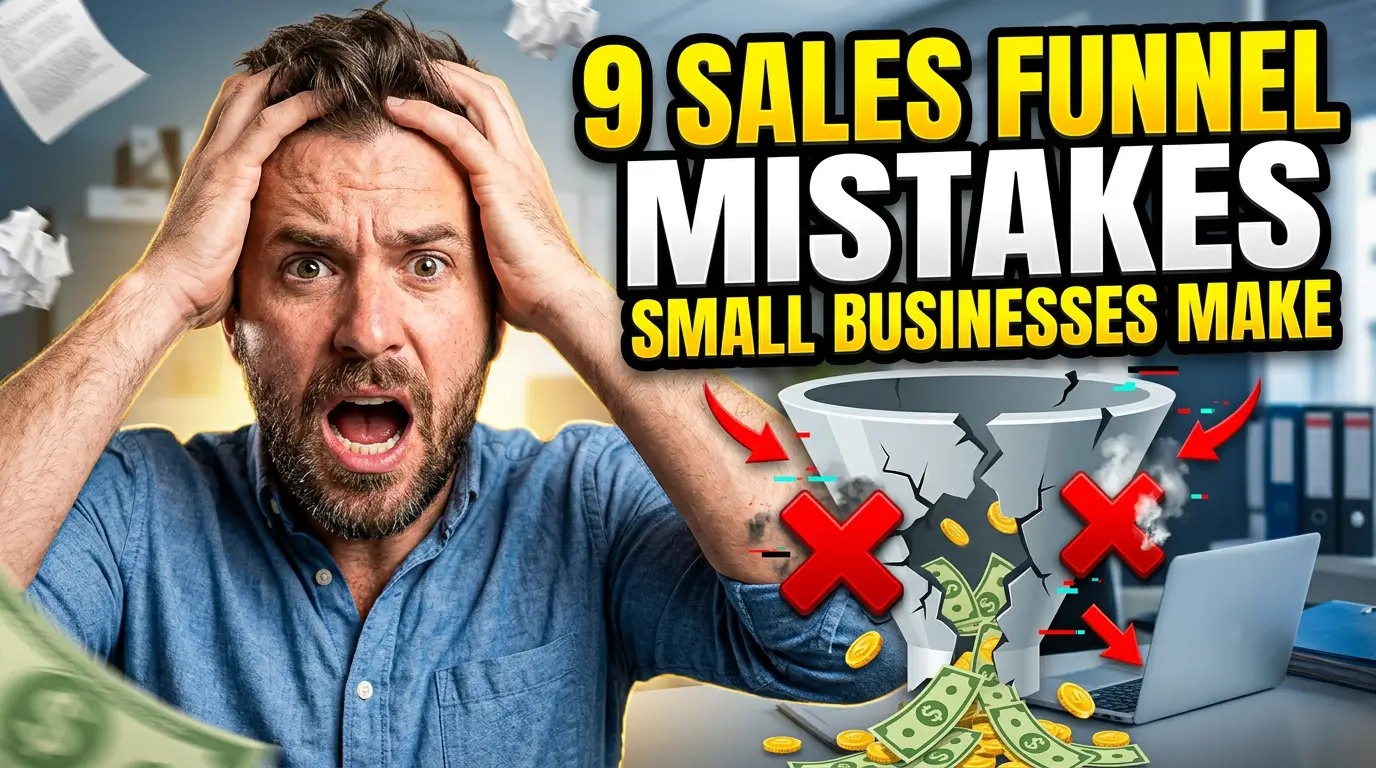
Here are the 9 most common sales funnel mistakes small businesses make, and what to do instead.
1. Sending All Traffic to Your Homepage
Your homepage is a lobby. It’s designed to orient visitors, not convert them. When you run ads or email campaigns and point everyone to the homepage, you’re asking people to figure out on their own what to do next.
The fix: build dedicated landing pages for each campaign, offer, or audience segment. A roofing company running ads for “storm damage repair” should land visitors on a page specifically about storm damage — with a clear headline, a phone number above the fold, and a short form. No navigation distractions, no unrelated services.
WordStream found that businesses with 10+ landing pages generate 55% more leads than those with fewer than 5. That’s not a coincidence — it’s targeted messaging doing its job.
2. Asking for the Sale Too Soon
Imagine walking into a car dealership and having the salesperson ask for your credit card before you’ve even looked at a car. That’s what it feels like when a business pushes a purchase offer to someone who just heard about them 10 minutes ago.
Most buyers need multiple touchpoints before they trust you enough to spend money. Salesforce research shows it takes an average of 6–8 touchpoints to generate a qualified lead. For high-ticket services, it can be even more.
The fix: map your funnel to awareness stages. Cold traffic gets educational content or a low-friction offer (like a free resource or consultation). Warm leads get testimonials, case studies, and comparisons. Only hot leads — those who’ve engaged repeatedly — should be getting direct purchase calls-to-action.
3. No Lead Capture Between “Visit” and “Buy”
If someone lands on your site, doesn’t buy, and leaves — they’re gone. Without capturing their contact information somewhere in the funnel, you have no way to follow up, re-engage, or build trust over time.
This is one of the most expensive funnel leaks a small business can have. You paid (in money or time) to get that visitor. If you can’t capture them, you’re starting from zero on every marketing dollar.
The fix: add an email capture that gives something in return — a checklist, a quote, a guide, a free audit. Even a simple “Get our pricing guide” offer converts far better than nothing. OptinMonster reports that the average email opt-in rate with a strong offer is 1.95%, versus 0.1% with a generic “subscribe to our newsletter” prompt.
4. Ignoring the Follow-Up Sequence
You got the email. Now what? Most small businesses send one welcome email and then nothing — or they go silent for weeks before blasting a promotional offer. Both approaches kill conversions.
A lead who signs up for your email list is at peak interest right now. The first 48–72 hours after opt-in are the highest-engagement window you’ll ever have with that contact.
The fix: set up a 5–7 email welcome sequence that runs automatically. Start with a strong first impression and deliver what you promised. Follow with trust-builders: a case study, an FAQ, a common objection answered, social proof. End with a soft pitch. Campaign Monitor found that welcome emails generate 4x more opens and 5x more clicks than regular campaigns — use that window wisely.
5. Making the Next Step Unclear
At every stage of your funnel, visitors should know exactly what you want them to do next. One action. One button. One outcome.
The mistake small businesses make is offering too many options — “Browse our services, read our blog, watch our video, get a quote, follow us on Instagram.” That’s not a funnel. That’s a menu. And when everything is an option, nothing gets clicked.
This is known as the paradox of choice: a study by Columbia University showed that too many options actually reduce the likelihood of any decision being made.
The fix: at every touchpoint — landing page, email, social post, follow-up — identify the one thing you want someone to do. Optimize everything to make that one action obvious, frictionless, and compelling.
6. Not Retargeting People Who Didn’t Convert
The vast majority of people who visit your website aren’t ready to buy immediately. That doesn’t mean they’ll never buy — it means they need more time and more exposure.
Retargeting lets you stay in front of those non-converting visitors as they browse other parts of the internet. It’s one of the highest-ROI plays in digital marketing precisely because you’re targeting people who already know who you are.
WordStream reports that retargeted ads have a 10x higher click-through rate than regular display ads, and retargeted visitors are 70% more likely to convert than cold traffic.
The fix: install the Facebook Pixel and Google Ads tag on your website. Create separate retargeting audiences for: homepage visitors, product/service page visitors, and cart abandonees (if applicable). Serve each group ads that address where they are in the decision process.
7. A Checkout or Contact Process That’s Too Complicated
You’ve done everything right — someone clicked your ad, read your page, watched your video, and is ready to reach out or buy. Then they hit a 12-field contact form, or a checkout process that requires creating an account before purchasing.
Friction kills. Every extra step, every unnecessary field, every forced account creation is a place where motivated buyers drop off.
Baymard Institute’s research shows that the average cart abandonment rate is 70.19%, and a complicated checkout is one of the top reasons. For service businesses, the same principle applies to contact forms and booking flows.
The fix: reduce your contact form to the minimum required fields (name, email, and one qualifying question). For ecommerce, offer guest checkout. For service businesses, consider a phone-first CTA for high-ticket services — sometimes a call converts better than any form.
8. No Social Proof at Decision Points
People look to others when making decisions — especially about businesses they’ve never worked with. If your funnel doesn’t have testimonials, reviews, case studies, or trust signals exactly where people are deciding, you’re leaving conversion on the table.
The mistake isn’t a lack of social proof overall — most businesses have some reviews or testimonials. The mistake is placing them only on a dedicated “Testimonials” page that nobody visits organically during the buying process.
BrightLocal’s Consumer Review Survey found that 98% of consumers read online reviews for local businesses, and the average consumer reads 10 reviews before feeling confident about a business.
The fix: place social proof contextually. Testimonials belong near your CTA buttons. Case study results belong on your services pages. Star ratings belong in the header. Don’t hide trust signals — put them exactly where doubt is most likely to surface.
9. Not Measuring the Funnel at All
If you don’t know your conversion rates at each stage — traffic to lead, lead to call, call to close — you’re flying blind. And when something isn’t working, you’ll have no idea where to fix it.
Most small business owners know their revenue but not their funnel metrics. They’ll increase their ad spend when leads slow down, not realizing the problem is actually in the follow-up sequence, not the top of the funnel.
Google Analytics 4 (free) combined with a simple CRM like HubSpot’s free tier gives you everything you need to track funnel stages. Set up conversion events for form submissions, call clicks, and purchases. Review them monthly.
The fix: define your funnel stages, assign a measurable event to each one, and review your stage-by-stage conversion rates every month. Even a rough tracking setup will reveal where the leaks are — and that’s the first step to fixing them.
What a Working Sales Funnel Actually Looks Like
A working small business funnel doesn’t have to be complex. Here’s a simple version that converts:
- Awareness: SEO content, paid ads, or social media brings in targeted traffic
- Landing: Traffic lands on a purpose-built page matched to their intent
- Capture: A compelling offer captures their email before they leave
- Nurture: An automated email sequence builds trust over 5–7 touchpoints
- Convert: A clear CTA with social proof and reduced friction drives the sale
- Retain: Follow-up systems turn buyers into repeat customers and referrers
The businesses that grow aren’t always the ones with the best product. They’re the ones with the tightest funnel — the ones who know exactly what happens to every lead from first click to closed deal.
Fix Your Funnel Before You Spend More on Traffic
It costs 5–10x more to acquire a new customer than to convert a warm lead you already have. Before you increase your ad budget, fix the leaks.
If you’re not sure where your funnel is breaking down — or you don’t have a proper one set up yet — we can help. At Your Web Team, we build and optimize websites and marketing systems specifically designed to turn visitors into paying customers.
Get a free website and funnel review →
We’ll identify exactly where you’re losing leads and show you what it would take to fix it.

Richard Kastl
Founder & Lead EngineerRichard Kastl has spent 14 years engineering websites that generate revenue. He combines expertise in web development, SEO, digital marketing, and conversion optimization to build sites that make the phone ring. His work has helped generate over $30M in pipeline for clients ranging from industrial manufacturers to SaaS companies.