A lot of small businesses work hard to get reviews, then make one strange mistake.
They leave all that trust sitting on Google.
That worked better a few years ago, when a prospect might find your business in Maps, glance at your star rating, and call. In 2026, the path is messier. People bounce between your Google Business Profile, your website, social platforms, and AI-generated answers before they decide who feels safest to contact.
BrightLocal’s 2026 Local Consumer Review Survey says 97% of consumers read reviews for local businesses, the average consumer now uses six different review sites, and 45% use ChatGPT or other generative AI tools for local recommendations. That means your reviews are no longer just local SEO garnish. They are trust infrastructure.
At the same time, Google says AI Overviews and AI Mode surface links to supporting websites, and the same fundamentals still matter, including internal links, textual content, page experience, and keeping your Business Profile information up to date (Google Search Central). If you want your website to help close the lead after discovery, you need more visible proof on-site.
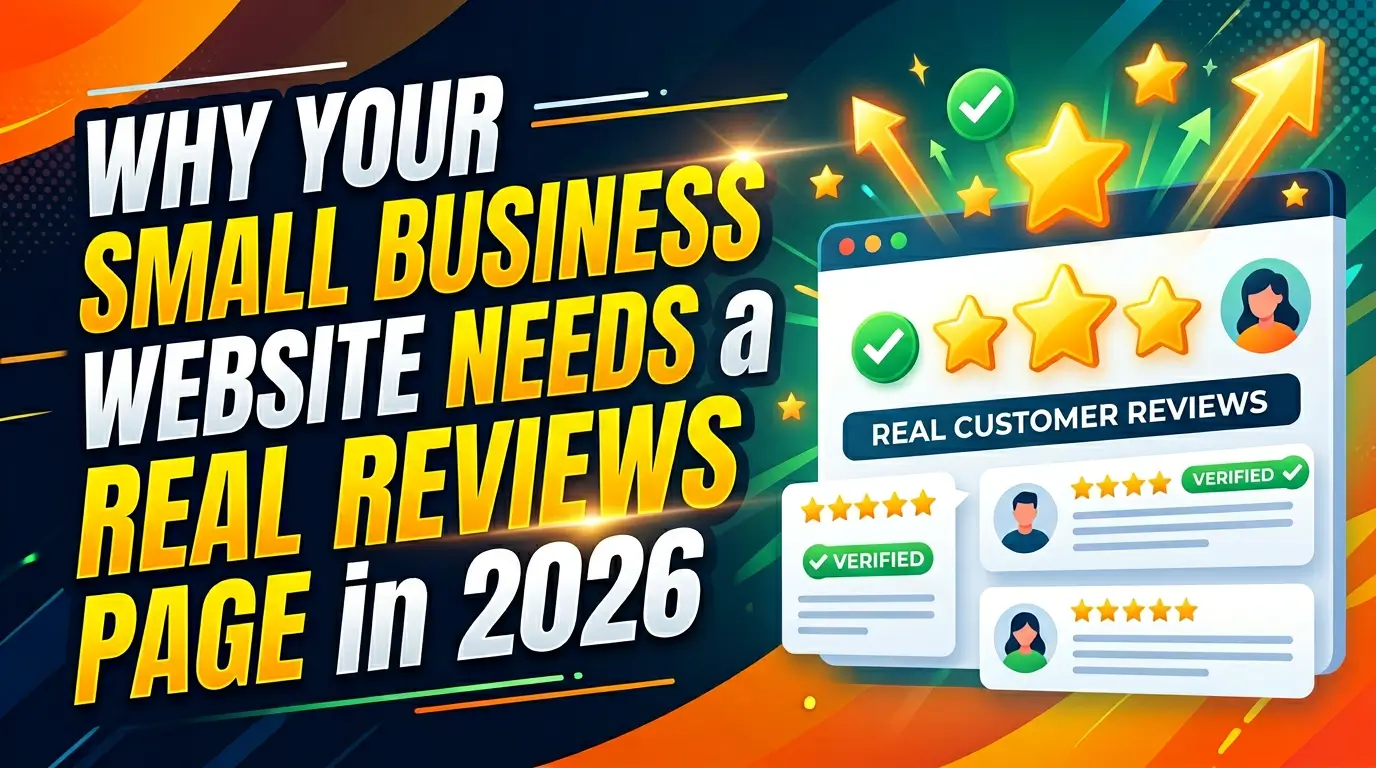
That is where a real reviews page helps.
Not a widget buried in the footer. Not a screenshot from 2023. A real page with recent, believable, easy-to-skim customer proof.
Why a reviews page matters more now
A reviews page does three jobs at once.
First, it gives a nervous buyer a place to verify that other people had a good experience with you. BrightLocal found that 74% of consumers only care about reviews written in the last three months, 47% will not use a business with fewer than 20 reviews, and 31% will only use a business with 4.5 stars or higher. If a prospect clicks to your site and cannot quickly see fresh proof, you force them to keep hunting.
Second, it gives search systems and AI systems more text-based evidence to understand who you help and what customers say about the experience. Google explicitly says important content should be available in textual form and easy to find through internal links. A well-built reviews page does both.
Third, it helps conversion. Northwestern’s Medill Spiegel Research Center found that the purchase likelihood for a product with five reviews is 270% greater than for a product with no reviews. That study was done in ecommerce, not local services, but the buying psychology carries over. Proof lowers risk. Lower risk increases action.
If you are a roofer, lawyer, med spa, accountant, HVAC company, agency, clinic, or B2B service firm, the visitor is still asking the same question: “Has this business done good work for people like me?” A reviews page answers that question fast.
What most small business websites get wrong
The usual setup looks like this:
- a homepage badge that says “4.9 stars”
- one or two testimonials with no dates
- a Google reviews link hidden on the contact page
That is not enough anymore.
BrightLocal reports that the most important review factor is consistent sentiment across multiple reviews, not one glowing quote. It also found that 37% of consumers care whether the business owner has responded to the review. Google’s own review guidance says honest and balanced reviews can help potential customers decide, and that a mix of positive and negative feedback often feels more trustworthy.
So when a site only shows three polished quotes and no real-world context, the page can actually feel less credible.
I see four recurring problems:
1. The proof is too thin
A few short testimonials are better than nothing, but they do not show pattern, volume, or recency.
2. The proof is disconnected from services
A plumbing company might have strong reviews about emergency repairs, drain cleaning, and water heater installs, but the website lumps them into one generic slider. That wastes specificity.
3. The proof is stale
If your latest visible review on the site is from last year, that creates friction, even if Google has newer ones.
4. The proof is hard to verify
Anonymous quotes with no link, no first name, and no service context feel like ad copy.
A good reviews page fixes all four.
What to include on the page
You do not need a fancy design. You need believable structure.
Start with a short intro that says what the page is and where the reviews come from. If the feedback is pulled from Google, say that. If it includes testimonials from projects, say that too.
Then build the page around proof blocks like these:
- your current average rating and approximate total review count, if you have enough volume to show it honestly
- recent reviews with dates or timing context
- the customer’s first name, business name, or neighborhood when appropriate
- the service provided, so the proof matches buyer intent
- links out to your Google reviews or other third-party profiles
- owner responses or notes that show the business is active
This is also a smart place to organize reviews by service line.
For example, a marketing agency could group reviews under website design, SEO, and paid ads. A contractor could group them under kitchen remodels, roof replacements, and emergency service. An accountant could separate small business tax work from bookkeeping and payroll. That gives both users and search engines cleaner context.
Google’s Business Profile help documentation says website clicks are a tracked profile action. In plain English, Google can send the click, but your site still has to earn the inquiry. Better proof on the landing experience improves those odds.
How to make the page help SEO and AI visibility
This is where most businesses either overcomplicate things or ignore the opportunity.
You do not need to “SEO optimize reviews” in some gimmicky way. You need to make the page easy to crawl, easy to understand, and easy to connect to the rest of your site.
Here is the practical version:
Use a clear page title
Call it Reviews, Results, Client Feedback, or Success Stories. Pick the label your customers will understand instantly.
Add internal links from your main pages
Google specifically recommends making content easy to find with internal links. Link to your reviews page from the homepage, key service pages, and contact page. If someone is deciding whether to trust you, do not make them search the navigation.
Keep the text crawlable
Google also says important content should be in textual form. If your proof is only an embedded widget or image screenshot, you are giving machines and users less to work with. Use real text on the page whenever possible.
Match visible content to any schema you use
Google’s AI features guidance says your structured data should match the visible text. If you add schema later, keep it aligned with what is actually on the page.
Keep your business details consistent
Google also advises site owners to keep Business Profile information up to date. If your reviews page says you serve one set of cities but your profile says something else, you create trust drag.
The bigger trend here is that websites are getting more valuable as verification layers. Adobe reported that traffic from generative AI sources to U.S. retail websites was up 1,200% in February 2025 versus July 2024, and those visitors viewed 12% more pages per visit with a 23% lower bounce rate. Semrush also says its research suggests AI search visitors could surpass traditional search visitors by 2028. Whether that timeline lands exactly or not, the direction is clear. More people will arrive on your site after an AI-assisted research step. When they do, proof pages matter.
How to keep the page fresh without making it a chore
This is the part that scares small business owners because it sounds like another thing to maintain.
It does not have to be heavy.
Google’s review guidance recommends asking customers to leave reviews through a direct Google link or QR code, replying to reviews, and keeping replies short, relevant, and timely. Build a simple monthly rhythm around that.
Once a month:
- add 3 to 5 recent reviews to the page
- replace anything that has grown stale
- make sure your service categories still reflect how customers describe the work
- update your total review count if you display it
That is enough for most small businesses.
If you want an even simpler rule, use this one: never let the visible reviews on your website feel older than the visible reviews on your Google profile.
Where the CTA belongs
Do not make the reviews page a dead end.
After someone reads proof, they are often ready for the next step. Add a clear call to action near the top and again near the bottom. That CTA might be “Request a Quote,” “Book a Consultation,” or “Talk With Our Team,” depending on the business.
Just keep the path short.
If your reviews page does its job, the visitor should not have to bounce back to the homepage and hunt for a form.
The simple version
If your business already has reviews, you are sitting on trust you have not fully used yet.
A real reviews page helps buyers verify you faster. It gives Google and AI systems more useful on-site proof. And it makes your website work harder after the click from Maps, Search, referrals, or AI answers.
This is not a flashy tactic. It is a practical one. Those usually age better.
If you want help turning your reviews, service pages, and trust signals into a site that brings in more qualified leads, get started here.