If you run a local service business, Google is not giving you the same search results page it gave you two years ago.
The old plan was simple enough: rank in the map pack, collect reviews, write service pages, and wait for phone calls. That still matters. But it is no longer the whole plan.
Local search is getting squeezed from several directions at once. Google is testing AI-powered local packs that show fewer businesses than the traditional 3-pack. Local pack ads have grown fast. Local Services Ads keep taking premium screen space. And informational SEO traffic is more exposed to AI Overviews than it used to be.
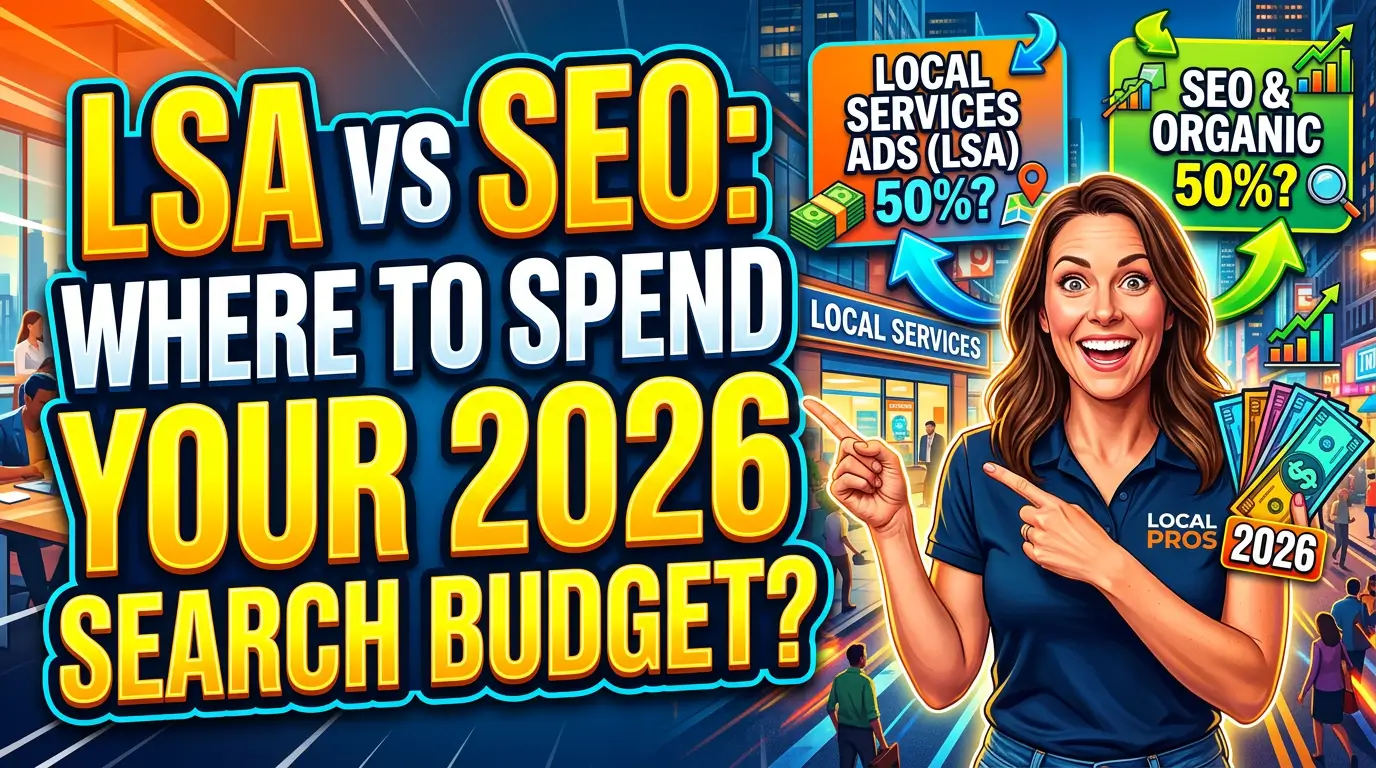
That does not mean small businesses should quit SEO and throw the whole budget into ads. That is usually how money gets burned. It means your 2026 search budget needs jobs assigned to it.
SEO should build durable visibility and trust. Local Services Ads should capture high-intent buyers when the math works. Google Ads should fill gaps where organic visibility is weak or the offer is urgent.
Here is how to split the budget without guessing.
What changed in local search
The biggest change is that Google is showing fewer easy organic paths to the customer.
Sterling Sky reported that AI-powered local packs were appearing on about 7% of tracked keywords in its ranking reports, and those AI local packs showed only 1 to 2 businesses instead of the usual 3. In the same analysis, AI local packs surfaced 5,943 unique businesses compared with 18,330 in traditional 3-packs, or about 32% as many businesses. Sterling Sky also found that 88% of the 322 markets reviewed had fewer unique businesses in AI local packs than in traditional local packs.
That matters because a local business can hold a decent ranking and still receive fewer calls if the result layout changes.
Paid placements are expanding too. PPC Land reported that local pack ads rose from 2.64% of tracked mobile keywords in early November 2025 to 21.99% by January 2026, a 733% increase in roughly three months. Sterling Sky saw a similar direction in its own local ranking reports, with local pack ads moving from about 1% at the start of 2025 to almost 22% by December 2025.
Local Services Ads are also taking more of the above-the-fold real estate for eligible categories. Sterling Sky reported that Local Services Ads appeared on roughly 11% of tracked queries at the beginning of 2025 and 31% by November.
Then there is AI Overview pressure. Semrush analyzed more than 10 million keywords and found that AI Overviews appeared for 6.49% of queries in January 2025, peaked near 24.61% in July, and settled at 15.69% in November. For a small business owner, the point is simple: ranking is not the same as visibility, and visibility is not the same as leads.
Why SEO still deserves budget
SEO is slower than ads, but it still does work that ads cannot do cheaply.
Your website, service pages, reviews, and local citations give Google, AI tools, directories, and customers a clearer picture of who you serve and why you are credible. BrightLocal’s 2026 local SEO statistics page reports that 80% of U.S. consumers search online for local businesses weekly, based on SOCi’s 2024 Consumer Behavior Index. BrightLocal also cites its 2025 Consumer Search Behavior research showing that 45% of consumers default to Google for local searches and 15% use Google Maps.
Your website is part of that trust path. BrightLocal’s 2026 Local Consumer Review Survey found that 54% of consumers visit a business website after reading positive reviews. That is the handoff many small businesses miss. Reviews create interest, but the website has to answer the practical questions: services, areas served, pricing signals, proof, insurance, availability, and how to get started.
SEO also supports AI visibility. BrightLocal reports that ChatGPT Search shows business websites for 58% of its local search sources, followed by business mentions at 27% and online directories at 15%, based on its 2024 ChatGPT Search source research. If your website is thin, outdated, or unclear, you are not giving search engines or AI systems much to cite.
The catch is that SEO should not be funded like a lottery ticket. Do not pay for vague monthly blogging and hope it helps. Put money into assets that help a real buyer choose you.
What Local Services Ads are good for
Local Services Ads work best when the customer has urgent intent and your business can respond fast.
Think plumbing, HVAC, electrical, locksmiths, garage doors, roofing, pest control, legal services, and other categories where a customer wants a short list of providers now. LSAs can put your business above standard paid search results and organic results, and the pay-per-lead model is easier for many owners to understand than paying per click.
But LSAs are not magic. They are an auction with trust signals. Google says Local Services Ads ranking can be affected by factors such as proximity, review score and count, responsiveness, business hours, complaint history, and whether Google receives serious or repeated complaints about the business.
That means your LSA performance is tied to operations. If calls go unanswered, leads sit too long, reviews are stale, or job categories are too broad, your cost per booked job can climb fast.
LSAs are worth testing if three things are true:
- Your category is eligible and customers usually need service soon.
- You can answer calls or messages quickly during advertised hours.
- Your average job value can absorb paid lead costs.
If you sell $99 tune-ups and close one in ten leads, LSAs may be rough unless repeat revenue is strong. If you sell $4,500 HVAC installs, $1,500 legal matters, or $2,800 water heater replacements, the math can work with a much higher cost per lead.
Where Google Ads fits
Standard Google Ads still has a role, but it should be tighter than most small business accounts are.
Use Google Ads when you need control over keyword intent, landing pages, offers, and geography. A roofer might use LSAs for emergency roof repair leads, but run search ads for “metal roof installation estimate” because that job type is higher value and deserves a dedicated landing page. A dentist might use Local Services Ads if available, but run Google Ads for implants, Invisalign, or emergency appointments.
Google Ads is useful when organic results are crowded with directories, AI answers, map features, and competitors. Just keep it controlled: one service, one location cluster, one landing page, call tracking, form tracking, and weekly search-term reviews. If that works, expand.
A practical 2026 budget split
There is no perfect split for every business. A startup plumber and an established law firm should not spend the same way. But there are useful starting points.
If you are starting from weak visibility
Put 60% into SEO and website cleanup, 25% into Local Services Ads if eligible, and 15% into standard Google Ads.
This is for businesses with a thin website, messy Google Business Profile, few reviews, weak service pages, and inconsistent tracking. Ads can generate early leads, but too much paid traffic will leak if the foundation is weak.
Your first 90 days should fix the basics: clean up your Google Business Profile, write dedicated pages for core services, add honest service-area proof, add reviews, fix contact forms, and set up call tracking.
BrightLocal cites Google’s own Business Profile support data showing that customers are 2.7 times more likely to consider a business reputable if they find a complete Business Profile on Google Search and Maps, and 70% more likely to visit businesses with a complete profile. That is not fancy marketing. That is basic trust infrastructure.
If you already rank but calls are dropping
Put 45% into SEO and conversion improvements, 35% into Local Services Ads, and 20% into Google Ads.
This is common right now. The business ranks, but calls are not what they used to be. The owner thinks SEO stopped working. Sometimes the real issue is that the search results page changed, competitors started buying visibility, or Google removed easy call actions from certain mobile layouts.
Sterling Sky’s local search research is a good warning here: it found Google Business Profile click-to-call declines across 179 profiles from 34 U.S. law firms, while website clicks did not show the same pattern. If call buttons are less prominent, your website has to convert more of the visitors who do click.
Spend SEO money on pages that help close the sale, not just rank. Add photos, service area proof, FAQs, pricing ranges when possible, warranty details, and stronger calls to action. Then use LSAs to recapture high-intent call demand.
If you are in a high-value, competitive category
Put 35% into SEO, 40% into Local Services Ads, and 25% into Google Ads.
This applies when one job can pay for weeks of marketing: legal, HVAC replacement, roofing, foundation repair, restoration, high-end remodeling, and similar markets. You still need SEO because trust and brand searches matter, but you may need more paid coverage because competitors are already buying the top of the page.
Set a hard rule: paid campaigns are judged by cost per booked job, not cost per lead.
The tracking you need before increasing spend
Do not scale paid search until you can see what happens after the click or call.
At minimum, track calls from Google Business Profile, LSAs, Google Ads, and your website separately. Track forms by landing page and source. Track booked jobs, not just raw leads. If your CRM or spreadsheet can handle it, track revenue by source too.
This is where many small businesses make bad decisions. They pause the channel that generates fewer leads, even if those leads close better. Or they keep funding the channel with the cheapest leads, even though the jobs are small.
Search Engine Land reported on Seer Interactive research showing that when AI Overviews appeared, organic CTR on informational queries fell from 1.41% to 0.64% year over year. But the same report also found that when a brand appeared in AI Overviews, paid CTR increased from 7.89% to 11% and organic CTR rose from 0.74% to 1.02%. Visibility quality matters more than raw ranking reports.
Your dashboard should answer one question: which search investments created qualified conversations and booked work?
What to do in the next 30 days
Start with a simple audit. Search your top five money terms on mobile, not just desktop. Look for LSAs, map ads, AI answers, directories, review sites, and competitors. If your business is visible only after a scroll or two, you have a visibility problem even if your rank tracker looks fine.
Next, review your Google Business Profile. Make sure categories, services, hours, service areas, photos, products, appointment links, and tracking numbers are correct. BrightLocal’s local statistics page cites research showing that 62% of consumers would avoid using a business if they found incorrect information online.
Then review your website like a buyer. Can they tell whether you serve their area, whether you handle their job type, what proof you have, and what to do next? If not, fix that before buying more traffic.
Finally, run a contained paid test. Pick one profitable service, one landing page, and one 30-day measurement window.
The bottom line
The small businesses that win in 2026 will not be the ones that choose SEO or ads like it is a team sport.
They will use SEO to build trust assets that make every channel convert better. They will use Local Services Ads where speed and urgent intent matter. They will use Google Ads where they need precision, testing, or immediate coverage.
If your search budget is just “SEO retainer” or “Google Ads spend,” tighten it up. Give every dollar a job. Measure booked work. Keep what pays.
Need help figuring out where your search budget is leaking? Start here and we will map the fastest path to more qualified local leads.