A customer doesn’t need ten choices when they’re ready to hire a plumber, accountant, roofer, med spa, dentist, attorney, or remodeler.
They need a safe shortlist.
That’s where local SEO is heading. Search results are getting tighter. AI summaries are compressing options. Review expectations are rising. Your Google Business Profile still matters, but it can’t carry the whole sales conversation by itself.
Sterling Sky reported that AI-powered local packs were showing on about 7% of the keywords they tracked in recent ranking reports. The same analysis found that AI local packs usually feature one to two businesses instead of three, and Places Scout found those AI local packs surfaced 5,943 unique businesses compared with 18,330 in regular 3-packs. That means the AI version showed roughly one-third as many businesses.
For a small business, that isn’t an abstract SEO trend. It means you need stronger proof before the customer gets to your contact form.
A local proof page is one practical way to do that.
What is a local proof page?
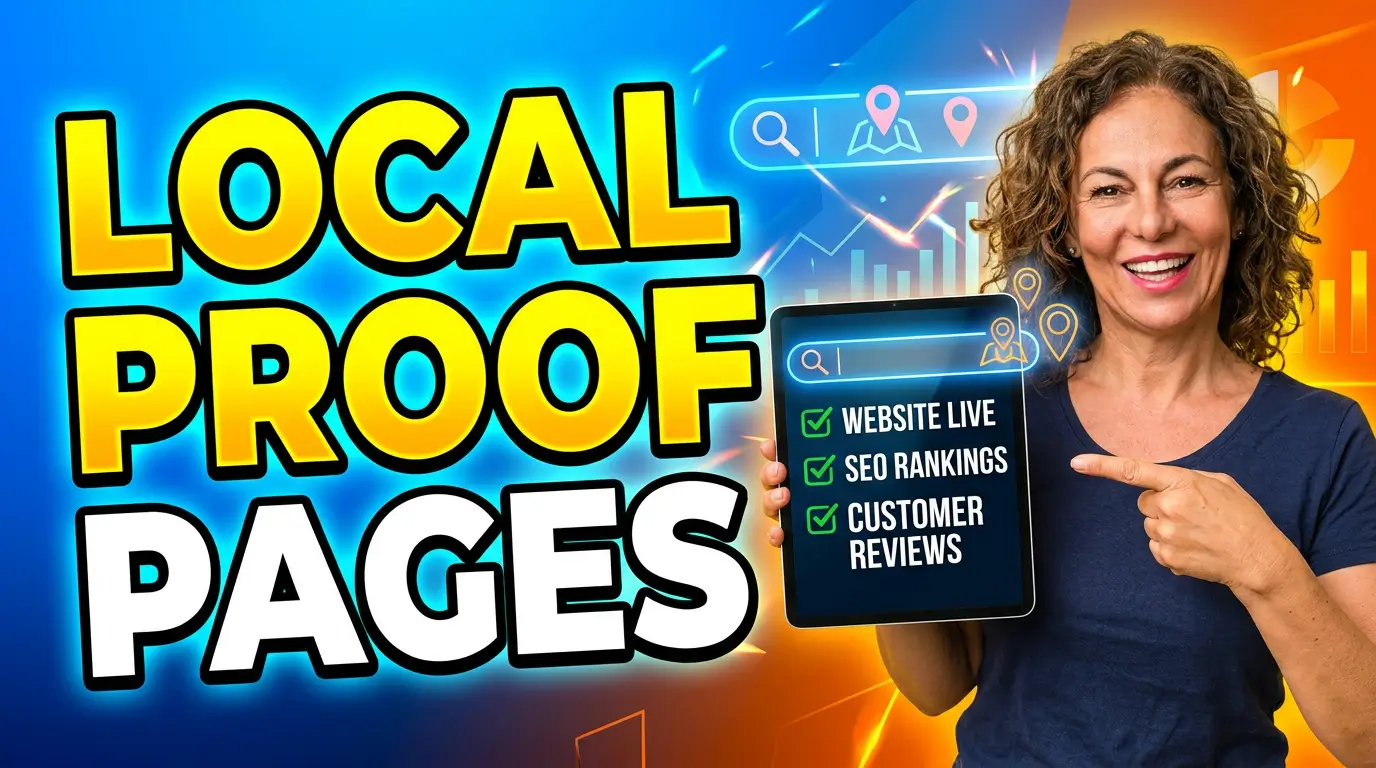
A local proof page is a focused website page that proves your business is real, active, local, qualified, and safe to contact.
It is not another thin city page. It is not a blog post stuffed with neighborhood names. It is not a generic “Why choose us” page that could belong to any company in your market.
Think of it as the evidence file behind your Google Business Profile, reviews, service pages, and sales conversations.
A good local proof page answers the questions buyers and search systems both care about:
- Do you serve this area?
- What specific services do you provide?
- What proof do you have?
- What do customers say about working with you?
- Who is behind the business?
- What happens after someone reaches out?
Google says local ranking is mainly based on relevance, distance, and prominence. It also says businesses with complete and accurate information are more likely to show up in local search results. A local proof page helps with the relevance and prominence side because it puts your service, location, reviews, photos, credentials, and next steps in one clean place.
The page is built for humans first. The SEO benefit comes from making the facts easier to trust.
Why this matters more in AI local search
The old local SEO playbook was simple enough. Fill out your Google Business Profile, get reviews, add local keywords to your website, build citations, and try to get into the map pack.
That still matters. But the margin for weak proof is getting smaller.
Sterling Sky’s 2026 local SEO analysis found that 88% of the 322 markets they reviewed had fewer unique businesses in AI local packs than traditional local packs. The same report said AI local packs often do not include call buttons, which matters for service businesses that depend on fast phone leads.
If fewer businesses are shown, your public evidence has to be cleaner than the competitor’s.
That evidence lives in more places than Google. BrightLocal’s 2026 Local Consumer Review Survey found that 97% of consumers read reviews for local businesses, and the average consumer uses six different review sites when choosing businesses. BrightLocal also reported that use of ChatGPT and other generative AI tools for local recommendations rose from 6% to 45% and became the third most popular source for business recommendations in its survey.
That is the buying path now. A customer may see you in Google, check reviews, ask ChatGPT, look at your website, scan photos, and then call. If your website doesn’t back up the same story, you create doubt.
Doubt costs leads.
What to put on a local proof page
This page does not need to be fancy. It needs to be specific.
Start with the business facts. Use your real business name, address or service area, phone number, hours, appointment options, and core services. Match the facts on your Google Business Profile. Google specifically recommends keeping business information and hours up to date, so don’t bury those basics in a footer where nobody checks them.
Then add proof that a buyer can judge quickly.
1. A clear local service statement
Open with the exact work you do and where you do it.
Bad: “We provide quality solutions for residential and commercial clients.”
Better: “We provide emergency drain cleaning, sewer camera inspections, and hydro jetting for homeowners and property managers in Plano, Frisco, Allen, and McKinney.”
The second version gives a customer, search engine, and AI assistant something concrete to work with. It ties services to geography without sounding like spam.
If you serve multiple markets, don’t list 80 cities in a wall of text. Use a short service area section, then link to detailed service pages or location pages where they make sense.
2. Review themes, not just review widgets
A review widget is fine, but it is not enough.
BrightLocal found that the most important review factor for consumers is whether a review is backed up by other reviews with similar sentiment. In the same survey, 44% of consumers said a review posted within the last month mattered, and 37% said the business owner’s response mattered.
That tells you what your proof page should show. Don’t only paste five glowing quotes. Group reviews around customer concerns.
For example:
- “Showed up on time” for home service businesses
- “Explained pricing clearly” for contractors and professional services
- “Helped me feel comfortable” for dental, medical, wellness, and legal services
- “Fixed it the first time” for repair and technical services
Use real review excerpts and link to the platform when possible. Then add a short note about how you handle feedback. A calm owner response to a mixed review can build more trust than another perfect five-star quote.
3. Photos that prove the business is active
Google tells businesses to add photos and videos to help customers understand what they offer. Your proof page should do the same.
Use real photos, not only stock images. Show the storefront, team, vehicles, job sites, finished work, equipment, office, treatment room, showroom, or before-and-after examples.
A local buyer wants to know that you are not a ghost listing. AI systems also have more context when your website, profile, and reviews all describe the same kind of work.
If you do not have many photos yet, start with six: exterior, interior, team, work example, vehicle or equipment, and one customer-facing process photo. Replace weak photos over time.
4. Credentials and risk reducers
Most local buyers are trying to avoid a bad decision.
That is why your proof page should include licenses, insurance details, certifications, warranty language, trade memberships, safety practices, payment options, privacy expectations, and service guarantees when they apply.
Don’t make exaggerated claims. State what you can prove.
A roofing company can mention license numbers and insurance. A CPA firm can show credentials and industries served. A med spa can show provider credentials and consultation process. A web design agency can show launch process, support terms, and ownership details.
The goal is simple: remove the buyer’s next objection before they ask it.
5. A plain-English process section
A lot of small business websites jump from “we’re great” to “contact us” too fast.
Show the customer what happens next.
For a service business, that might be call, schedule, inspection, estimate, approval, work, cleanup, follow-up. For a professional firm, it might be inquiry, fit check, consultation, proposal, onboarding, monthly review.
This matters because uncertainty lowers conversion. A buyer is more likely to contact you when the next step feels low-risk and clear.
How to connect the page to local SEO
A local proof page works best when it is connected to the rest of your site.
Link to it from your homepage, footer, about page, contact page, and top service pages. Add a short “Why local customers choose us” block on service pages that links to the proof page. If you have a Google Business Profile website link or appointment link strategy, make sure customers can reach the page from the path they actually use.
Use LocalBusiness structured data where appropriate. Google’s LocalBusiness documentation says businesses can include details such as name, address, phone number, opening hours, and other business information in structured data. That markup is not a magic ranking switch, but it helps machines read the same facts that humans see on the page.
Keep the page fresh. Add new photos quarterly. Refresh review excerpts. Update service areas when they change. Remove expired offers. Check that hours, phone numbers, and appointment links still match your Google Business Profile.
This is basic maintenance, but basic maintenance wins more often than small businesses want to admit.
What not to do
Don’t turn this into another spam page.
Avoid fake local photos, copied reviews, city-name stuffing, hidden text, exaggerated awards, and claims you cannot back up. If you use AI to draft copy, edit it hard. Your proof page should sound like your actual business, not a template.
Also avoid making the page all about you. The buyer is asking, “Can I trust this company with my money, my home, my health, my time, or my business?” Every section should help answer that question.
A simple local proof page outline
Use this structure if you’re starting from scratch:
- Local service statement with cities or neighborhoods served
- Short trust summary with years in business, team size, credentials, or specialties
- Review themes with real excerpts and links
- Photos of people, place, work, and process
- Credentials, license, insurance, warranty, or guarantee details
- Step-by-step process for new customers
- FAQs that answer buying questions
- Clear CTA to call, book, or request a quote
You don’t need 3,000 words. You need enough clear evidence for a buyer to feel safe taking the next step.
The payoff: fewer doubts, better leads
A local proof page will not fix a bad business. It will not make fake reviews safe. It will not replace your Google Business Profile, service pages, or real customer service.
But if you’re already doing good work, it gives that work a better place to show up.
Local search is becoming a shortlist game. Sterling Sky’s AI local pack data shows fewer businesses getting surfaced in some mobile results. BrightLocal’s review data shows buyers checking more sources before they trust a company. Google’s own guidance still rewards complete, accurate, helpful business information.
The practical move is obvious: make your proof easier to find.
If your website does not clearly show why a local customer should trust you, fix that before spending more money on traffic. A stronger proof page can help more of the visitors you already have become calls, appointments, and quote requests.
Need help building the kind of local proof page that supports SEO and turns visitors into leads? Start here.