Your website is getting visitors. But visits don’t pay the bills — leads do.
A lead magnet is the offer you make in exchange for someone’s email address (and permission to keep talking to them). Done right, it’s one of the highest-ROI additions you can make to any website. Done wrong, it’s a generic PDF collecting virtual dust on your server.
The average email list has a return of $36 for every $1 spent, but that math only works if people actually want what you’re giving them. In 2026, “free eBook” isn’t enough. Visitors are savvier, inboxes are fuller, and the bar for earning an email address has never been higher.
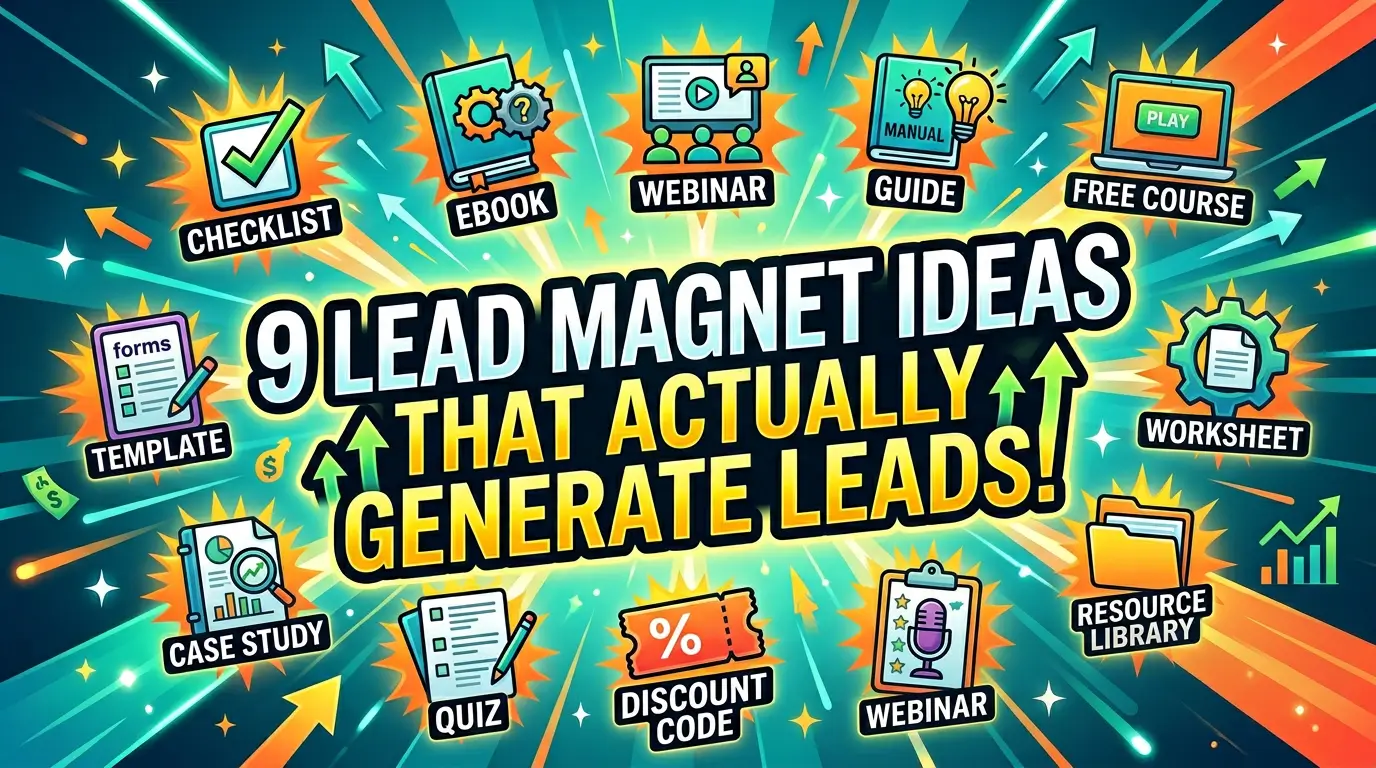
Here are 9 lead magnet ideas that actually work — each one targeting a specific pain point with real conversion potential.
1. The Interactive Quiz or Assessment
Best for: Service businesses, consultants, SaaS
Quizzes are among the highest-converting lead magnets available right now. Outgrow reports that interactive content generates 2× more conversions than passive content, and quizzes specifically average a 31% lead capture rate — compared to roughly 2–3% for a standard opt-in form.
Why do they work? Because visitors get something immediately useful: an answer specific to them. Instead of a generic guide, they get a score, a diagnosis, or a recommendation based on their answers.
Example: A web design agency could offer a “Is Your Website Costing You Clients? 10-Question Assessment” — visitors answer questions about their site’s speed, mobile experience, and CTAs, then get a score and personalized recommendations. The email captures the result delivery.
Tools like Typeform, Outgrow, or Interact make these straightforward to build without a developer.
2. The ROI or Savings Calculator
Best for: B2B, professional services, SaaS
If your service saves clients money or generates revenue, put a number on it before they even talk to you. A calculator lets visitors input their own data and see a personalized result — which is infinitely more persuasive than a generic “businesses save an average of X%” claim.
Demand Gen Report found that 87% of B2B buyers say interactive tools are effective in helping them understand which solution meets their needs. When someone calculates that a faster website could recover $4,200/month in lost leads, your consulting fee suddenly looks very reasonable.
Example: A web performance agency could build a “Website Speed Revenue Calculator” — visitors enter monthly traffic, average order value, and current load time, and get an estimate of how much revenue they’re losing to slow pages. The full report (with fix recommendations) gets emailed to them.
Build these with Calconic or embed a spreadsheet-style calculator using Sheepform.
3. The Swipe File or Template Pack
Best for: Marketing, copywriting, design, any process-heavy industry
Templates and swipe files solve an immediate, concrete problem: the blank page. Instead of a generic “get inspired” ebook, you’re handing someone a starting point they can use today.
The key word is specific. “Email templates for consultants to follow up after proposals” will outperform “100 email templates for business” every single time. Specificity signals relevance, and relevance earns the email address.
Example: A marketing agency could offer “7 Cold Outreach Email Templates That Booked Us $200K in New Clients” — real templates with real results attached. The specificity of the outcome makes the offer credible and the specificity of the templates makes it immediately useful.
Deliver via a Google Drive folder, a Notion page, or a simple PDF. The format matters less than the content.
4. The Free Mini-Course (Email-Based)
Best for: Coaches, consultants, educators, agencies
A 5- or 7-day email mini-course lets you demonstrate expertise over time — not all at once in a PDF that gets skimmed and forgotten. Each day, your subscriber gets a short, actionable lesson delivered to their inbox. By day 7, they know your thinking, your approach, and your results.
Campaign Monitor data shows that welcome email sequences generate 320% more revenue than single broadcast emails. A mini-course is essentially a structured welcome sequence that provides real value while building the relationship.
Example: A web design studio could offer “The 5-Day Website Conversion Fix: One Change Per Day to Turn More Visitors Into Clients.” Each email covers one specific improvement — page speed, headline clarity, social proof, CTA placement, and trust signals. On day 6, they pitch a paid audit.
Set this up in Mailchimp, Kit (formerly ConvertKit), or MailerLite using an automation sequence.
5. The Checklist or Audit Sheet
Best for: Service businesses, consultants, compliance-heavy industries
Checklists work because they’re immediately actionable and easy to scan. Unlike an ebook that demands time, a checklist lets someone assess their situation in 10 minutes and clearly see where they’re falling short.
The most effective checklists are diagnostic — they’re designed to reveal gaps that your service can fix. A visitor who downloads your “Website Lead Generation Audit Checklist” and checks off 8 out of 20 items is a warm prospect. They’ve self-identified the problem; you just need to offer the solution.
Example: A local SEO agency could create a “Google Business Profile Optimization Checklist” — 25 specific things that affect local rankings, with clear yes/no checkboxes. Visitors who complete it realize they’ve missed half the items and become highly motivated to book a call.
Keep these to one page. A clean, well-designed PDF converts better than a dense multi-page document.
6. The Webinar or Live Workshop Replay
Best for: High-ticket services, complex B2B solutions, coaches
Live webinars convert well because of scarcity and the implied effort of showing up. But the replay — gated behind an email address — lets you capture leads around the clock from a single session you recorded once.
ON24 research found that 76% of B2B buyers have bought from a company after watching a webinar. The medium builds trust and demonstrates expertise in a way that text simply can’t match.
Example: A website design firm could run a one-time “How to Build a Website That Generates 50 Leads Per Month” workshop, record it, and gate the replay. The offer is evergreen — new visitors discover it, enter their email to watch, and enter the sales funnel.
The key is a compelling topic that promises a specific outcome. “Webinar Replay” alone won’t convert. “Watch How We Built a 47-Lead-Per-Month Website From Scratch (Full Walkthrough)” will.
7. The Free Resource Library
Best for: Content-heavy businesses, agencies, SaaS companies
Instead of offering one download, bundle several templates, guides, and tools into a private “resource library” behind a single email opt-in. The perceived value is higher than any single asset, and the library format suggests ongoing value — not just a one-time exchange.
The psychology here is anchoring: a library of 10 resources feels worth giving an email for, even if the visitor only needs one. HubSpot data consistently shows that content upgrades and bundled resources outperform single ebook downloads by 2–5× in opt-in rate.
Example: A digital marketing agency could offer the “Website Performance Toolkit” — including a speed audit template, a competitor research spreadsheet, a Google Analytics 4 setup guide, and a conversion copywriting checklist. Password-protect a page on your site or use a Google Drive folder.
Promote it as a “library” or “toolkit,” not a “bundle.” The word choice changes the perceived value.
8. The Free Audit or Strategy Session (Low-Barrier Version)
Best for: Service businesses with high-ticket offers
A free audit sounds simple, but the way you position it matters enormously. “Free consultation” is a commodity. “Free 15-Minute Website Revenue Audit” is a specific promise — I will look at your website and tell you what it’s costing you in lost leads.
The specificity of the deliverable makes it a lead magnet, not just a sales call in disguise. And when you actually deliver insight on that call, you earn trust and move prospects much faster through the sales process.
Salesforce research shows that 84% of customers say the experience a company provides is as important as its products and services. Demonstrating competence in a free audit is experience-building before the sale.
Example: A web agency could offer a “Free 15-Minute Website Conversion Audit” — limited to 10 per month, booked via Calendly. The landing page shows exactly what they’ll review: page speed, mobile UX, CTA clarity, trust signals, and one quick win. The scarcity (10 spots) makes it feel valuable and creates urgency.
9. The Comparison Guide or Buyer’s Guide
Best for: Businesses where the buyer is actively researching options
When someone is in buying mode, they’re searching “[Option A] vs [Option B]” and “best [solution] for [situation].” A comprehensive comparison or buyer’s guide positions you as the trusted expert who helps them make the right decision — whether or not that decision leads back to you.
Guides built for buyers in research mode often rank well organically and convert well as gated content. Forrester data shows that B2B buyers consume an average of 27 pieces of content before making a purchase decision. Being the source of one of those 27 pieces puts you in a powerful position.
Example: A web design agency targeting small businesses could offer “WordPress vs. Webflow vs. Squarespace vs. Wix: The Honest Comparison for Business Owners (No Jargon, No Affiliate Bias).” The guide compares each platform on cost, ease of use, SEO capability, and scalability — and recommends the right fit based on the visitor’s business type. At the end, it mentions the agency can build on any platform.
Gate the full guide behind an email, and include a summary table on the landing page to demonstrate the quality of what’s inside.
How to Pick the Right Lead Magnet for Your Business
Not all lead magnets work for every business. Here’s a quick filter:
- High-ticket services (consulting, web design, law, finance): Free audit, mini-course, or ROI calculator — anything that builds trust and demonstrates expertise.
- eCommerce or product businesses: Discount code, buyer’s guide, or quiz (“Find your perfect [product]”).
- SaaS or software: Calculator, template pack, or webinar replay showing the product solving a real problem.
- Content businesses: Resource library, swipe file, or checklist.
The single biggest mistake is building a lead magnet around what’s easy to create rather than what your specific visitor actually wants. Before you design anything, ask: What does my ideal customer need right now, and what would make it a no-brainer to hand over their email?
One More Thing: Delivery Matters as Much as the Offer
You can have the best lead magnet in your industry and still kill your conversion rate with a bad opt-in experience. A few things that consistently hurt performance:
- Asking for too much information (name + email + phone + company = friction). Start with email only.
- Generic confirmation pages that say “Thank you! Check your email.” Send them somewhere useful — a related blog post, a case study, or a booking page.
- Slow delivery. If someone opts in to receive a checklist and it doesn’t hit their inbox in 60 seconds, you’ve broken trust before the relationship even started.
The lead magnet gets them in. The follow-up keeps them there.
Need Help Setting This Up?
At Your Web Team, we build websites designed to capture leads from day one — with clear CTAs, optimized opt-in flows, and integrations that connect directly to your CRM or email platform.
Get a free consultation and see what your site could be doing →

Richard Kastl
Founder & Lead EngineerRichard Kastl has spent 14 years engineering websites that generate revenue. He combines expertise in web development, SEO, digital marketing, and conversion optimization to build sites that make the phone ring. His work has helped generate over $30M in pipeline for clients ranging from industrial manufacturers to SaaS companies.