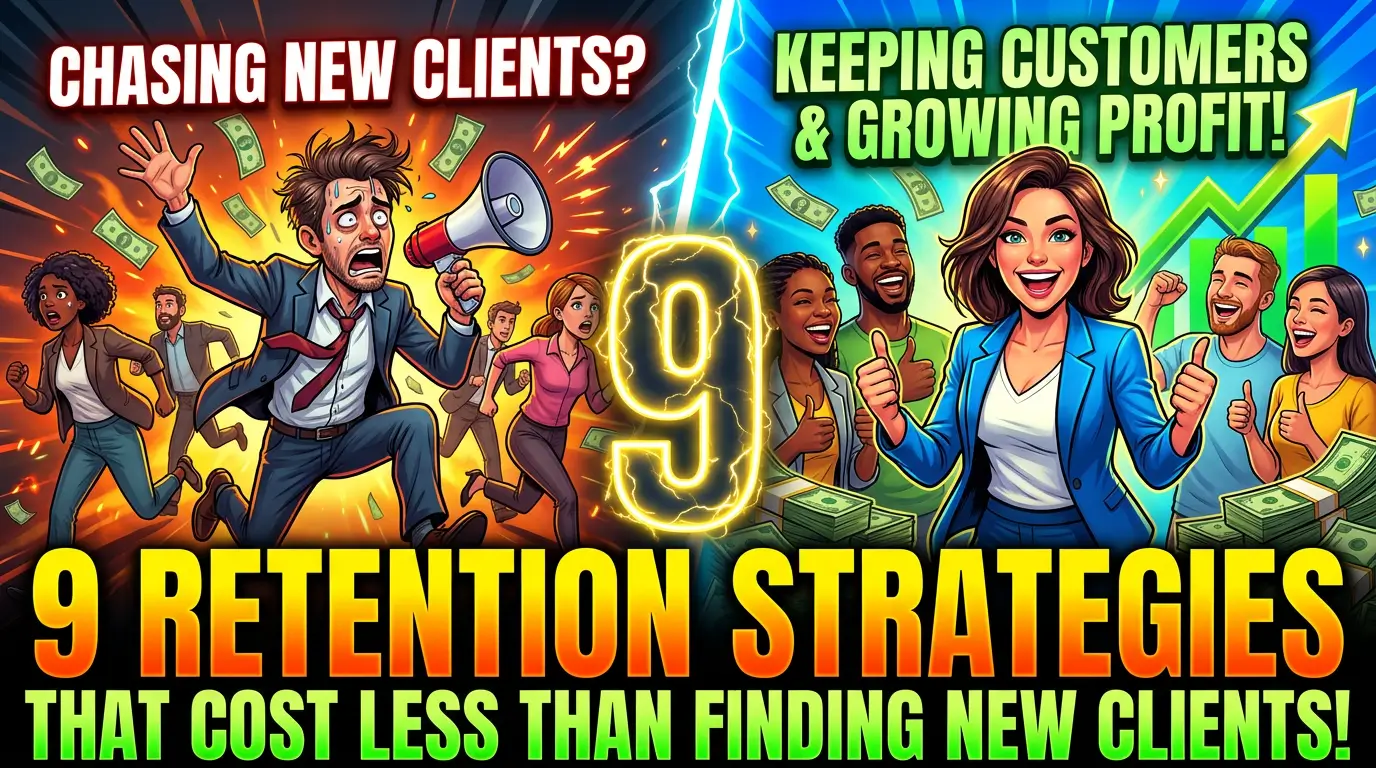
Most small business owners spend the majority of their marketing budget chasing new leads. That’s understandable — new customers feel like growth. But there’s a math problem hiding in plain sight.
According to research from Bain & Company, increasing customer retention by just 5% can boost profits by 25% to 95%. And HubSpot reports that acquiring a new customer costs anywhere from 5 to 7 times more than keeping an existing one.
The customers you already have are your most valuable asset — and most small businesses are leaving serious money on the table by neglecting them.
Here are 9 retention strategies you can implement right now, without blowing your budget.
1. Set Up a Post-Purchase Email Sequence
The moment after someone buys is the highest-trust window you’ll ever have with them. Most businesses send one confirmation email and go silent. That’s a wasted opportunity.
A simple 3-part post-purchase sequence can dramatically increase repeat business:
- Email 1 (Day 1): Confirm the order and set expectations. Make them feel good about the decision.
- Email 2 (Day 3–5): Share a tip, tutorial, or resource that helps them get more value from what they bought.
- Email 3 (Day 14): Check in. Ask if they have questions. Gently introduce a related product or service.
Klaviyo’s benchmark data shows post-purchase flows generate an average ROI of 341% — more than almost any other automated email type. Tools like Mailchimp, Klaviyo, or ActiveCampaign make this setup straightforward even if you’re not technical.
2. Create a Simple Loyalty Program
You don’t need a punch card from 2005 or an expensive SaaS platform to run a loyalty program. A simple points system or tiered reward structure gives customers a reason to come back.
Starbucks Rewards is the textbook example — their loyalty members account for over 40% of total revenue despite being a fraction of total customers. But you don’t need Starbucks-level infrastructure.
For small businesses, tools like Smile.io (e-commerce) or a manual VIP tier system work well. Even something as simple as: “Spend $500 with us and you’ll always get priority scheduling + 10% off” creates a tangible goal customers work toward. The psychological principle at play is called the goal gradient effect — people accelerate their behavior as they get closer to a reward.
3. Ask for Feedback (Then Actually Act on It)
Customers who feel ignored don’t complain — they leave quietly. A simple feedback loop signals that you care, and it surfaces problems before they become churn.
Send a short NPS (Net Promoter Score) survey 7–14 days after a purchase or project completion. Ask just two questions:
- “On a scale of 1–10, how likely are you to recommend us?”
- “What’s one thing we could do better?”
Satmetrix research consistently shows that companies who close the feedback loop — meaning they follow up on negative responses — retain significantly more customers than those who only collect data.
Free tools like Google Forms or Typeform make this easy. The secret isn’t the tool — it’s the follow-up. When someone gives you a 6 out of 10, pick up the phone.
4. Personalize Your Follow-Ups With a CRM
“Hi [First Name]” in an email is the bare minimum. Real personalization means remembering what someone bought, what they asked about, and where they are in their journey with you.
A CRM (Customer Relationship Management) tool lets you do this at scale. When a service business owner knows that a client’s contract renewal is coming up in 60 days, they can reach out proactively instead of reactively. That small shift changes the entire relationship dynamic.
HubSpot CRM has a robust free tier. Zoho CRM is excellent for small teams. Even Notion with a simple contacts database beats keeping everything in your head.
Salesforce research found that 73% of customers expect companies to understand their unique needs and expectations — and most small businesses are failing this test simply because they’re not tracking anything.
5. Build a Private Community or VIP Group
People don’t just buy products — they buy belonging. A private Facebook Group, Slack channel, or Discord server for your customers creates ongoing value that has nothing to do with your product itself.
Digital marketing agency owners have used private client communities to dramatically reduce churn because clients feel like insiders, not just invoice numbers. One small example: SparkToro built an engaged audience by offering a private Slack community to paying members — customers stayed for the community even during slower months.
The barrier to entry here is low. Create a private Facebook Group, name it something exclusive, and post one valuable piece of content per week. Invite your best clients first. Make them feel like founders. Then watch your retention numbers quietly improve.
6. Send “Just Because” Value Emails
Most business emails ask for something — a purchase, a review, a referral. Retention emails that give without asking create an entirely different association in your customer’s mind.
This could be:
- A curated industry article they’d find useful
- A quick tip based on a problem you know they face
- A heads-up about an industry change that affects them
- A “we were thinking of you” note tied to something relevant
Campaign Monitor’s Email Marketing Benchmarks report shows that value-based emails consistently outperform promotional emails in open rate and click-through. When customers see your name in their inbox and immediately think “these people always send me something useful,” you’ve built something most businesses never do: a conditioned positive response.
Aim for one value email per month, per customer segment. No pitch. No CTA. Just value.
7. Make It Insanely Easy to Reorder or Rebook
Friction is the silent killer of repeat business. If a customer has to hunt for your contact page, dig through old emails to find what they bought, or fill out a long form just to order again — many of them simply won’t.
Audit your reorder experience today. Ask yourself: if my best customer wanted to buy from me again right now, what would they have to do?
Amazon Prime is built almost entirely on this principle — one-click checkout removes the friction that would otherwise let second thoughts creep in. For small businesses, this might mean:
- A simple “Reorder” button in your confirmation emails
- A dedicated client login portal
- A “Book again with the same specs” option for service businesses
- A saved preferences form that auto-fills
Baymard Institute research shows average cart abandonment is around 70% — and a big chunk of that is pure friction. The same dynamic applies to rebooking and reordering.
8. Celebrate Customer Milestones
One of the most human and overlooked retention tactics is simply acknowledging that time has passed and a relationship has grown. Sending a “1-year anniversary” email, a birthday discount, or a “you’ve been with us since the beginning” note costs almost nothing — but the emotional impact is outsized.
A study by the Journal of Marketing found that customers who felt emotionally connected to a brand had a 306% higher lifetime value than those who were merely satisfied.
Practical milestone ideas:
- Anniversary of first purchase (with a small discount or gift)
- Customer birthday (even a simple “Happy Birthday” email)
- Milestone purchases: “You’ve ordered 10 times — thank you!”
- “We’ve worked together for 2 years” message to service clients
These can be automated in almost any email platform with basic tagging and date-based triggers.
9. Create a Proactive Check-In System
Retention problems often become visible too late — the customer is already mentally gone before they tell you. A scheduled check-in system lets you identify and resolve dissatisfaction before it turns into churn.
For service businesses, this means a quarterly “health check” call or email to every active client. For product businesses, it might be a 30-day check-in asking how things are going.
Gainsight’s State of Customer Success report shows that proactive outreach is the single highest-impact retention activity for subscription and service businesses — beating price, features, and even product quality in reducing churn.
The script is simple: “Hey [Name], I wanted to check in and make sure everything is going well on your end. Is there anything we could be doing better for you?” That question alone, asked consistently, catches problems early — and signals that you’re a business worth staying with.
The Retention-First Mindset
None of these strategies require a large budget, a big team, or advanced technology. What they require is a shift in mindset: from acquisition-first to retention-first.
When you keep a customer for 3 years instead of 1, you don’t just triple the revenue — you also multiply referrals, reduce support overhead, and build a business that doesn’t need to constantly sprint just to stay in place.
The best time to build a retention system was when you got your first customer. The second best time is now.
Want a website that converts and retains? Work with our team to build a site that does both — from first click to loyal customer.

Richard Kastl
Founder & Lead EngineerRichard Kastl has spent 14 years engineering websites that generate revenue. He combines expertise in web development, SEO, digital marketing, and conversion optimization to build sites that make the phone ring. His work has helped generate over $30M in pipeline for clients ranging from industrial manufacturers to SaaS companies.