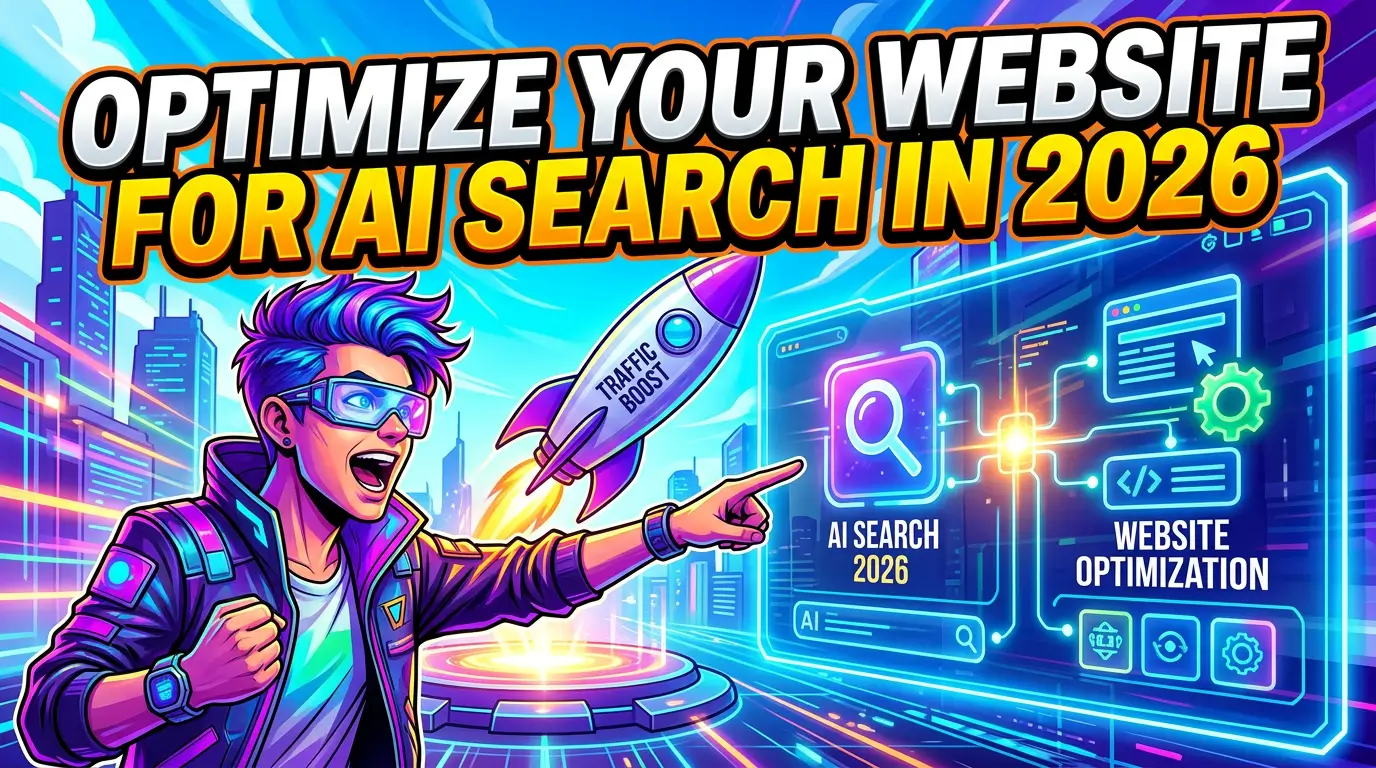
Your next customer might never visit Google. Instead, they’ll ask ChatGPT, Perplexity, or Google’s Gemini a question like “What’s the best web design agency near me?” — and the AI will give them a direct answer, citing specific businesses by name.
If your website isn’t structured for AI search, you’re invisible in this new channel. And it’s growing fast.
Nearly 40% of Americans now use at least one AI chatbot monthly, while ChatGPT alone processes 2.5 billion prompts per day. This isn’t a niche trend — it’s a fundamental shift in how people discover businesses.
Here’s the good news: optimizing for AI search isn’t complicated. It builds on the SEO work you’re (hopefully) already doing, with some important adjustments. Let’s break down exactly what you need to do.
What Is AI Search Optimization (and Why Should You Care)?
AI search optimization goes by several names — LLMO (Large Language Model Optimization), GEO (Generative Engine Optimization), or AEO (Answer Engine Optimization). They all mean the same thing: making your website the source that AI models choose to cite when answering questions about your industry.
Here’s the critical difference from traditional SEO: there’s no “page two” in an AI response. Your content is either cited in the answer or completely invisible. AI models don’t rank you — they either quote you or skip you entirely.
According to Position Digital’s research, 75% of AI Mode sessions end without the user clicking any external links. That means the AI’s answer is the destination. If your business is mentioned in that answer, you win. If it’s not, you don’t exist.
The Numbers That Should Wake You Up
Before we dive into tactics, here’s why this matters right now:
- Organic click-through rates have dropped 61% for queries where an AI Overview appears — but when your brand is cited in the AI Overview, organic CTR is actually 35% higher than average.
- 44.2% of all LLM citations come from the first 30% of your content — meaning your intro paragraphs are more important than ever (Position Digital).
- Brands are 6.5x more likely to be cited through third-party sources than through their own domains (Position Digital).
- Content depth, readability, and freshness matter more than traditional metrics like backlinks when it comes to securing AI mentions.
The takeaway? AI search rewards clarity, authority, and structure — not just keyword density and link building.
7 Ways to Optimize Your Small Business Website for AI Search
1. Structure Your Content So AI Can Actually Parse It
AI models don’t read your page the way a human does. They chunk your content into passages and score each one for how well it answers a specific question. If your content is a wall of marketing copy with no structure, the AI moves on to a competitor’s page.
What to do:
- Use clear H2 and H3 headings that mirror the questions your customers actually ask
- Lead with direct answers, then provide supporting detail
- Use bullet points and numbered lists for key information
- Include a brief, clear summary at the top of every important page
- Add FAQ sections with concise, standalone answers
Think of every section as a self-contained snippet that an AI could pull and cite on its own.
2. Lead With Your Best Content (The Intro Matters Most)
Remember that stat about 44.2% of citations coming from the first 30% of your text? This means your opening paragraphs need to be packed with your most valuable, quotable information.
What to do:
- Open every blog post and service page with a clear, direct statement of what the page covers and why it matters
- Put your unique data, insights, or definitions upfront — don’t bury them below the fold
- Avoid generic introductions like “In today’s digital world…” — get straight to the point
- Write your intro as if it’s the only part someone (or an AI) will ever read
3. Build Entity Authority, Not Just Keyword Rankings
Traditional SEO focused on keywords. AI search focuses on entities — people, businesses, concepts, and the relationships between them. As Moz’s Chima Mmeje explains, “the relationships are more about entities and semantic relationships than link-based relationships.”
For a small business, this means AI needs to understand what your business is, where it operates, what it specializes in, and why it’s authoritative.
What to do:
- Make sure your business name, services, and location appear consistently across your website
- Create detailed “About” and service pages that clearly define what you do (don’t be vague)
- Use structured data (schema markup) on your website — LocalBusiness, Organization, FAQ, and Service schemas help AI models understand your content
- Build topical clusters: instead of isolated blog posts, create interconnected content hubs around your core topics
If you want to go deeper on how AI models evaluate business authority, our guide to entity-based SEO for small businesses covers the concept in detail — including how to structure your content so AI models can clearly understand what you do and who you serve.
4. Earn Third-Party Mentions and Citations
Here’s a surprising finding: brands are 6.5x more likely to be cited via third-party sources than through their own website. That means what other sites say about you matters enormously for AI visibility.
Think of third-party mentions as the “new backlinks” for AI search. In 2026, “Share of Answer” is the new market share — and citations are how you earn it.
What to do:
- Get listed in relevant industry directories and review platforms
- Pursue guest posts and expert quotes on reputable sites in your niche
- Encourage customer reviews on Google, Yelp, and industry-specific platforms
- Build relationships with local media and business organizations
- Create data, research, or tools that other sites naturally want to reference
5. Keep Your Content Fresh and Accurate
AI models increasingly prioritize freshness and accuracy when deciding which sources to cite. Outdated content with old statistics or broken links signals to AI that your site isn’t a reliable source.
What to do:
- Audit your existing content quarterly and update statistics, examples, and recommendations
- Add “Last updated” dates to your content — AI models use this as a trust signal
- Remove or redirect outdated pages rather than leaving them to rot
- When you reference data or studies, link to the original source (this builds credibility with both AI and humans)
6. Optimize for Conversational, Question-Based Queries
People talk to AI chatbots in full sentences and questions, not two-word keyword phrases. Your content needs to match this conversational intent.
What to do:
- Research the actual questions your customers ask (use tools like AnswerThePublic, or just ask your sales team)
- Create content that directly answers those questions in natural language
- Include the question as a heading and the answer immediately below it
- Think about follow-up questions too — AI conversations are multi-turn, so comprehensive content wins
7. Don’t Abandon Traditional SEO
Here’s what many people get wrong: AI search optimization doesn’t replace SEO — it builds on top of it. Google still processes an estimated 16.4 billion searches per day, and 95% of Americans still use traditional search engines.
As Moz’s 2026 SEO predictions emphasize, the fundamentals — technical SEO, site speed, mobile optimization, internal linking — still matter. In fact, the discovery phase of AI search often runs on the same infrastructure as Google’s search engine.
What to do:
- Keep your technical SEO tight: fast load times, mobile-friendly design, clean site architecture
- Maintain a strong internal linking structure
- Continue building quality backlinks — each inbound link is also a third-party signal that helps AI models recognize your site as authoritative
- Track both traditional SEO metrics AND your AI search visibility
Not sure where your traditional SEO stands right now? Our DIY SEO audit guide for small businesses walks you through a step-by-step process to find the gaps — without needing an agency or expensive tools.
How to Track Your AI Search Visibility
You can’t improve what you don’t measure. Here’s how to start tracking your presence in AI search:
-
Monitor LLM referral traffic. Check your analytics for traffic from chatgpt.com, perplexity.ai, and other AI platforms. As Moz notes, LLMs are more of an “influence channel” than a traffic channel — but referral data still gives you directional insight.
-
Track branded search volume. If AI is mentioning your brand, you’ll see increases in branded searches and direct traffic.
-
Test AI responses manually. Regularly ask ChatGPT, Perplexity, and Gemini questions your customers would ask. See if your business comes up. Screenshot and track the results over time.
-
Monitor third-party mentions. Set up Google Alerts for your business name and key service terms to track when other sites mention you.
The Bottom Line
AI search isn’t coming — it’s here. And for small businesses, it represents both a threat and an opportunity. The businesses that adapt now will capture visibility in this new channel while competitors are still focused exclusively on traditional Google rankings.
The good news is that what AI models reward — clear, well-structured, authoritative content that genuinely helps people — is exactly what you should be creating anyway. There are no tricks or hacks here. Just good web content, well-organized, consistently updated, and backed by real expertise.
Start with the basics: structure your content clearly, lead with your best insights, build your entity authority, and earn mentions across the web. You don’t need to overhaul everything overnight — but you do need to start.
Ready to make sure your website is optimized for both traditional search and AI search? Get in touch with our team — we’ll audit your site and build a strategy that keeps you visible wherever your customers are searching.

Richard Kastl
Founder & Lead EngineerRichard Kastl has spent 14 years engineering websites that generate revenue. He combines expertise in web development, SEO, digital marketing, and conversion optimization to build sites that make the phone ring. His work has helped generate over $30M in pipeline for clients ranging from industrial manufacturers to SaaS companies.