A lot of small business owners are seeing the same pattern in search right now. Impressions are holding up. Sometimes they’re even rising. But clicks feel softer, especially on informational searches.
That’s not your imagination. Google’s search results are changing fast.
According to Semrush’s AI Overviews study, AI Overviews appeared for 6.49% of queries in January 2025, climbed to 24.61% in July, and settled at 15.69% in November 2025. Semrush also found that the share of AI Overview-triggering queries with commercial intent grew from 8.15% to 18.57%, while transactional queries rose from 1.98% to 13.94%. In plain English, this is no longer just an informational-content problem.
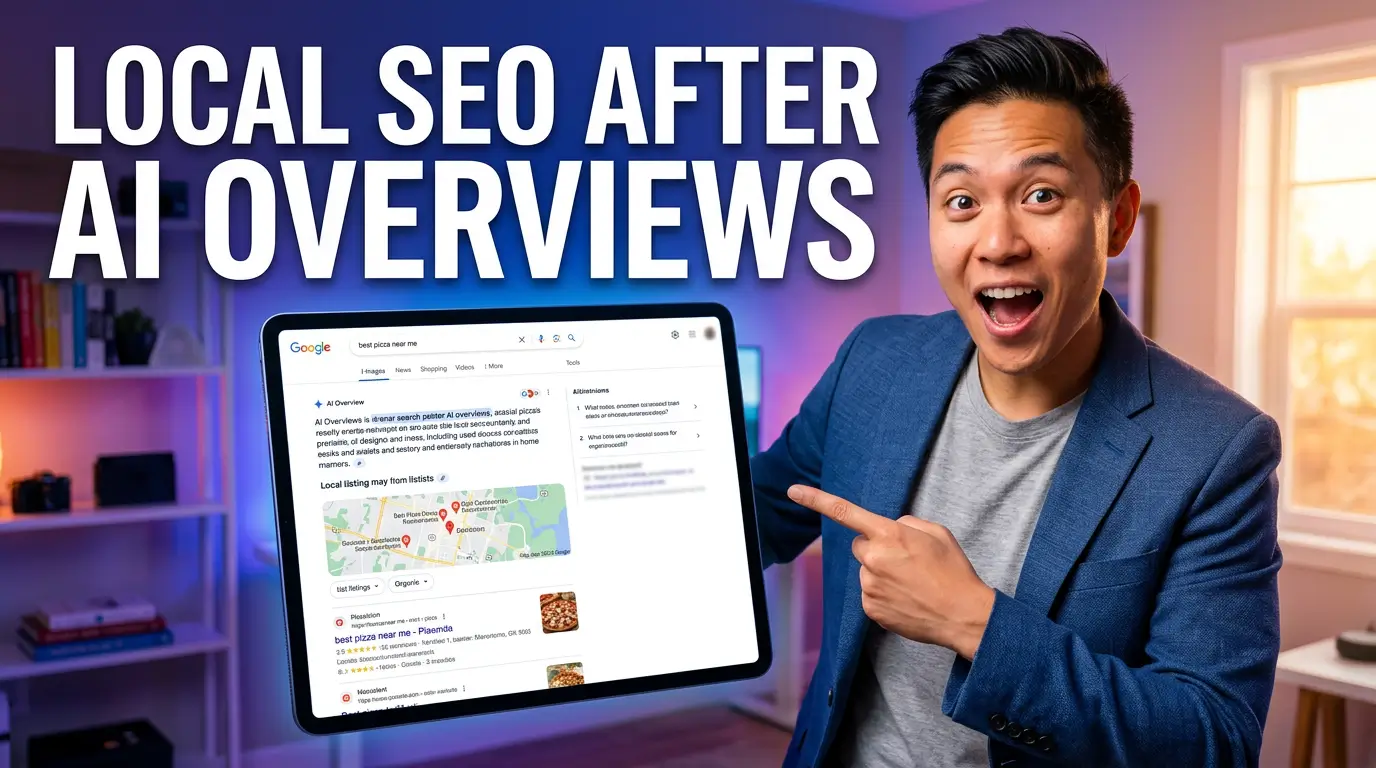
For local businesses, the shift is more nuanced than the usual “SEO is dead” hot takes. Local Falcon’s 2025 whitepaper found that AI Overviews appeared on 40.2% of the 60,000 local queries they studied. Their data also suggests AI Overviews currently place less emphasis on proximity than traditional local packs.
That matters. It means being the closest business to the searcher is not enough on its own. Your business profile, your website content, your reviews, and your proof all have to do more of the heavy lifting.
If you run a law firm, HVAC company, med spa, accounting firm, roofing company, dental practice, or any other local service business, here’s what I’d fix first.
1. Stop treating your Google Business Profile like a directory listing
Google says businesses with complete and accurate information are more likely to show up in local search results. It also says local ranking is influenced by relevance, distance, and prominence. That hasn’t changed.
What has changed is the amount of competition around that listing.
If AI Overviews are summarizing local options, Google needs clean signals about what you do, where you do it, and why you’re credible. A half-filled profile with two old photos and a vague category is not going to carry its weight.
Here’s the practical standard:
- Use your primary category carefully, then add secondary categories that actually match revenue-driving services
- Fill out services, service areas, hours, business description, appointment links, and products if they apply
- Upload recent photos that show your work, team, location, and results
- Keep holiday and special hours current
- Make sure the phone number, address, and website URL match what’s on your site
None of that is glamorous. It is basic blocking and tackling. But in local search, basics still move the needle.
2. Reviews now do two jobs, trust and discoverability
Most business owners already know reviews help conversion. The bigger shift is that reviews now help machines understand your business too.
BrightLocal’s 2026 Local Consumer Review Survey found that 97% of consumers read reviews for local businesses, the average consumer checks six different review sites, and 41% say they always read reviews when browsing for businesses. BrightLocal also reports that consumers increasingly look for 4.5-star businesses and fresh reviews.
Google’s own guidance says to remind customers to leave reviews and reply to them. It also explicitly warns businesses not to offer incentives for reviews because that violates its policy on fake and misleading content.
So the play here is simple, but most small businesses still don’t run it consistently.
Ask for reviews after real customer wins. Ask by text and email. Point customers to the right review link. Then reply like a human being, not a bot.
A good review profile does three things at once. It improves trust when someone lands on your listing. It gives Google more context about your services, quality, and geography. It gives AI systems more language to associate with your brand.
That’s especially important if your customers mention specifics like “emergency AC repair,” “estate planning attorney,” “custom cabinets,” or “same-day screen replacement.” Those phrases help reinforce what you actually want to rank for.
3. Build service pages for buying intent, not just blog traffic
This is where a lot of small business sites still miss the mark.
They publish top-of-funnel blog posts, but the money pages are thin. Or worse, every service page says the same thing with a city name swapped in.
That approach was already weak. In an AI Overview environment, it’s worse.
Semrush’s data shows AI Overviews are expanding beyond informational searches into commercial, transactional, and navigational queries. If your service pages are generic, you’re easier to summarize and easier to skip.
Your best local SEO pages should answer the questions a ready-to-buy customer is actually asking:
- What exactly do you do?
- Who is this service for?
- What does the process look like?
- What areas do you serve?
- What makes you different from the other three companies on the map?
- What proof do you have?
- What’s the next step?
A strong local service page usually needs original photos, local proof, FAQs, real examples, and a clear conversion path. If you’re a plumber in Columbus, don’t stop at “We offer plumbing services.” Show the neighborhoods you serve, the emergency issues you handle, the brands you install, and the response windows customers can expect. The same principle applies to service businesses in competitive metros, which is why a focused page like our Cleveland web design service page works better than a vague statewide catch-all.
4. Publish content that helps your Business Profile rank better
A lot of SEO advice splits local SEO and content marketing into separate buckets. That’s a mistake.
Local Falcon’s study argues that local visibility is becoming more dependent on content quality, authority, and intent alignment, especially for informational local queries.
That doesn’t mean you need to become a full-time publisher. It means your content should support the services and locations that matter.
For example:
- A family law firm could publish a plain-English guide on custody timelines in its state
- A roofing company could publish a storm damage insurance checklist for homeowners in its market
- A physical therapy clinic could publish a page about how to choose between PT, chiropractic care, and orthopedic evaluation for lower back pain
The point is not traffic for traffic’s sake. The point is publishing the kind of content that gives Google and AI systems better language to connect your brand to real local intent.
When that content links naturally to your service pages and your service pages link back to supporting resources, your site becomes easier to crawl, easier to understand, and more useful to buyers.
5. Fix the technical basics you keep putting off
This part is boring, but the boring parts are often where leads leak out.
Search Engine Land’s review of the 2025 Web Almanac SEO chapter found that HTTPS adoption is now above 91%, title tag adoption is nearly 99%, and canonical adoption rose to 67%+. But it also notes that nearly 33% of pages still lack canonical implementation, and many sites still lag on mobile performance.
For a small business website, that means you don’t need a fancy technical SEO strategy before you need a competent one.
Check these first:
- One clear title tag and meta description per important page
- Proper canonicals, especially if you have location or filtered pages
- Fast mobile load times
- Working internal links
- No duplicate service pages fighting each other
- Schema where it makes sense, especially local business, organization, FAQ, and review-related markup when valid
- Clean crawl paths to your money pages
These are not advanced tactics. They’re table stakes. If your competitors are weak, table stakes can still win the hand.
6. Make your website convert the people who do click
If fewer searchers click through, each visit matters more.
This is where most SEO conversations fall apart. Businesses obsess over rankings, but local SEO only matters if it turns into calls, booked appointments, quote requests, or walk-ins.
BrightLocal’s 2026 survey says reviews often push consumers to check a business’s website, social channels, and other platforms before they decide. In other words, your website is the closer.
So ask a blunt question. When someone lands on your service page from Google or your Business Profile, does the page make the next step obvious?
You need:
- A headline that matches search intent
- A visible call to action near the top of the page
- Trust signals, like review snippets, certifications, case studies, or before-and-after work
- A short path to contact, call, quote, or booking
- Proof that you’re local and active now, not five years ago
If a visitor has to hunt for your phone number, guess whether you serve their area, or read six paragraphs before understanding what you do, you’ll lose business even if rankings look fine.
7. Track branded search and assisted conversions, not just organic clicks
One reason business owners get confused right now is that AI search muddies the old metrics.
You may lose some clicks on informational queries and still gain revenue if more people see your brand, remember it, then come back later through a branded search, direct visit, or phone call.
That’s why this year I’d watch:
- Branded search growth in Search Console
- Google Business Profile calls, direction requests, and website clicks
- Form fills and calls by landing page
- Lead quality by service page, not just traffic volume
- Review velocity and review recency
This isn’t just a reporting preference. It’s how you avoid cutting the channels that are still influencing pipeline.
What small businesses should do in the next 30 days
If you want the short version, here it is.
First, fully update your Google Business Profile. Second, start a real review request process. Third, strengthen your top five service pages with local proof, FAQs, and clearer calls to action. Fourth, publish a few useful support pieces tied directly to buyer intent. Fifth, clean up technical issues that make your site harder to crawl or slower to use.
That’s not flashy. But it is the kind of work that holds up when search changes.
AI Overviews are changing local SEO, no question. But they haven’t replaced the fundamentals. Small businesses still win when they send clear relevance signals, build real trust, and make it easy for customers to take the next step.
If your rankings are unstable, your clicks are softening, or your local pages aren’t turning traffic into leads, get started with our team. We’ll help you tighten the parts of your website that actually drive revenue.

Richard Kastl
Founder & Lead EngineerRichard Kastl has spent 14 years engineering websites that generate revenue. He combines expertise in web development, SEO, digital marketing, and conversion optimization to build sites that make the phone ring. His work has helped generate over $30M in pipeline for clients ranging from industrial manufacturers to SaaS companies.