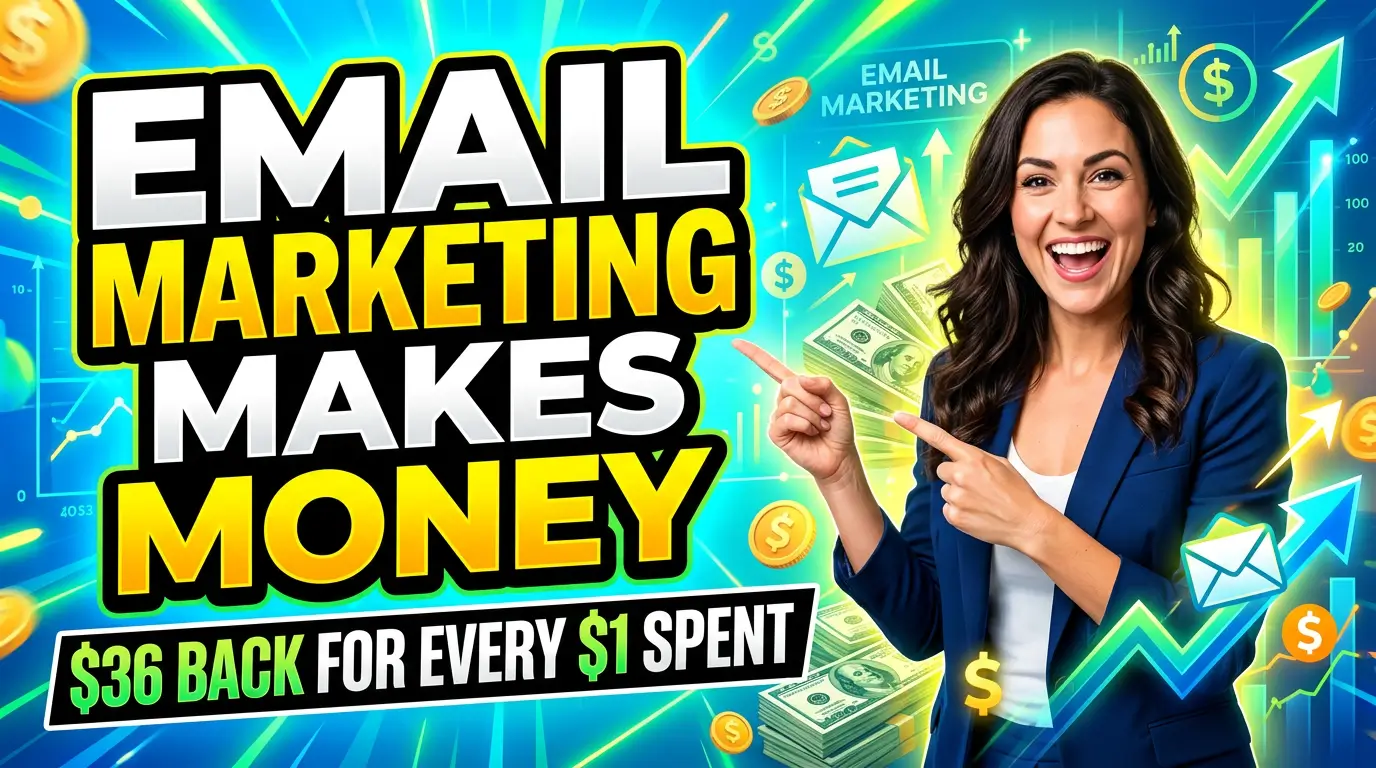
If you had an investment that returned $36 for every dollar you put in, you’d pour everything into it. That’s exactly what email marketing does — and most small businesses are either not doing it, doing it badly, or treating it like an afterthought.
According to DemandSage, email marketing delivers an average ROI of 3,600% — and 81% of small businesses rely on email as their primary customer acquisition channel**. Meanwhile, email is 40 times more effective than Facebook and Twitter combined when it comes to winning new customers.
Yet a lot of small business owners treat email as an occasional blast — a newsletter they send when they remember, with no strategy behind it.
This guide will change that. Let’s talk about how to build, segment, automate, and optimize an email list that actually grows your business.
Why Email Still Dominates in 2026
Before we get into tactics, let’s establish why email deserves your attention more than any other channel:
- 4.48 billion people use email worldwide — that’s more than any social media platform
- 99% of email users check their inbox daily — some up to 20 times a day
- Average email open rate hit 43.46% in 2025 — far outpacing organic social reach
- 59% of consumers say marketing emails have influenced their purchases
- 80% of marketers say they’d rather give up social media than email
The people you’re trying to reach are already there, every single day. The question is whether you’re showing up in their inbox — or just hoping they’ll find you on Instagram.
Step 1: Build a List Worth Having
Your email list is only as valuable as the people on it. A small, engaged list of 500 real customers will outperform a bloated list of 10,000 cold contacts every time.
How to grow your list fast (without buying it):
Add an opt-in to your website immediately
If your website doesn’t have an email capture form, you’re leaving money on the table every day. Place one above the fold on your homepage, in your blog sidebar, and as an exit-intent popup. Keep it simple: name and email, a clear value proposition.
Offer something worth trading an email for
Generic “sign up for our newsletter” CTAs don’t convert well anymore. Create a lead magnet — a checklist, discount code, free estimate, mini-guide, or exclusive resource — that solves a real problem for your ideal customer. Give them a compelling reason to hand over their address.
Capture emails at every customer touchpoint
- After a purchase or service appointment
- When someone calls or fills out a contact form
- At events, trade shows, or in-store
- Via social media bio links pointing to a landing page
The goal is to move people off rented platforms (Instagram, Facebook) and onto your own list — one you own and control.
Step 2: Segment Your List (This Is Where the Money Is)
Sending the same email to everyone on your list is the fastest way to train them to ignore you.
78% of marketers say subscriber segmentation is the single most effective email marketing strategy — ahead of personalization and automation.
Basic segments every small business should have:
- New leads — people who opted in but haven’t bought yet
- Current customers — active clients who need nurturing and upsells
- Past customers — people who bought once but went quiet
- Location-based — especially important for local service businesses
- Interest-based — if you sell multiple services or products, segment by what they’ve engaged with
Even simple segmentation can dramatically improve results. An email about HVAC maintenance to someone who just asked about electrical work is wasted noise. An email about seasonal AC tune-ups to someone who had their AC serviced last spring? That’s money.
Step 3: Write Emails People Actually Open
Your subject line determines whether your email gets read or deleted. Here’s what works in 2026:
Subject line principles:
- Keep it under 50 characters (most email clients truncate longer)
- Create curiosity or convey clear value — pick one
- Personalization tokens (“Hey [First Name]”) still bump open rates by 10–15%
- Numbers and specifics outperform vague promises (“3 ways to cut your heating bill this winter” beats “Save money on energy”)
- Avoid spam trigger words: FREE, URGENT, Act Now, Limited Time (ironically, these get flagged)
Body copy rules:
- Write like a human, not a corporation
- One email, one goal — don’t try to do five things at once
- Lead with the most important thing, not with “I hope this email finds you well”
- Short paragraphs, scannable formatting
- One clear CTA button — tell them exactly what to do next
72% of marketers say message personalization is one of their top-performing strategies. That doesn’t mean just using someone’s first name — it means referencing what they bought, what they asked about, or where they are in their customer journey.
Step 4: Automate Your Best Emails
The real leverage in email marketing comes from automation. You set it up once and it works while you sleep.
Automated email workflows generate 30x higher returns compared to one-off broadcast campaigns, according to EmailMonday. And 71% of marketers are already using automation — which means if you’re not, your competitors probably are.
The sequences every small business needs:
Welcome Series (3–5 emails)
Triggered the moment someone joins your list. This is your highest-engagement window — introduce your business, share your story, demonstrate expertise, and make an early offer. Don’t just say “Thanks for signing up!” — use these emails to build trust fast.
Lead Nurture Sequence
For people who showed interest but didn’t buy. Send 4–6 emails over 2–3 weeks that address common objections, share case studies, provide social proof, and move them toward a decision. According to Campaign Monitor, ethical permission-based nurture sequences are the foundation of effective email for small businesses.
Post-Purchase Follow-Up
After someone buys or hires you, send a thank-you, then a check-in, then a request for a review or referral. Google reviews and word-of-mouth start here. This is one of the most underused sequences in small business marketing.
Re-Engagement Campaign
For subscribers who haven’t opened an email in 90+ days. Send 2–3 emails asking if they want to stay on your list, with a compelling reason to re-engage. If they still don’t open, remove them. A clean list always outperforms a big one.
Step 5: Measure What Matters
You can’t improve what you don’t track. These are the metrics that actually matter for small business email marketing:
| Metric | What It Tells You | 2025 Benchmark |
|---|---|---|
| Open Rate | Subject line + list health | 43.46% |
| Click-to-Open Rate | Email content quality | 6.81% |
| Unsubscribe Rate | List fit + email frequency | Under 0.5% |
| Conversion Rate | Whether emails drive action | Varies by goal |
If your open rates are low, the problem is your subject lines — or your list quality. If opens are high but clicks are low, the problem is your email content or CTA. Work backward from the metric to find the fix.
When to send: Research from DemandSage shows Tuesday, Wednesday, and Thursday are the best days to send marketing emails, with 9 AM–12 PM and 12 PM–3 PM being the highest-engagement windows. Test this against your own data — your audience may behave differently.
Common Mistakes That Kill Email Results
Buying an email list. This is the fastest way to destroy your deliverability, get flagged as spam, and waste money. Every subscriber should opt in voluntarily.
Sending too infrequently. If you email once every three months, people forget who you are and mark you as spam. Aim for at least twice a month.
Ignoring mobile. More than half of all emails are opened on mobile devices. If your email looks broken on a phone, it’s getting deleted. Use a responsive template, short subject lines, and large CTA buttons.
No clear CTA. Every email should have one job. Don’t ask people to read your blog, book a call, AND follow you on Instagram in the same email. Pick one action per email.
Not cleaning your list. Inactive subscribers drag down your deliverability scores. Every 90 days, run a re-engagement campaign and remove people who don’t respond.
The Platforms Worth Using
For most small businesses, one of these three will cover everything you need:
- Mailchimp — best free tier, simple to use, integrates with everything
- MailerLite — more features at a lower price than Mailchimp for growing lists
- ActiveCampaign — best automation for businesses with complex sales cycles or multiple services
All three offer drag-and-drop editors, automation workflows, segmentation, and analytics. Start with whatever your team will actually use consistently.
Start This Week
Email marketing isn’t complicated — it’s just often deprioritized. But with the highest ROI of any digital marketing channel, it deserves to be at the top of your strategy, not the bottom.
Here’s your action plan:
- Add an opt-in form to your website today — linked to a real lead magnet
- Set up a 3-email welcome series this week
- Segment your list by new leads vs. current customers
- Send a value-first email every 1–2 weeks — tips, insights, something useful
- Review your metrics monthly and adjust what isn’t working
If your website isn’t set up to capture email addresses effectively, or if you need help building the automations that drive consistent leads — that’s exactly what we help small businesses with at YourWebTeam.

Richard Kastl
Founder & Lead EngineerRichard Kastl has spent 14 years engineering websites that generate revenue. He combines expertise in web development, SEO, digital marketing, and conversion optimization to build sites that make the phone ring. His work has helped generate over $30M in pipeline for clients ranging from industrial manufacturers to SaaS companies.