A customer asks ChatGPT for the best electrician in town. Another asks Perplexity which accounting firm handles contractors. A third asks Copilot to compare local web design companies.
If your business gets recommended, that visitor may not land on your homepage. They might land on an old service page, a pricing page, a case study, a tool, or a blog post you wrote two years ago.
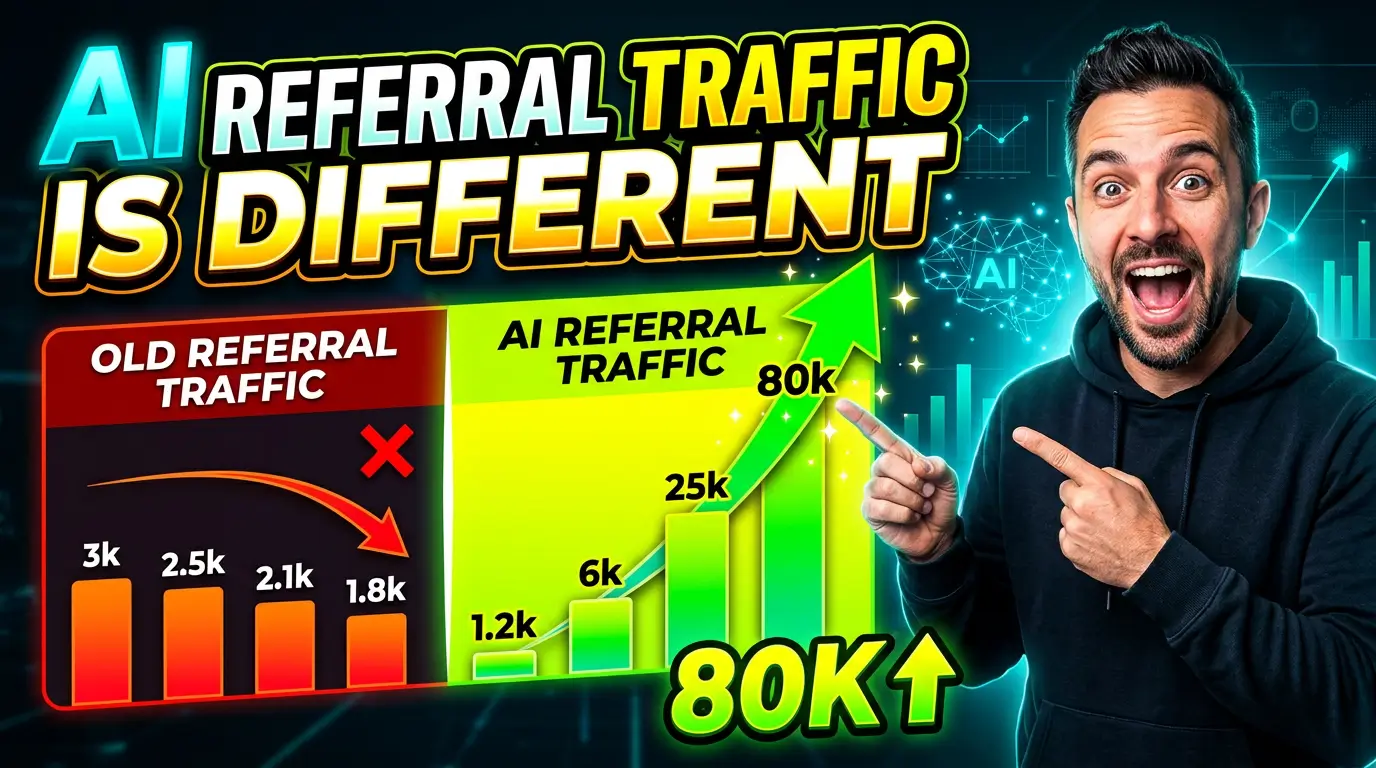
That matters because AI referral traffic is not just “organic search with a new label.” A 2026 Search Engine Land analysis of 10 websites and 150,000 indexed pages found that the top 10 organic pages captured 55% of organic sessions, but those same pages captured only 29% of LLM sessions. The same study found that 49 of the top 100 organic pages had zero LLM traffic at all. Source: Search Engine Land’s SEO-GEO gap analysis.
For small businesses, the takeaway is simple: stop assuming your homepage is the front door.
AI tools are choosing side doors. Your job is to make those side doors ready for a buyer.
Why AI Referral Traffic Behaves Differently
Traditional Google search usually starts with a query, a list of results, and a click. AI search often starts with a conversation. The user may ask for a recommendation, compare options, request a shortlist, then click only after the AI has already framed the decision.
That changes the visitor’s mindset.
Someone who clicks from Google after searching “roof repair near me” is still scanning. Someone who clicks after an AI assistant says “Company A is a strong option because they offer emergency repairs, financing, and strong reviews” arrives with more context. They are not starting from zero.
The data backs this up. In the Search Engine Land dataset, service and product pages generated 29.4 LLM sessions per 1,000 organic sessions, compared with 23.4 for article pages, 14.0 for FAQ or support pages, 9.8 for tools and demos, and 5.6 for homepages. Source: Search Engine Land.
That is a big warning for local shops, contractors, consultants, clinics, agencies, and professional services firms. Your homepage may be polished, but AI visitors may land deeper on the site where the copy is thinner, the offer is less clear, and the next step is buried.
Google is also pushing AI answers into more commercial searches. Semrush analyzed more than 10 million keywords and found that AI Overviews appeared for 6.49% of queries in January 2025, rose to 24.61% in July, then settled at 15.69% in November. More important for business owners, Semrush found that commercial, transactional, and navigational AI Overview triggers all grew during that period. Source: Semrush AI Overviews study.
This is no longer just a top-of-funnel content problem. AI search is moving into the part of the funnel where people compare vendors and make buying decisions.
The wrong response is “we need more AI traffic.” The better response is “the AI traffic we already get should not leak.” Start with conversion readiness, not hype.
Step 1: Find Your AI Landing Pages
Open GA4 and build a simple report for referral traffic from AI tools. You are looking for landing pages where sessions came from sources like ChatGPT, Perplexity, Claude, Copilot, Gemini, You.com, and other assistant-style referrers.
Do not stop at total sessions. Export the landing pages.
You want to answer four questions:
- Which pages receive AI referrals?
- Which of those pages are service, pricing, tool, case study, or comparison pages?
- Which pages have no clear next step?
- Which pages get AI visits but no form fills, calls, bookings, or quote requests?
If your numbers are small, use a 90-day window instead of a 30-day window. AI referral data is still messy, and not every platform passes a clean referrer. The goal is not perfect attribution. The goal is finding pages that AI tools already think are worth sending people to.
Also check Search Console for pages getting impressions around comparison queries, brand queries, and service-intent terms. AI assistants often cite pages that already have clear entity signals, structured information, and useful details.
Step 2: Treat AI Landing Pages Like Sales Pages
A lot of small business pages are written like brochures. They describe the service, mention experience, add a contact button, and call it done.
That is not enough when an AI tool drops a buyer into the middle of your site.
Every AI-referred landing page should answer five questions fast:
- What do you do?
- Who is it for?
- What problem do you solve?
- Why should I trust you?
- What should I do next?
This sounds basic because it is basic. Basic is where the money leaks.
If a ChatGPT visitor lands on your “commercial HVAC maintenance” page, do not make them infer whether you serve their type of building. Say it clearly: “Preventive HVAC maintenance for offices, medical buildings, retail spaces, and light industrial facilities within 30 miles of Dayton.”
If a Perplexity visitor lands on your pricing page, do not hide the next step below five paragraphs. Put the call to action near the top: “Want a fixed quote? Send us your project details and we’ll respond within one business day.”
AI tools may get the visitor to the right page. The page still has to close the gap.
Step 3: Add Proof Where the Visitor Lands
AI assistants often summarize your business before the click. If the user clicks through, they are usually checking whether the summary holds up.
Give them proof on the page they landed on.
For a service page, add a short proof block near the top:
- Customer type served
- Result or outcome
- Location or industry
- Review count or rating if accurate
- One short testimonial
Do not make the visitor hunt for your proof on a separate reviews page. BrightLocal’s 2026 Local Consumer Review Survey says reviews remain “stable, sticky, and more important than ever” as consumers evaluate local businesses. Source: BrightLocal Local Consumer Review Survey 2026.
For a small business, proof does not need to be fancy. A plumber can show “312 five-star Google reviews.” A CPA can show “Serving contractors and trades businesses since 2014.” A web design company can show “Average launch time: 45 to 60 days for standard small business sites.”
Specific beats polished.
Step 4: Make the Page Machine-Readable
AI systems understand pages better when the important information is clear in the HTML, not trapped in images, sliders, vague headings, or custom scripts.
Google says structured data gives it “explicit clues about the meaning of a page” and can help Google understand page content. Google also lists case studies where structured data was associated with better search result interaction, including Rotten Tomatoes measuring a 25% higher click-through rate on pages enhanced with structured data and Nestlé measuring an 82% higher click-through rate for pages shown as rich results. Source: Google Search Central structured data documentation.
For a small business, that usually means:
- Use clear H1, H2, and H3 headings.
- Add LocalBusiness, Organization, Service, Product, FAQPage, or Review schema where appropriate.
- Put prices, service areas, hours, phone numbers, and requirements in text.
- Use descriptive button text like “Request a Roof Repair Estimate,” not “Submit.”
- Keep forms simple and label every field.
Accessibility helps here too. Microsoft’s guidance on preparing websites for agents says agents rely on structure and consistency, including clearly labeled buttons, links, and form fields. Source: Microsoft’s guide to optimizing sites for agents.
This is not just for bots. Clear structure helps human buyers who are scanning on a phone between jobs, meetings, or errands.
Step 5: Remove Friction From the Next Step
AI-referred visitors often arrive with a task in mind. Do not slow them down.
Common friction points include:
- Contact forms with too many fields
- Popups covering the CTA
- Phone numbers hidden in the footer
- Booking links that open broken third-party widgets
- Service pages with no city, price range, timeline, or process details
- CTAs that say “Learn More” when the buyer is ready to ask for help
If someone lands on a service page, give them a direct path to ask about that service. If someone lands on a comparison page, give them a direct path to ask which option fits. If someone lands on a case study, give them a direct path to get a similar result.
This is where many small business websites lose leads. The page technically has a contact button, but the intent does not match the offer.
Example: A visitor lands on “WordPress vs Webflow for service businesses.” The CTA should not be a generic “Contact Us.” It should say “Not sure which platform fits your site? Book a 15-minute website planning call.”
Same site. Better fit.
Step 6: Create Pages AI Tools Can Confidently Recommend
AI assistants need enough detail to explain why you belong in a recommendation. If your website says “We provide quality service at affordable rates,” there is nothing to cite. Every competitor says that.
Search Engine Land’s dataset found that trends and analysis posts attracted LLM citations 78% of the time, while data-based year-in-review posts sat at 61%. Generic how-to content sat at 12%. Source: Search Engine Land.
The lesson is not “stop writing how-to content.” The lesson is to add information that only your business can provide: service area, response times, customer types, pricing ranges, project examples, support terms, and real proof.
A Simple 30-Minute AI Landing Page Audit
Pick one page that has AI referral traffic, or pick your most important service page if you do not have enough data yet.
Run through this checklist:
- Can a first-time visitor understand the offer in five seconds?
- Is the service area or target customer obvious?
- Is there proof above the first major scroll?
- Is the next step specific to the page topic?
- Are the form fields labeled clearly?
- Is the phone number visible on mobile?
- Does the page include specific details an AI assistant could cite?
- Is the page marked up with relevant structured data?
- Does the page load fast enough on a phone?
- Would you trust this page if an AI tool recommended it to you?
If the answer is no on more than three items, fix the page before you chase more traffic.
What to Measure Next
Do not judge this work by rankings alone. Track AI referral sessions by landing page, calls, form fills, bookings, quote requests, conversion rate by page type, and pages receiving AI visits but no conversions.
This gives you a practical worklist. Improve pages that get AI visits but no leads. Add unique proof to pages that convert from Google but are not getting AI referrals.
You do not need to rebuild your whole website for AI search. Start with the pages AI tools already send people to.
The Bottom Line
AI search is changing the front door of your website. Some visitors will still come through Google. Some will come through maps. Some will come through referrals. More will come through AI assistants that already shaped the buying decision before the click.
That means your deep pages need to sell, not just exist.
If you want help finding the pages AI tools are sending traffic to and turning them into lead-ready landing pages, get started with Your Web Team. We’ll show you where the leaks are and what to fix first.